

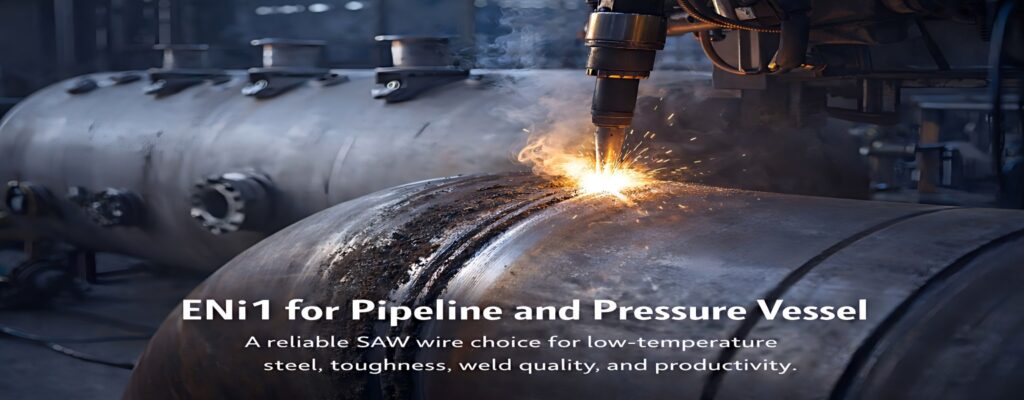
ENi1 for Pipeline and Pressure Vessel
In pipeline and pressure vessel fabrication, welding consumable selection is never a minor detail. It directly affects weld quality, low-temperature performance, long-term reliability, and the consistency of production. When the project involves demanding service conditions, many fabricators look for a wire that offers stable mechanical properties, dependable toughness, and compatibility with submerged arc welding productivity. That is where ENi1 becomes highly relevant. AKWELD lists AK-ENi1 as a submerged arc welding wire classified under AWS A5.23 F8A/P6-ENi1-Ni1 and EN ISO 14171-A S 46 4 FB T2Ni1, describing it for low-temperature steel applications such as storage containers and transportation pipes.
ENi1 is generally chosen for applications where weld metal toughness matters as much as strength. In pipeline work and pressure vessel manufacturing, welded joints may be exposed to low ambient temperatures, fluctuating loads, transport stress, or strict inspection requirements. Under these conditions, the objective is not only to complete the weld efficiently, but to maintain reliable impact performance and sound weld integrity throughout service. AKWELD’s published ENi1 data highlights low sulfur and phosphorus content, good mechanical performance, and typical impact values of at least 34 J at -50°C, which helps explain why this classification is associated with low-temperature service.
For pipeline fabrication, consistency is everything. Long seam welds, circumferential joints, and repeated production cycles demand a consumable that supports uniform deposition and predictable results. A suitable ENi1 setup can help fabricators maintain welding efficiency while targeting the mechanical performance expected in transport pipe and related low-temperature steel projects. This matters not only for new production, but also for contractors and OEMs that want to reduce rework, improve weld acceptance rates, and keep delivery schedules under control. Those commercial advantages are often as important as the technical ones.
Pressure vessel manufacturing places a different kind of pressure on welding decisions. Here, the weld is part of a safety-critical structure. Buyers, inspectors, and engineering teams usually pay close attention to procedure control, weld metal properties, and traceable product quality. In this environment, ENi1 becomes attractive because it is associated with applications where low-temperature toughness and solid mechanical performance are required. For tanks, storage systems, and vessel-related fabrication, the goal is to achieve a weld deposit that supports compliance, durability, and confidence in service.
Another reason ENi1 matters is the relationship between consumable choice and total fabrication cost. In many workshops, the visible cost is the price of the wire itself, but the real cost is determined by the full welding outcome. A wire that contributes to stable arc behavior, acceptable bead formation, and repeatable results can help reduce repair rates, inspection failures, and production delays. For businesses serving pipeline, storage tank, and pressure equipment markets, that reliability translates into fewer interruptions and a better reputation with end users. This is one of the main reasons technical buyers increasingly evaluate welding consumables as a performance decision, not just a purchasing decision. This paragraph is a practical engineering and manufacturing inference based on the application context described for ENi1 on the cited product page.
Of course, wire performance does not exist in isolation. Flux selection, welding parameters, joint preparation, cleanliness, and procedure discipline all affect final results. AKWELD specifically notes using ENi1 together with flux such as SJ618, which reinforces an important point for engineers and production teams: a welding wire should be evaluated as part of a complete process system, not as a standalone material. When the wire, flux, parameters, and base material are properly matched, the fabrication team is in a stronger position to achieve both productivity and weld quality.
For buyers comparing options, the right question is not simply, “Is this an ENi1 wire?” A better question is, “Is this ENi1 solution suitable for my pipeline or pressure vessel application, my service temperature, and my production process?” That means reviewing classification, published mechanical properties, low-temperature impact performance, process compatibility, and supplier support. A qualified supplier should be able to provide clear technical data, application guidance, and a consistent quality standard for batch-to-batch production. This recommendation follows directly from Google’s guidance to provide original, useful, trustworthy content and from the technical product information available on the cited ENi1 page.
In practical terms, ENi1 is not just a product code. For pipeline and pressure vessel manufacturers, it represents a welding consumable option aimed at balancing productivity with dependable low-temperature mechanical performance. When selected correctly and applied under controlled welding procedures, it can support stronger weld integrity, smoother fabrication, and better long-term service confidence. For companies that compete on quality, delivery, and technical trust, that makes ENi1 a meaningful part of the welding solution rather than a simple line item on a quotation sheet. This concluding assessment is an original synthesis grounded in the ENi1 application and performance information cited above.