

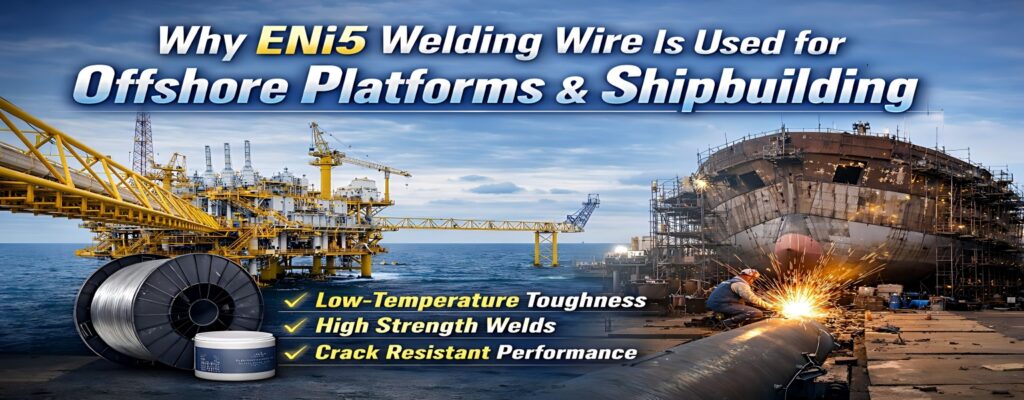
Why ENi5 Welding Wire Is Used for Offshore Platforms and Shipbuilding
Introduction
In offshore engineering and shipbuilding, welding materials are not just consumables—they are critical to structural integrity, safety, and long-term performance. Among various welding wires available today, ENi5 submerged arc welding (SAW) wire has become a preferred choice for fabricators working on offshore platforms and marine vessels.
But what makes ENi5 stand out in such demanding environments? This article explains why It welding wire is widely used in offshore and shipbuilding applications, focusing on its properties, benefits, and real-world performance.
What Is ENi5 Welding Wire?
It is a low-alloy nickel-bearing welding wire typically classified under AWS A5.23 for submerged arc welding. It is designed to provide:
High strength weld metal
Excellent low-temperature toughness
Good crack resistance
Compatibility with structural steels like S355, EH36, and other offshore grades
When used with the right flux, ENi5 produces welds that meet strict mechanical and impact requirements required in marine environments.
Key Challenges in Offshore and Shipbuilding Welding
Before understanding why It is used, it’s important to look at the challenges faced in these industries:
1. Extreme Low Temperatures
Offshore structures often operate in sub-zero conditions, especially in deep sea or Arctic regions.
2. High Mechanical Stress
Ships and platforms are exposed to waves, wind, and dynamic loads, requiring welds with high strength and fatigue resistance.
3. Corrosive Environment
Saltwater and humidity accelerate corrosion, putting additional stress on welded joints.
4. Safety Requirements
Failure in offshore structures can be catastrophic, so materials must meet strict international standards.
Why ENi5 Welding Wire Is Preferred
1. Excellent Low-Temperature Toughness
One of the main reasons ENi5 is used is its nickel (Ni) content, which significantly improves impact toughness at low temperatures.
Maintains ductility even at -40°C or lower
Reduces the risk of brittle fracture
Ideal for cryogenic and offshore applications
This makes It particularly suitable for North Sea, Arctic offshore platforms, and LNG-related vessels.
2. High Strength and Structural Reliability
It weld metal typically matches or exceeds the strength of high-grade structural steels used in shipbuilding.
Supports heavy load-bearing structures
Ensures long-term durability under cyclic stress
Meets standards for pressure vessels and offshore frameworks
3. Superior Crack Resistance
Welding thick plates in offshore structures increases the risk of cracking. ENi5 helps minimize this risk due to:
Optimized chemical composition
Controlled hydrogen levels (when used with proper flux)
Good weld metal plasticity
This is critical for multi-pass welding in thick sections.
4. ENi5 Compatibility with Offshore Steels
It is widely used with steels such as:
S355 / S420
EH36 / DH36 (shipbuilding grades)
Low-alloy high-strength steels
This versatility makes it a go-to solution for shipyards and offshore fabricators.
5. ENi5 Excellent Performance in Submerged Arc Welding (SAW)
It is primarily used in SAW processes, which are common in large-scale fabrication.
Benefits include:
Deep weld penetration
High deposition rates
Stable arc performance
Consistent weld quality
This improves production efficiency while maintaining high standards.
6. ENi5 Proven Use in Offshore and Marine Projects
ENi5 has been widely applied in:
Offshore oil and gas platforms
Ship hull structures
LNG storage tanks
Marine pipelines
Pressure vessels
Its long track record gives engineers confidence in its reliability.
Choosing the Right Flux for ENi5
To achieve optimal results, ENi5 must be paired with a suitable flux. The right combination ensures:
Proper mechanical properties
Low hydrogen content
Smooth weld appearance
Common flux types used with ENi5 include basic or agglomerated fluxes designed for low-temperature applications.
ENi5 vs Other Welding Wires
Compared to standard carbon steel wires, ENi5 offers:
| Feature | ENi5 | Standard Wire |
|---|---|---|
| Low-temperature toughness | Excellent | Limited |
| Crack resistance | High | Moderate |
| Offshore suitability | Ideal | Not recommended |
| Nickel content | Yes | No |
This makes ENi5 a specialized solution for demanding environments, rather than a general-purpose wire.
ENi5 Conclusion
It welding wire has become a trusted material in offshore platforms and shipbuilding because it meets the industry’s toughest requirements. Its combination of low-temperature toughness, high strength, crack resistance, and compatibility with marine steels makes it an ideal choice for critical structures.
For engineers and buyers working in offshore or shipbuilding sectors, selecting It is not just about performance—it’s about ensuring safety, compliance, and long-term reliability in some of the harshest environments on earth.