

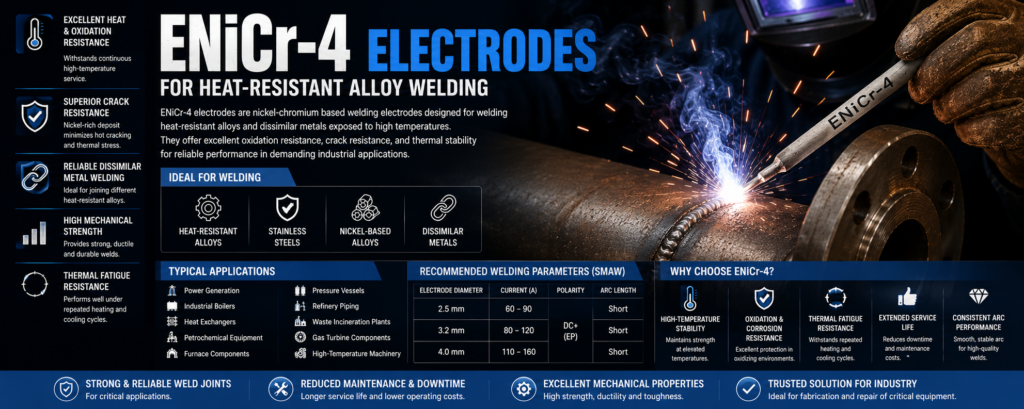
ENiCr-4 Electrodes for Heat-Resistant Alloy Welding
Heat-resistant alloys play a vital role in industries where components must withstand extreme temperatures, oxidation, and thermal cycling. From power generation and petrochemical processing to furnace manufacturing and heavy industrial equipment, selecting the correct welding consumable is essential for producing reliable and long-lasting welds.ENiCr-4
ENiCr-4 electrodes are designed specifically for welding nickel-chromium heat-resistant alloys and joining dissimilar metals that operate under demanding service conditions. Their excellent resistance to heat, oxidation, and thermal fatigue makes them an ideal choice for critical fabrication, repair, and maintenance projects.
This guide explains the properties, applications, advantages, welding procedures, and best practices for using ENiCr-4 electrodes for heat-resistant alloy welding.
What Is an ENiCr-4 Electrode?
ENiCr-4 is a nickel-chromium-based covered welding electrode developed for Shielded Metal Arc Welding (SMAW). The weld deposit offers excellent mechanical strength while maintaining stability at elevated temperatures.
Its balanced nickel and chromium composition delivers outstanding resistance to oxidation, corrosion, and thermal cracking, making it suitable for both similar and dissimilar metal welding.
ENiCr-4 electrodes are widely used wherever weld joints must remain reliable during prolonged exposure to high temperatures.
Key Features of ENiCr-4 Electrodes
ENiCr-4 electrodes provide several important advantages for industrial welding applications.
Excellent Heat Resistance
The weld metal maintains mechanical integrity under continuous high-temperature service.
Superior Oxidation Resistance
Chromium forms a protective oxide layer that minimizes surface degradation during prolonged heat exposure.
High Crack Resistance
The nickel-rich weld deposit effectively reduces thermal stress and minimizes the risk of hot cracking.
Reliable Dissimilar Metal Welding
ENiCr-4 can successfully join different heat-resistant alloys while maintaining excellent metallurgical compatibility.
Excellent Mechanical Properties
The deposited weld metal offers:
High tensile strength
Good ductility
Excellent toughness
Stable performance during thermal cycling
Typical Applications of ENiCr-4 Electrodes
ENiCr-4 electrodes are commonly used in industries where equipment operates under elevated temperatures and severe environments.
Typical applications include:
Power generation equipment
Industrial boilers
Pressure vessels
Heat exchangers
Furnace components
Petrochemical processing equipment
Refinery piping systems
Waste incineration plants
Gas turbine components
High-temperature industrial machinery
They are equally suitable for new fabrication, maintenance, and repair work.
Materials That Can Be Welded
ENiCr-4 electrodes are suitable for joining a wide range of heat-resistant materials.
Common base metals include:
Nickel-chromium alloys
Heat-resistant stainless steels
Nickel-based alloys
High-temperature corrosion-resistant alloys
Dissimilar combinations of nickel and stainless steels
Material compatibility should always be verified before welding.
Advantages of ENiCr-4 in Heat-Resistant Alloy Welding
Long-Term Thermal Stability
ENiCr-4 weld deposits maintain strength even after prolonged service at elevated temperatures.
Excellent Resistance to Thermal Fatigue
Components exposed to repeated heating and cooling cycles benefit from the weld metal’s high ductility and crack resistance.
Outstanding Corrosion Performance
The chromium-rich weld metal performs well in oxidizing industrial environments.
Reduced Maintenance Costs
Durable welds minimize equipment downtime and extend service life.
Consistent Welding Performance
ENiCr-4 electrodes provide stable arc characteristics, making them suitable for both fabrication and repair applications.
Preparing for Welding
Proper preparation significantly improves weld quality.
Before welding:
Remove rust and oxide scale.
Eliminate oil and grease.
Clean moisture from the joint.
Grind damaged areas if repairing existing components.
Ensure proper joint alignment.
Clean surfaces help produce sound welds with fewer defects.
Recommended Welding Procedure
Following the correct welding procedure helps maximize weld performance.
Step 1: Electrode Preparation
Store electrodes in a clean, dry environment.
If moisture is suspected, dry the electrodes according to the manufacturer’s recommendations before use.
Step 2: Machine Settings
Select the appropriate current according to electrode diameter.
Typical reference values:
| Electrode Diameter | Current (A) |
|---|---|
| 2.5 mm | 60–90 |
| 3.2 mm | 80–120 |
| 4.0 mm | 110–160 |
Maintain a short arc length throughout welding.
Step 3: Heat Input Control
Moderate heat input helps maintain desirable mechanical properties.
Avoid:
Excessive weaving
Extremely high current
Long continuous welds
Balanced heat input minimizes distortion and residual stress.
Step 4: Multi-Pass Welding
For thicker materials:
Deposit multiple weld passes.
Remove slag completely between passes.
Inspect each layer before continuing.
Proper interpass cleaning improves weld quality.
Step 5: Cooling
Allow the weldment to cool naturally.
Rapid cooling should generally be avoided unless specified by the welding procedure.
Controlled cooling reduces thermal stress.
ENiCr-4 Best Welding Practices
Professional welders often follow these recommendations:
Use stable travel speed.
Maintain consistent arc length.
Keep electrodes dry.
Remove slag completely after every pass.
Minimize contamination.
Follow qualified welding procedures.
Inspect completed welds visually before final acceptance.
These practices improve weld integrity and service performance.
ENiCr-4 Common Welding Challenges
Although ENiCr-4 offers excellent weldability, improper procedures may lead to defects.
Porosity
Possible causes:
Moist electrodes
Dirty base material
Long arc length
Hot Cracking
Possible causes:
Excessive restraint
High heat input
Poor joint design
Slag Inclusion
Possible causes:
Inadequate slag removal
Incorrect electrode angle
Excessive travel speed
Most issues can be prevented through proper preparation and welding technique.
Why Choose ENiCr-4 for High-Temperature Welding?
Industries continue to select ENiCr-4 because it provides:
Reliable performance at elevated temperatures
Excellent oxidation resistance
Superior thermal fatigue resistance
Strong weld integrity
Stable welding characteristics
Good corrosion resistance
Long service life
Excellent dissimilar metal welding capability
These benefits make ENiCr-4 an ideal solution for demanding industrial applications.
ENiCr-4 Maintenance and Repair Applications
ENiCr-4 is frequently used to repair valuable equipment that operates under extreme conditions.
Typical repair projects include:
Furnace tubes
Boiler components
Pressure vessels
Heat exchangers
High-temperature piping
Industrial burners
Process equipment
Refinery components
Its excellent metallurgical compatibility helps restore equipment performance while extending operational life.
ENiCr-4 Conclusion
ENiCr-4 electrodes are a trusted solution for heat-resistant alloy welding, delivering exceptional performance in high-temperature industrial environments. Their combination of excellent oxidation resistance, thermal stability, crack resistance, and mechanical strength makes them well suited for critical fabrication and repair work.
By following proper surface preparation, selecting suitable welding parameters, controlling heat input, and applying sound welding techniques, fabricators can produce durable, high-quality welds capable of withstanding demanding service conditions. Whether used for pressure vessels, furnaces, boilers, heat exchangers, or other high-temperature equipment, ENiCr-4 electrodes provide the reliability and long-term performance required for modern industrial welding applications.