

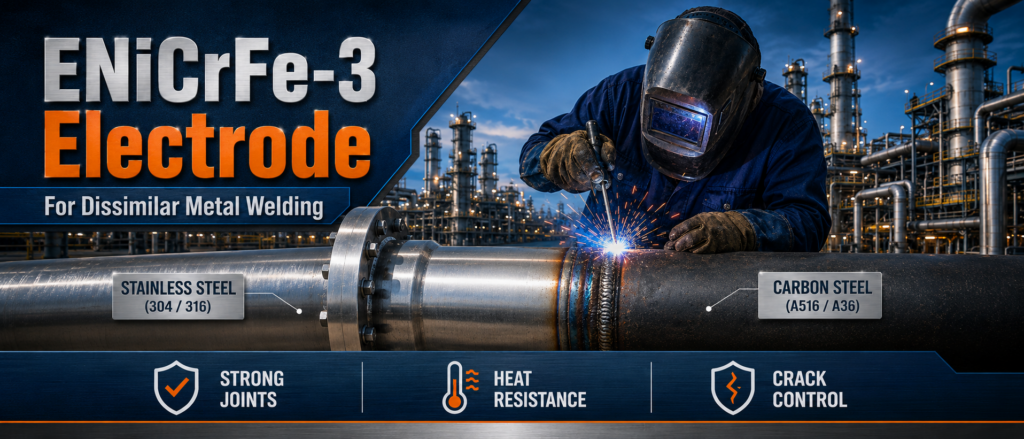
ENiCrFe-3 Electrode for Dissimilar Metal Welding
Dissimilar metal welding is widely used in power generation, petrochemical processing, pressure vessel manufacturing, furnace construction, and industrial maintenance. However, joining metals with different chemical compositions, thermal expansion rates, and mechanical properties can create serious welding challenges.ENiCrFe-3
The ENiCrFe-3 electrode is a nickel-based covered electrode designed for demanding welding applications involving nickel alloys, stainless steels, carbon steels, and low-alloy steels. Its balanced weld-metal composition helps produce strong, corrosion-resistant, and heat-resistant joints between materials that may otherwise be difficult to weld together.
This article explains the advantages, applications, welding characteristics, and practical use of ENiCrFe-3 electrodes for dissimilar metal welding.
What Is an ENiCrFe-3 Electrode?
ENiCrFe-3 is a nickel-chromium-iron welding electrode used primarily for shielded metal arc welding. It deposits nickel-based weld metal containing chromium, iron, and other alloying elements that support strength, oxidation resistance, and metallurgical stability.
The nickel-rich weld deposit provides good compatibility with many different base metals. This makes the electrode especially valuable when the two materials being joined respond differently to welding heat.
Common applications include:
Nickel alloy to carbon steel welding
Nickel alloy to low-alloy steel welding
Nickel alloy to stainless steel welding
Stainless steel to carbon steel welding
Joining heat-resistant alloys
Repairing high-temperature industrial components
Overlaying steel surfaces with nickel-based weld metal
Because every application has different service conditions, the electrode should always be selected according to the base materials, operating temperature, corrosion environment, joint design, and approved welding procedure.
ENiCrFe-3 Why Dissimilar Metal Welding Is Difficult
Welding two similar metals is generally easier because their melting behavior, thermal conductivity, and mechanical properties are relatively compatible. Dissimilar metals can behave very differently during heating and cooling.
Several problems may occur.
Different Thermal Expansion Rates
One metal may expand and contract more than the other during welding. This difference can create residual stress around the weld and heat-affected zone.
In high-temperature service, repeated heating and cooling may increase the risk of fatigue, distortion, or cracking.
Different Melting Characteristics
The two base metals may have different melting temperatures and thermal conductivity. One side of the joint may melt faster or absorb heat differently.
Poor heat control can result in uneven fusion, excessive penetration, or incomplete bonding.
Weld Metal Dilution
During welding, a portion of each base metal enters the molten weld pool. This process is called dilution.
Excessive dilution can change the chemistry and performance of the weld deposit. It may reduce corrosion resistance, lower ductility, or increase sensitivity to cracking.
Formation of Brittle Structures
Certain combinations of iron, nickel, chromium, and other alloying elements can form undesirable microstructures when incorrect filler metal or welding parameters are used.
A suitable nickel-based electrode can help reduce this risk by creating a more tolerant weld-metal structure.
Carbon Migration
When some steels are joined to nickel alloys or stainless steels for high-temperature service, carbon may migrate across the fusion boundary over time.
This can change hardness and strength near the joint. Proper filler-metal selection, joint design, and welding procedure are essential for controlling long-term performance.
Why Use ENiCrFe-3 for Dissimilar Metal Welding?
The ENiCrFe-3 electrode offers several important benefits when joining materials with different properties.
1. ENiCrFe-3 Nickel-Based Weld Metal
Nickel provides good metallurgical compatibility with many ferrous and nickel-based alloys. It helps the weld deposit tolerate dilution from both sides of a dissimilar joint.
This is one of the main reasons ENiCrFe-3 is frequently considered for joining nickel alloys to steels.
2. ENiCrFe-3 Good Crack Resistance
Dissimilar joints can develop high stress during solidification and cooling. The relatively ductile nickel-based weld deposit can accommodate some of this stress more effectively than a rigid weld structure.
Correct joint preparation, electrode handling, heat input, and bead placement are still necessary to achieve reliable crack control.
3. ENiCrFe-3 High-Temperature Performance
ENiCrFe-3 weld metal can maintain useful strength and oxidation resistance in elevated-temperature applications.
This makes it suitable for equipment such as:
Industrial furnaces
Heat-treatment systems
Boiler components
Process piping
High-temperature vessels
Exhaust systems
Thermal processing equipment
The exact operating limit must be determined by the applicable engineering specification and service environment.
4. Corrosion and Oxidation Resistance
Chromium in the weld deposit contributes to oxidation and corrosion resistance. This is important when the welded component is exposed to heat, steam, gases, chemicals, or industrial process environments.
However, electrode selection should be based on the specific corrosive medium rather than general corrosion resistance alone.
5. Versatile Industrial Applications
ENiCrFe-3 electrodes can be used for fabrication, maintenance, repair, and surfacing. They are particularly helpful when replacing an entire component would be expensive or impractical.
Common ENiCrFe-3 Welding Applications
Nickel Alloy to Carbon Steel
Joining nickel alloys to carbon steel is common in industrial equipment where only the process-contact areas require higher corrosion or temperature resistance.
The nickel-based weld deposit acts as a transition zone between the different materials. Careful control of dilution is important, particularly on the carbon steel side.
Nickel Alloy to Stainless Steel
Nickel alloys and stainless steels may be joined in piping, vessels, heat exchangers, and chemical processing equipment.
ENiCrFe-3 can provide a compatible weld deposit capable of handling differences in composition and thermal behavior.
Stainless Steel to Carbon Steel
Some dissimilar stainless-to-carbon-steel joints may benefit from a nickel-based filler metal, especially when thermal cycling, elevated temperature, or difficult dilution conditions are involved.
The final electrode selection should be confirmed through the welding procedure and service requirements.
High-Temperature Equipment Repair
Furnace components, burner parts, exhaust systems, and thermal processing equipment may experience oxidation, cracking, and dimensional change.
ENiCrFe-3 electrodes can be used for selected repairs where nickel-based weld metal is required.
Nickel-Based Surfacing and Buffer Layers
The electrode may also be used to deposit a nickel-based buffer layer on steel before completing a dissimilar joint or applying additional corrosion-resistant weld metal.
Buffer layers can help control dilution and improve compatibility between the base metal and final weld deposit.
ENiCrFe-3 Recommended Joint Preparation
Good preparation is critical for successful dissimilar metal welding.
Clean the Welding Area
Remove all contaminants from the base metal, including:
Oil
Grease
Moisture
Paint
Rust
Oxide scale
Cutting residue
Sulfur-containing contamination
Nickel-based weld metal can be sensitive to contamination. The joint surface and nearby area should be thoroughly cleaned before welding.
Use dedicated clean tools where necessary to avoid transferring iron particles or other contaminants.
Prepare a Suitable Groove
The groove should provide sufficient access for the electrode and allow complete fusion without excessive heat input.
Nickel-based weld metal may not flow exactly like ordinary carbon steel weld metal. A slightly wider groove angle may help the welder control the arc and fusion at both sidewalls.
Check Fit-Up and Alignment
Poor fit-up can increase weld volume, distortion, and residual stress. Maintain consistent root opening and alignment throughout the joint.
For critical applications, use suitable fixtures or tack-welding procedures to prevent movement during welding.
How to Weld with an ENiCrFe-3 Electrode
1. Follow the Approved Welding Procedure
Use a qualified welding procedure specification whenever the joint is part of pressure equipment, high-temperature equipment, structural fabrication, or safety-critical machinery.
The procedure should define:
Electrode diameter
Welding current
Polarity
Preheat temperature
Interpass temperature
Bead sequence
Joint design
Post-weld heat treatment requirements
Inspection methods
2. Store and Handle Electrodes Correctly
Moisture in the electrode coating can contribute to porosity, arc instability, and weld defects.
Keep electrodes dry and store them according to the manufacturer’s handling instructions. Do not use electrodes with damaged, cracked, or contaminated coatings.
3. Use a Short Arc Length
A short, controlled arc helps reduce spatter, oxidation, and excessive heat input. It also improves directional control of the weld pool.
An excessively long arc may increase the risk of porosity and irregular bead shape.
4. Use Stringer Beads
Narrow stringer beads are generally preferred over wide weaving for many nickel-alloy welding applications.
Stringer beads help:
Control heat input
Limit dilution
Improve slag control
Reduce distortion
Lower residual stress
Maintain consistent fusion
When weaving is necessary, keep the movement controlled and avoid excessive bead width.
5. Control Heat Input
High heat input can enlarge the heat-affected zone, increase dilution, and create unnecessary stress.
Use the lowest practical current that still produces stable arc performance and complete fusion. Avoid slow travel speed and oversized weld beads.
6. Control Interpass Temperature
Allow the weld area to cool between passes when required by the procedure. Excessive interpass temperature can affect the base metal, increase distortion, and reduce control of the weld-metal structure.
The permitted interpass temperature depends on the materials being joined and the applicable welding specification.
7. Clean Between Passes
Completely remove slag after every weld pass. Pay particular attention to the bead edges and joint sidewalls.
Remaining slag can cause inclusions, incomplete fusion, and internal discontinuities in subsequent passes.
Use suitable grinding and brushing tools without contaminating the nickel-based weld deposit.
8. Fill the Crater Carefully
Arc craters can become crack initiation points. Before breaking the arc, fill the crater and reduce its depth.
Do not leave sharp depressions at the end of the weld bead.
Preheating and Post-Weld Heat Treatment
Preheating requirements are usually controlled by the steel side of the joint rather than the nickel alloy side.
Carbon steels and low-alloy steels may require preheating to reduce cooling rate, hydrogen cracking risk, and heat-affected-zone hardness. Nickel alloys often require lower heat input and controlled interpass temperatures.
These requirements must be balanced carefully in a dissimilar joint.
Post-weld heat treatment can also be complex because the two materials may respond differently to temperature. A treatment suitable for one base metal may negatively affect the other base metal or the weld deposit.
For this reason, preheat and post-weld heat treatment should never be selected by habit. They should be based on qualified engineering and welding procedures.
ENiCrFe-3 Common Welding Defects and Prevention
Porosity
Possible causes include moisture, oil, surface contamination, damaged electrode coatings, or excessive arc length.
Prevent porosity by cleaning the joint thoroughly, keeping electrodes dry, and maintaining a short arc.
Slag Inclusion
Slag inclusion may result from poor cleaning, narrow groove geometry, low current, incorrect electrode angle, or excessive weaving.
Remove slag completely and ensure each pass has proper sidewall fusion.
Incomplete Fusion
Incomplete fusion can occur when the welder directs too much heat toward one base metal and insufficient heat toward the other.
Adjust the electrode angle, travel speed, and current to achieve balanced fusion on both sides of the joint.
Hot Cracking
Hot cracking may be related to contamination, restraint, excessive bead size, poor crater filling, or unsuitable weld chemistry.
Control contamination, use smaller beads, reduce restraint where possible, and fill all arc craters properly.
Excessive Dilution
High current, slow travel, and excessive penetration can allow too much base metal to enter the weld pool.
Use controlled parameters and multiple smaller passes to maintain the intended properties of the nickel-based weld deposit.
ENiCrFe-3 Quality Inspection for Dissimilar Metal Welds
Inspection requirements depend on the application and applicable code. Common methods include:
Visual inspection
Liquid penetrant testing
Radiographic testing
Ultrasonic testing
Hardness testing
Chemical composition verification
Mechanical testing
Macro examination
Visual inspection should check bead appearance, undercut, overlap, cracks, crater condition, arc strikes, and surface porosity.
For pressure-retaining or high-temperature equipment, additional nondestructive and mechanical testing may be required.
How to Select the Right ENiCrFe-3 Electrode
Before selecting an electrode, review the following factors:
Exact base-metal grades
Joint thickness
Welding position
Service temperature
Corrosion environment
Pressure requirements
Thermal cycling
Required mechanical properties
Applicable welding standard
Heat-treatment conditions
Inspection requirements
ENiCrFe-3 is a versatile option, but it is not automatically suitable for every nickel alloy or dissimilar combination. The selected weld metal must be compatible with the complete service environment.
ENiCrFe-3 Electrode Advantages
The main advantages of ENiCrFe-3 electrodes include:
Suitable for many dissimilar metal joints
Nickel-based weld deposit
Good tolerance to base-metal dilution
Strong resistance to welding-related cracking
Good elevated-temperature performance
Useful oxidation and corrosion resistance
Suitable for fabrication and maintenance
Applicable to buffer layers and surfacing
Reliable manual welding performance
Useful for complex industrial repairs
ENiCrFe-3 Conclusion
The ENiCrFe-3 electrode for dissimilar metal welding provides a practical solution for joining nickel alloys to carbon steel, low-alloy steel, and stainless steel. Its nickel-based weld deposit offers strong metallurgical compatibility, good crack resistance, elevated-temperature performance, and useful corrosion resistance.
Successful results depend on more than electrode selection. Joint cleanliness, groove design, heat input, dilution control, interpass temperature, bead sequence, and inspection all influence weld quality.
When applied through a qualified welding procedure, ENiCrFe-3 electrodes can produce dependable dissimilar metal joints for power plants, petrochemical equipment, furnaces, pressure systems, process piping, and industrial maintenance applications.