
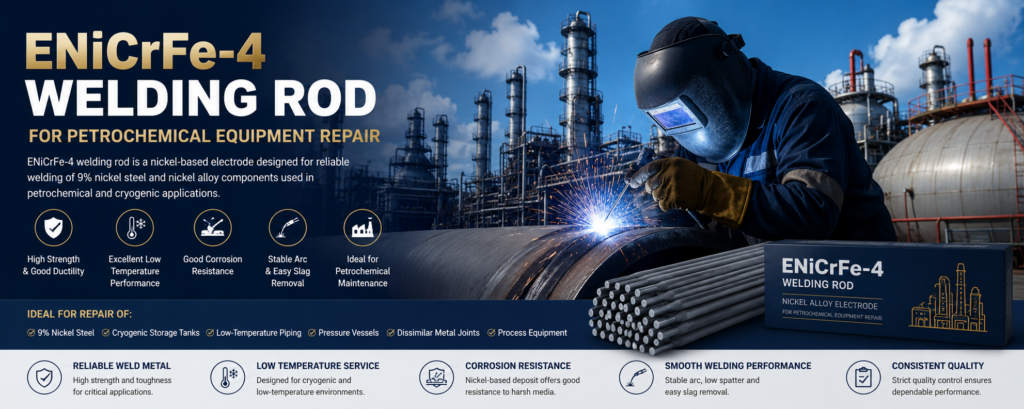
ENiCrFe-4 Welding Rod for Petrochemical Equipment Repair
Petrochemical equipment operates under demanding conditions that may include corrosive media, low temperatures, thermal cycling, pressure fluctuations, and continuous production schedules. When piping systems, storage equipment, process vessels, or nickel-alloy components require maintenance, selecting the correct welding consumable is essential for restoring joint integrity and extending equipment service life.ENiCrFe-4
The ENiCrFe-4 welding rod is a nickel-chromium-iron covered electrode designed for shielded metal arc welding. It is particularly associated with the welding of 9% nickel steel and may also be considered for selected nickel-alloy and dissimilar-metal applications when approved by the relevant welding procedure.
With its nickel-rich weld deposit, balanced alloying elements, and dependable mechanical properties, ENiCrFe-4 provides a practical welding solution for repair projects involving cryogenic equipment and specialized petrochemical components.
What Is an ENiCrFe-4 Welding Rod?
ENiCrFe-4 is a nickel-based covered electrode classified for shielded metal arc welding. Its deposited weld metal contains nickel as the principal element, together with chromium, iron, manganese, molybdenum, niobium, and tantalum.
This alloy system is designed to produce weld metal with a combination of:
High tensile strength
Good ductility
Suitable low-temperature performance
Resistance to cracking
Stable metallurgical characteristics
Compatibility with selected nickel-containing steels
ENiCrFe-4 is most commonly recognized for welding 9% nickel steel, a material widely used in cryogenic storage and processing systems. The electrode may also be used for certain repair joints involving nickel-chromium-iron alloys or dissimilar metals, provided the application has been reviewed and qualified by a welding engineer.
Why ENiCrFe-4 Is Relevant to Petrochemical Equipment Repair
Petrochemical maintenance is rarely limited to joining two clean pieces of new material. Repair welding often involves aged equipment, restricted access, residual stress, complex joint geometry, surface contamination, and differences between the original base material and the repair section.
The ENiCrFe-4 welding rod can help address several of these challenges.
Strong Nickel-Rich Weld Deposit
The high nickel content helps produce a weld deposit with good ductility and resistance to brittle behavior. This is especially important in applications exposed to low operating temperatures or repeated thermal changes.
A ductile weld deposit can better accommodate localized stresses caused by contraction, expansion, equipment vibration, and uneven heat distribution.
Compatibility with 9% Nickel Steel
One of the primary applications of ENiCrFe-4 is welding 9% nickel steel. This material is commonly selected for equipment intended to handle liquefied gases and other low-temperature media.
Potential applications may include:
Cryogenic storage tanks
Low-temperature process vessels
Gas-processing equipment
Transfer piping
Storage terminals
Refrigeration-related systems
Specialized pressure-containing components
When repairs involve 9% nickel steel, the welding consumable must provide suitable mechanical properties while minimizing the risk of weld cracking and unacceptable loss of toughness.
Suitability for Selected Dissimilar-Metal Joints
Petrochemical plants frequently contain combinations of carbon steel, low-alloy steel, stainless steel, and nickel alloy. During maintenance, replacement components may not always have exactly the same composition as the original material.
A nickel-based ENiCrFe-4 welding electrode may be considered for selected dissimilar-metal joints because its weld deposit can tolerate a degree of dilution from different base materials.
However, dissimilar-metal welding must never be based only on the electrode classification. The final selection should consider:
Base metal composition
Joint design
Dilution level
Operating temperature
Corrosive environment
Post-weld heat treatment
Mechanical property requirements
Applicable construction code
Good Mechanical Strength
ENiCrFe-4 weld metal generally provides higher strength than some earlier nickel-chromium-iron electrode classifications. This makes it useful where the repair weld must support pressure, structural loading, or thermal stress.
Mechanical strength alone is not enough to qualify a repair procedure, but it is an important part of restoring equipment integrity.
Practical Shielded Metal Arc Welding Process
Because ENiCrFe-4 is a covered electrode for shielded metal arc welding, it can be used in many field repair situations where large automated welding systems are not practical.
The process is suitable for:
On-site maintenance
Small repair areas
Confined spaces
Short weld lengths
Complex equipment geometry
Shutdown repair work
Locations with limited access
Portable welding equipment also makes the process convenient for maintenance teams working across different parts of a petrochemical facility.
ENiCrFe-4 Typical Petrochemical Repair Applications
The ENiCrFe-4 welding rod may be evaluated for several specialized maintenance applications.
Cryogenic Storage Equipment
Cryogenic equipment requires welds that can maintain adequate toughness at low temperatures. ENiCrFe-4 is particularly relevant to the fabrication and repair of components made from 9% nickel steel.
Possible repair areas include:
Tank shell sections
Nozzle connections
Piping attachments
Structural transitions
Localized weld defects
Replacement plates
Connection joints
All repairs on cryogenic equipment should follow approved procedures and include the required nondestructive examination.
Low-Temperature Process Piping
Piping systems carrying low-temperature gases or liquids may experience high contraction stresses. Repair consumables must therefore provide sufficient strength and ductility.
ENiCrFe-4 can be considered when the piping material, operating conditions, and engineering specifications require a nickel-rich weld deposit.
Pressure Vessel Components
Localized defects in pressure-containing equipment may include cracks, corrosion damage, incomplete fusion, or worn connection areas. ENiCrFe-4 may be used for qualified repairs involving compatible base materials.
The repair procedure should define:
Defect removal method
Joint preparation
Preheat requirements
Interpass temperature
Welding position
Electrode diameter
Current range
Inspection method
Acceptance criteria
Nickel-Alloy Equipment
Certain reactors, heat-resistant components, and process units use nickel-chromium-iron alloys because of their performance at elevated temperatures or in aggressive environments.
ENiCrFe-4 may be suitable for selected repair joints involving these alloys, but the exact filler metal should always be matched to the base material and service conditions.
Transition and Dissimilar-Metal Joints
Maintenance projects may require joining a nickel-containing steel to another alloy family. Nickel-based electrodes are often evaluated for such transition joints because they can reduce some of the metallurgical difficulties associated with directly joining different materials.
For critical dissimilar joints, procedure qualification testing is strongly recommended before production welding begins.
Key Advantages of ENiCrFe-4 Welding Electrodes
When correctly selected and applied, ENiCrFe-4 welding rods can offer several benefits for petrochemical maintenance.
1. Reliable Weld Metal Strength
The weld deposit provides mechanical strength suitable for demanding industrial joints. This supports the restoration of pressure-containing or load-bearing components.
2. Good Ductility
A nickel-rich deposit can absorb deformation more effectively than a highly rigid weld metal. This is valuable where the joint experiences thermal cycling or localized residual stress.
3. Low-Temperature Application Potential
ENiCrFe-4 is closely associated with 9% nickel steel and cryogenic applications, making it relevant to low-temperature storage and processing equipment.
4. Resistance to Weld Cracking
The alloy design supports good weldability when the correct joint preparation, current, arc length, and interpass control are used.
5. Field Repair Flexibility
Shielded metal arc welding equipment is portable and adaptable. It can be used in maintenance areas where access is limited or where the equipment cannot be moved to a workshop.
6. Stable Welding Performance
A properly manufactured ENiCrFe-4 electrode can provide a stable arc, manageable slag, controlled spatter, and consistent bead formation.
Actual welding behavior depends on electrode condition, power source settings, welder technique, and storage practices.
ENiCrFe-4 Recommended Preparation Before Welding
Successful petrochemical repair depends as much on preparation as on filler-metal selection.
Confirm the Base Material
Positive material identification should be considered when equipment records are incomplete or when there is a risk of mixing different alloys.
Using the wrong electrode on an unidentified base material can result in cracking, poor corrosion performance, or unacceptable mechanical properties.
Remove the Complete Defect
Cracks and damaged weld metal should be fully removed by an approved method. The excavation area should be inspected before new weld metal is deposited.
Leaving even a small portion of the original crack may cause the defect to reappear after welding.
Clean the Joint Thoroughly
Nickel-alloy welding is sensitive to contamination. Remove:
Oil
Grease
Moisture
Paint
Oxide scale
Rust
Sulfur-containing contamination
Cutting residue
Carbon deposits
Use clean tools dedicated to the material whenever contamination from carbon steel could affect the repair.
Control Electrode Moisture
Covered electrodes should be stored in dry conditions and handled according to the manufacturer’s instructions. When rebaking is required, use the specified temperature and holding time.
Excessive moisture can contribute to porosity, unstable arc behavior, and hydrogen-related welding problems.
Follow a Qualified Welding Procedure
The welding procedure should specify the essential variables for the repair, including:
Welding current and polarity
Electrode diameter
Welding position
Travel speed
Bead sequence
Maximum weave width
Preheat temperature
Interpass temperature
Cleaning between passes
Heat input limitations
For pressure equipment and safety-critical joints, the procedure should be supported by the required qualification records.
ENiCrFe-4 Welding Technique Considerations
Nickel-based electrodes require controlled welding techniques to obtain sound deposits.
Maintain a Short Arc
A short, stable arc helps reduce oxidation, porosity, spatter, and excessive heat input. A long arc can reduce shielding effectiveness and create an irregular weld bead.
Use Controlled Stringer Beads
Stringer beads are often preferred for nickel-alloy welding because they provide better control of heat input and weld-pool behavior.
Wide weaving should only be used when permitted by the approved welding procedure.
Clean Every Weld Pass
Slag and surface oxides must be removed completely before depositing the next layer. Pay particular attention to bead edges, joint corners, and restart areas.
Incomplete cleaning can cause slag inclusions or lack of fusion.
Control Interpass Temperature
Excessive interpass temperature can affect the weld microstructure, increase distortion, and reduce control over the weld pool.
The permitted temperature should be defined in the welding procedure rather than estimated during production.
ENiCrFe-4 Fill Craters Before Breaking the Arc
Unfilled craters may develop shrinkage cracks. Before stopping, reduce the travel speed briefly and fill the end of the weld pool.
Restart areas should be cleaned and blended before welding continues.
Inspection After Repair Welding
Petrochemical equipment repairs should be inspected according to the applicable code, service risk, and engineering specification.
Inspection methods may include:
Visual testing
Liquid penetrant testing
Magnetic testing where material compatibility allows
Ultrasonic testing
Radiographic testing
Leak testing
Pressure testing
Hardness testing
Ferrite or composition verification
Low-temperature impact testing for procedure qualification
The inspection plan should be established before welding begins. This prevents uncertainty about acceptance requirements after the repair has already been completed.
How to Select a Reliable ENiCrFe-4 Welding Rod
Not all welding electrodes provide the same level of consistency. For critical petrochemical applications, buyers should evaluate more than price.
Important purchasing factors include:
ENiCrFe-4 Classification Compliance
Confirm that the electrode is supplied according to the specified ENiCrFe-4 classification and that the relevant test documentation is available.
Chemical Composition Control
Consistent weld-metal chemistry is essential for predictable mechanical properties and welding behavior.
ENiCrFe-4 Mechanical Test Results
Review tensile strength, yield strength, elongation, and any additional low-temperature testing required by the project.
Batch Traceability
Each package should have clear classification, size, batch, and manufacturing identification. Traceability is especially important for pressure equipment and regulated repair work.
ENiCrFe-4 Packaging Quality
Moisture-resistant packaging helps protect the electrode coating during transportation and storage.
ENiCrFe-4 Welding Performance
Stable arc behavior, consistent melting, easy slag removal, and uniform bead appearance can improve productivity and reduce repair rates.
ENiCrFe-4 Welding Rod Selection Checklist
Before approving ENiCrFe-4 for a repair, confirm the following:
Is the base metal positively identified?
Does the approved welding procedure specify ENiCrFe-4?
Is the equipment operating at low temperature?
Is 9% nickel steel involved?
Is the joint a dissimilar-metal connection?
Are corrosion conditions understood?
Is post-weld heat treatment required?
Are impact properties required?
Is the electrode batch fully traceable?
Are the welders qualified for the process and position?
Have inspection and acceptance criteria been established?
This checklist helps prevent filler-metal selection based only on a general product description.
ENiCrFe-4 Conclusion
The ENiCrFe-4 welding rod for petrochemical equipment repair offers a nickel-rich weld deposit, reliable mechanical strength, good ductility, and practical field-welding capability. Its most important application is the welding of 9% nickel steel, making it particularly relevant to cryogenic storage and low-temperature processing systems.
However, successful repair welding depends on more than choosing the correct electrode classification. Base-metal identification, defect removal, surface cleaning, electrode storage, heat-input control, welder qualification, and final inspection all influence the reliability of the completed joint.
When ENiCrFe-4 is selected through proper engineering review and applied under a qualified welding procedure, it can provide a dependable solution for maintaining specialized petrochemical equipment and reducing the risk of premature repair failure.