

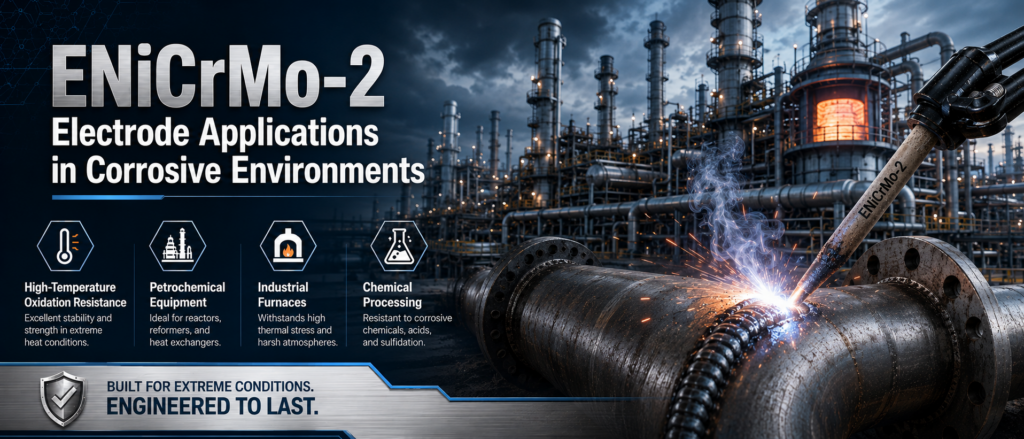
ENiCrMo-2 Electrode Applications in Corrosive Environments
Industrial equipment operating in corrosive and high-temperature environments requires weld metal capable of maintaining strength, stability and surface protection throughout its service life. ENiCrMo-2 electrode is designed for shielded metal arc welding of nickel-chromium-iron-molybdenum alloys used under demanding thermal and chemical conditions.
Its balanced nickel, chromium, molybdenum and iron content provides a useful combination of oxidation resistance, high-temperature strength, weldability and resistance to certain forms of environmental cracking. These characteristics make ENiCrMo-2 suitable for furnace equipment, petrochemical systems, combustion components and selected chemical-processing applications.
However, ENiCrMo-2 should not be treated as a universal solution for every corrosive medium. Correct electrode selection must consider temperature, chemical concentration, pressure, base-metal composition and the type of corrosion expected during operation.
What Is an ENiCrMo-2 Electrode?
ENiCrMo-2 is a nickel-alloy covered electrode classified under AWS A5.11 for shielded metal arc welding, also known as SMAW or stick welding. The corresponding weld deposit is identified as UNS W86002.
The weld metal is primarily nickel with significant additions of chromium, iron and molybdenum. Typical composition ranges include:
Nickel as the balance
Chromium between approximately 20.5% and 23%
Iron between approximately 17% and 20%
Molybdenum between approximately 8% and 10%
Controlled amounts of cobalt, tungsten, manganese, silicon and carbon
This composition is designed to produce welds that remain mechanically stable while exposed to elevated temperatures and aggressive industrial atmospheres.
ENiCrMo-2 is commonly selected for joining matching nickel-chromium-iron-molybdenum base materials. It may also be considered for certain dissimilar joints involving compatible nickel-, iron- or cobalt-based high-temperature alloys.
Why ENiCrMo-2 Performs Well in Corrosive Environments
The corrosion performance of ENiCrMo-2 comes from the combined functions of its major alloying elements.
Chromium for Oxidation Resistance
Chromium supports the formation of a protective oxide layer on the weld surface. This layer helps slow further oxidation when the welded component is exposed to hot air, combustion products and other oxidizing atmospheres.
This characteristic is particularly important in furnaces, combustion chambers, heat-treatment systems and high-temperature processing equipment.
Molybdenum for Resistance in Reducing Conditions
Molybdenum helps improve resistance in selected reducing and chemically aggressive environments. It also contributes to the high-temperature strength and metallurgical stability of the weld deposit.
The molybdenum content of ENiCrMo-2 is useful in mixed industrial conditions where oxidation resistance alone is not sufficient.
Nickel for Metallurgical Stability
Nickel provides the base structure of the weld deposit and supports ductility, thermal stability and resistance to several forms of corrosion. A nickel-rich weld can tolerate repeated heating and cooling better than many conventional steel weld deposits.
Nickel also helps reduce the risk of excessive hardening when ENiCrMo-2 is used for approved dissimilar-metal joints.
Resistance to Stress-Corrosion Cracking
ENiCrMo-2 weld metal has demonstrated good resistance to stress-corrosion cracking in certain petrochemical applications. This is valuable because welded joints often contain residual stress and may be exposed to heat, process chemicals and cyclic operating loads at the same time.
Actual performance still depends on the complete environment. Qualification testing should be completed whenever the service medium is especially severe or insufficiently documented.
Main ENiCrMo-2 Electrode Applications
Petrochemical Processing Equipment
Petrochemical facilities frequently combine high temperatures, process gases, thermal cycling and corrosive contaminants. ENiCrMo-2 can be used to weld suitable components such as:
Furnace internals
Process tubing
Retorts
Catalyst support structures
High-temperature ducts
Burner assemblies
Transfer piping
Pyrolysis equipment
Hot-gas handling components
The electrode is especially valuable where the weld must retain strength while resisting oxidation and environmental cracking.
ENiCrMo-2 may also be used for field repairs when access is limited and portable SMAW equipment is more practical than automated welding systems.
Industrial Furnaces and Heat-Treatment Systems
Industrial furnaces expose welded components to repeated heating, cooling and contact with oxidizing, reducing or neutral atmospheres. These conditions can cause scaling, metal loss, embrittlement and premature cracking in ordinary weld metals.
Typical ENiCrMo-2 electrode applications in furnace systems include:
Furnace rolls
Support members
Baffles
Heating fixtures
Muffles
Radiant sections
Trays and baskets
High-temperature brackets
Internal structural components
Its combination of oxidation resistance and elevated-temperature strength makes ENiCrMo-2 useful where both corrosion and mechanical loading must be considered.
Combustion and Gas-Turbine Components
Combustion systems create complex conditions involving hot gases, rapid temperature changes and combustion-related contaminants. Welded joints in these systems must resist oxidation without losing ductility.
ENiCrMo-2 can be considered for compatible components such as:
Combustor liners
Transition ducts
Flame holders
Spray bars
Exhaust sections
Tailpipes
Afterburner components
High-temperature housings
The electrode is particularly useful for repair welding and joining matching high-temperature nickel alloys.
Chemical-Processing Equipment
ENiCrMo-2 may be used in chemical-processing equipment when the dominant service conditions involve elevated temperatures, hot gases and moderate chemical attack.
Potential components include:
Process retorts
Flash-dryer parts
Catalyst grids
Thermal-processing vessels
High-temperature reaction chambers
Tubing used in pyrolysis operations
Chemical compatibility must be evaluated carefully. ENiCrMo-2 is not automatically the best electrode for concentrated acids, strong chloride solutions or severe wet-corrosion service.
Dissimilar-Metal Welding
ENiCrMo-2 can serve as a dissimilar-metal filler for selected combinations of solid-solution-strengthened, high-temperature alloys. Its nickel-rich structure can help accommodate differences in thermal expansion and metallurgical behavior between compatible materials.
Possible applications include joining:
Nickel alloys to selected iron-based alloys
Nickel alloys to compatible cobalt-based alloys
Different nickel-based high-temperature materials
Repair sections where the original and replacement materials differ
Dissimilar-metal welding should always be supported by a qualified welding procedure. Dilution from the base metals can change weld-metal chemistry, corrosion resistance and cracking behavior.
Maintenance and Repair Welding
SMAW is often selected for maintenance because the equipment is portable and does not require external shielding gas. ENiCrMo-2 electrodes can therefore be useful for repairing high-temperature equipment in refineries, furnaces, chemical plants and power-generation facilities.
Common repair work may include:
Sealing cracks
Replacing worn sections
Repairing furnace fixtures
Restoring combustion components
Joining replacement sections
Rebuilding damaged high-temperature assemblies
Before repair welding, the damaged region must be evaluated to determine whether the failure resulted from corrosion, thermal fatigue, creep, contamination or an unsuitable original design.
Corrosion Conditions ENiCrMo-2 Can Address
High-Temperature Oxidation
One of the principal strengths of ENiCrMo-2 is resistance to oxidation at elevated temperatures. This makes it well suited to components exposed to hot air and combustion gases.
A sound, clean weld surface supports the formation of a more consistent protective oxide layer.
Oxidizing, Reducing and Neutral Furnace Atmospheres
Furnaces may alternate between different atmospheric conditions during production cycles. ENiCrMo-2 is useful because it can provide reasonable stability across oxidizing, reducing and neutral high-temperature atmospheres.
Performance can still be affected by sulfur, carbon activity, halides, deposits and temperature fluctuations.
Carburizing Environments
Carbon-rich furnace atmospheres can cause carbon to diffuse into metal surfaces, resulting in embrittlement and dimensional changes. Nickel-chromium-iron-molybdenum weld deposits can provide useful resistance in selected carburizing conditions.
The exact performance depends on temperature, carbon activity, exposure time and atmosphere composition.
Petrochemical Stress-Corrosion Conditions
ENiCrMo-2 is recognized for resistance to stress-corrosion cracking in certain petrochemical environments. This may improve the reliability of welds exposed to process contaminants, residual welding stress and elevated temperatures.
This benefit should not replace service-specific testing or engineering review.
Hot Corrosion
Combustion systems may contain sulfur compounds, salts and ash deposits that accelerate attack at elevated temperatures. ENiCrMo-2 may provide better resistance than conventional steel weld deposits in selected hot-corrosion conditions.
Where deposits contain large amounts of chlorides, sulfur or vanadium compounds, corrosion testing and regular inspection are recommended.
Welding Recommendations for ENiCrMo-2
Good corrosion resistance depends on weld quality as much as electrode chemistry. Defects, contamination and excessive heat input can create weak areas that corrode faster than the surrounding material.
Clean the Joint Thoroughly
Remove all oil, grease, paint, scale, moisture, marking materials and corrosion products before welding. Use clean tools reserved for nickel-alloy fabrication whenever possible.
ENiCrMo-2 Control Heat Input
Excessive heat input can increase distortion, enlarge the heat-affected zone and encourage unwanted metallurgical changes. Use controlled amperage, short arc length and stringer beads unless the qualified procedure states otherwise.
ENiCrMo-2 Maintain a Low Interpass Temperature
A controlled interpass temperature helps limit heat accumulation. The permitted value should come from the approved welding procedure and base-metal requirements.
ENiCrMo-2 Use the Correct Polarity
ENiCrMo-2 covered electrodes are commonly used with direct current electrode positive. Current must be adjusted according to electrode diameter, welding position, joint thickness and manufacturer recommendations.
ENiCrMo-2 Remove Slag Between Passes
Slag must be completely removed before depositing the next weld bead. Trapped slag can create corrosion initiation points, reduce mechanical strength and prevent complete fusion.
ENiCrMo-2 Protect Electrodes from Moisture
Covered electrodes should be stored in dry conditions. Moisture absorption may affect arc stability, deposit quality and weld soundness. Follow the specified storage and redrying procedure for the exact electrode batch.
ENiCrMo-2 Limit Dilution
When welding dissimilar metals or applying a corrosion-resistant layer, excessive dilution can reduce chromium, nickel and molybdenum levels in the deposited weld metal. Controlled penetration and multiple layers may be necessary to obtain the required final chemistry.
Limitations of ENiCrMo-2 in Corrosive Service
ENiCrMo-2 offers valuable resistance to high-temperature oxidation and certain petrochemical environments, but it is not the most corrosion-resistant nickel-alloy electrode for every application.
It may not be the preferred choice for:
Highly concentrated reducing acids
Severe wet-chloride environments
Strongly oxidizing acid mixtures
Aggressive crevice-corrosion conditions
Chemical systems requiring very low iron weld deposits
Applications requiring maximum resistance to localized aqueous corrosion
In these environments, an electrode with higher molybdenum, lower iron or a different chromium balance may be more suitable.
Selection should be based on actual process chemistry rather than the general description of “corrosive service.”
How to Select ENiCrMo-2 for a Project
Before specifying ENiCrMo-2, review the following conditions:
Base-metal grade and thickness
Operating and peak temperatures
Chemical composition of the process medium
Presence of chlorides, sulfur compounds or carbon-rich gases
Oxidizing or reducing potential
Pressure and mechanical loading
Frequency of heating and cooling cycles
Welding position and access
Applicable construction code
Required inspection and testing methods
A welding procedure qualification should confirm mechanical properties, weld soundness and compatibility with the intended service environment.
ENiCrMo-2 Conclusion
ENiCrMo-2 electrode is an effective welding consumable for compatible nickel-chromium-iron-molybdenum alloys operating in corrosive, oxidizing and high-temperature environments. Its most important applications include petrochemical furnace equipment, combustion components, industrial heat-treatment systems, chemical-processing hardware and selected dissimilar-metal joints.
The electrode provides a valuable balance of oxidation resistance, high-temperature strength, ductility and resistance to certain forms of stress-corrosion cracking. Nevertheless, its suitability depends on the exact service conditions.
For reliable long-term performance, engineers should evaluate process chemistry, temperature, base-metal compatibility, dilution and applicable welding codes before approving ENiCrMo-2 for corrosive service.