
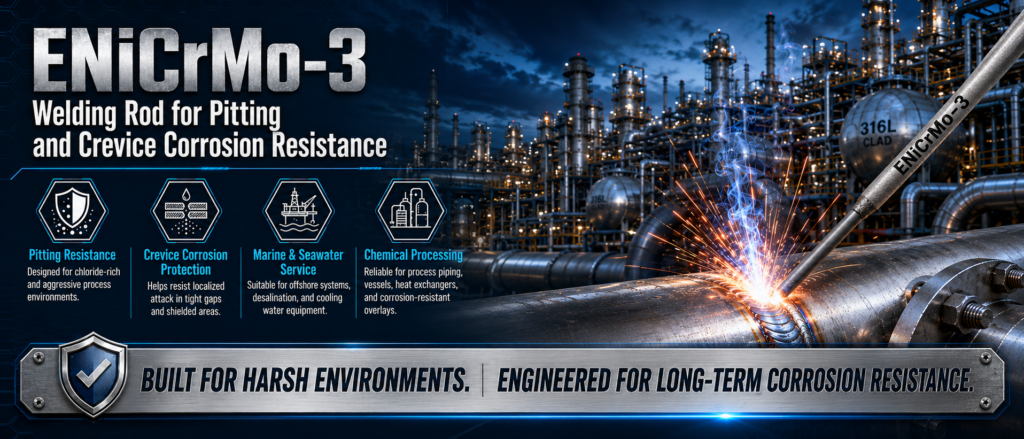
ENiCrMo-3 Welding Rod for Pitting and Crevice Corrosion Resistance
Welded equipment used in seawater, chemical processing, pollution control and other chloride-containing environments can fail through localized corrosion even when the surrounding metal appears undamaged. Pitting and crevice corrosion are especially dangerous because they concentrate attack within small areas and may penetrate a component before significant general corrosion becomes visible.
The ENiCrMo-3 welding rod is a nickel-chromium-molybdenum covered electrode developed for shielded metal arc welding of corrosion-resistant alloys. Its weld deposit combines nickel with substantial chromium, molybdenum and niobium additions, providing strong resistance to pitting, crevice corrosion and other forms of localized attack.
ENiCrMo-3 is widely considered for process piping, pressure vessels, heat exchangers, marine equipment and corrosion-resistant overlays. However, reliable performance depends on more than electrode classification. Base-metal compatibility, dilution, joint design, heat input, surface condition and actual process chemistry must all be evaluated.
What Is an ENiCrMo-3 Welding Rod?
ENiCrMo-3 is a covered nickel-alloy electrode classified under the A5.11 specification for shielded metal arc welding, also called SMAW or stick welding. Its corresponding weld-metal designation is UNS W86112.
The term ENiCrMo-3 welding rod is commonly used in purchasing and industrial discussions. Technically, however, ENiCrMo-3 is a flux-covered electrode. It should not be confused with ERNiCrMo-3, which is a bare filler metal used for processes such as GTAW, GMAW and submerged arc welding.
A typical ENiCrMo-3 weld deposit contains:
| Element | Typical specification range |
|---|---|
| Nickel | Balance |
| Chromium | 20.0–23.0% |
| Molybdenum | 8.0–10.0% |
| Niobium and tantalum | 3.15–4.15% |
| Iron | 7.0% maximum |
| Manganese | 1.0% maximum |
| Silicon | 0.75% maximum |
| Carbon | 0.10% maximum |
The classification is commonly used to weld 625-type nickel alloys, 825-type alloys, highly alloyed stainless steels and other molybdenum-containing materials. It is also used for corrosion-resistant surfacing and selected dissimilar-metal joints. (Haynes International)
Why Pitting and Crevice Corrosion Are Serious
Pitting corrosion
Pitting is a highly localized form of corrosion that creates small cavities or holes in a metal surface. Chloride ions can destabilize a protective passive film, allowing a small anodic area to develop while the larger surrounding surface remains passive.
Once a pit begins, the local environment inside it may become increasingly aggressive. Metal-ion hydrolysis can lower the pH, while chloride ions migrate into the pit to maintain electrical neutrality. The result is an autocatalytic process that can continue beneath a relatively small surface opening.
Pitting is difficult to detect and predict because the total loss of metal may be low even when individual pits become dangerously deep.
ENiCrMo-3 Crevice corrosion
Crevice corrosion develops in shielded spaces where fluid movement and oxygen exchange are restricted. Common locations include:
Gasket interfaces
Lap joints
Flange faces
Deposits and scale
Bolt and washer interfaces
Weld backing areas
Poorly drained equipment
Irregular weld profiles
As oxygen is consumed inside the crevice, the chemistry becomes different from the surrounding bulk solution. Chlorides can accumulate, the local pH can decrease and the passive surface may break down.
Crevice corrosion can begin under less severe conditions than free-surface pitting because the geometry of the crevice restricts mass transport and helps maintain the aggressive local environment.
How ENiCrMo-3 Resists Localized Corrosion
The corrosion resistance of an ENiCrMo-3 welding rod comes from the combined effect of its major alloying elements.
Chromium supports passive-film formation
Chromium helps create and maintain a thin protective oxide film on the weld-metal surface. This passive layer reduces the rate of general corrosion and provides the first line of defense against localized attack.
The relatively high chromium content of ENiCrMo-3 is particularly useful in oxidizing environments and in systems where the passive film must repeatedly repair itself after minor mechanical or chemical damage.
Molybdenum improves resistance to localized attack
Molybdenum is one of the most important elements for improving resistance to pitting and crevice corrosion in chloride-containing environments.
When the passive film is locally damaged, molybdenum helps reduce the rate of active dissolution and supports repassivation. It is especially valuable inside pits and crevices, where the solution may become acidic and rich in chlorides.
With approximately 8–10% molybdenum, ENiCrMo-3 weld metal generally offers considerably greater localized corrosion resistance than conventional stainless-steel weld deposits.
Nickel provides stability in aggressive media
Nickel forms the base of the ENiCrMo-3 weld-metal structure. It contributes to ductility, metallurgical stability and resistance in a broad range of reducing and mixed chemical environments.
A nickel-rich matrix also helps produce weld metal that can accommodate thermal cycling and differences in thermal expansion when joining dissimilar materials.
Niobium contributes to weld-metal strength
Niobium, together with tantalum, contributes primarily to strengthening and metallurgical stability. It works with molybdenum to strengthen the nickel matrix without requiring a conventional precipitation-hardening heat treatment.
Although chromium and molybdenum are the principal contributors to localized corrosion resistance, the complete alloy balance allows the deposit to combine corrosion resistance with useful mechanical strength. Nickel-chromium-molybdenum deposits of this type are recognized for resistance to severe corrosive environments, particularly pitting and crevice attack.
ENiCrMo-3 Welding Rod Applications
Chemical-processing equipment
Chemical plants frequently handle chlorides, acidic solutions, contaminated process streams and mixed oxidizing-reducing conditions. Welded joints in these systems require corrosion resistance comparable to the base material.
ENiCrMo-3 welding rods may be used for compatible:
Reactors
Process vessels
Agitators
Storage tanks
Transfer piping
Heat exchangers
Condensers
Evaporators
Valve bodies
Pump components
The electrode is particularly valuable when localized corrosion is a greater concern than uniform wall thinning.
Marine and seawater systems
Seawater contains enough chloride to create a significant risk of pitting and crevice corrosion. Stagnant water, deposits, gaskets, flange connections and low-flow areas can make the conditions more severe.
Potential ENiCrMo-3 applications include:
Seawater piping
Offshore process equipment
Marine heat exchangers
Pump and valve repairs
Splash-zone components
Desalination equipment
Cooling-water systems
Seawater strainers
Suitability should be confirmed for the actual temperature, flow velocity, oxygen level, biological activity and crevice geometry. ENiCrMo-3 provides strong resistance, but no weld deposit should be considered immune to every seawater condition.
Flue-gas cleaning equipment
Pollution-control systems may expose equipment to wet chlorides, sulfur compounds, acidic condensates and temperature cycling. These conditions can promote both general and localized corrosion.
ENiCrMo-3 may be selected for:
Scrubber internals
Absorber vessels
Ductwork
Spray headers
Drain systems
Outlet sections
Corrosion-resistant overlays
Smooth weld profiles and proper surface cleaning are especially important because deposits can create oxygen-shielded crevices.
Oil and gas equipment
Oil and gas systems may contain chlorides, carbon dioxide, hydrogen sulfide, water and process contaminants. ENiCrMo-3 can be considered for compatible components where corrosion-resistant nickel-alloy weld metal is required.
Common applications may include:
Process piping
Separator internals
Valve trim
Manifolds
Offshore modules
Sour-service equipment
Repair welds
Corrosion-resistant cladding
Material selection for sour service requires a complete review of hardness, environmental cracking risk, applicable specifications and post-weld condition. Corrosion resistance alone is not sufficient.
Pulp and paper processing
Bleaching and chemical-recovery systems may expose equipment to chlorides, acidic compounds and oxidizing chemicals. ENiCrMo-3 weld metal can be used in selected corrosion-resistant equipment where pitting or crevice attack is a concern.
Possible applications include process vessels, piping, mixers, washers and heat-transfer equipment.
ENiCrMo-3 Corrosion-resistant cladding
ENiCrMo-3 electrodes can deposit a corrosion-resistant surface over carbon steel, low-alloy steel or stainless steel. This approach allows the structural material to provide strength while the weld overlay protects the exposed surface.
Typical cladding applications include:
Vessel interiors
Valve sealing areas
Pipe surfaces
Flange faces
Nozzles
Process rolls
Repair areas
Cladding procedures must control dilution carefully. Excessive mixing with an iron-rich substrate can reduce the chromium, nickel and molybdenum content of the final surface layer.
Dissimilar-metal welding
ENiCrMo-3 is also used for selected joints between nickel alloys, stainless steels, low-alloy steels and carbon steels. Its highly alloyed deposit can tolerate a degree of dilution while maintaining useful mechanical and corrosion properties.
A qualified welding procedure is essential because dilution may produce an actual weld composition that differs substantially from the nominal electrode chemistry.
Why Weld Quality Affects Corrosion Resistance
Selecting an ENiCrMo-3 welding rod does not automatically guarantee a corrosion-resistant joint. Localized corrosion frequently begins at weld imperfections or geometric irregularities.
Incomplete fusion
Lack of fusion can produce narrow internal gaps that behave like crevices. Process chemicals may enter these spaces and remain trapped, creating highly aggressive local conditions.
Slag inclusions
Trapped slag can interrupt the continuity of the corrosion-resistant weld metal. It may also create tight interfaces where solution chemistry becomes concentrated.
Undercut
Undercut creates sharp recesses along the weld toe. These areas can retain liquid and deposits while also producing stress concentration.
Excessive weld reinforcement
A rough or excessively convex bead can interfere with drainage and cleaning. It may encourage deposit accumulation and create shielded areas at the weld toes.
Porosity
Open surface pores can trap process fluids. Even small cavities may become initiation points for localized attack.
Arc strikes and surface contamination
Uncontrolled arc strikes, embedded iron particles and carbon-steel tool contamination can damage the passive surface or introduce lower-alloy regions.
Recommended Welding Practices
Clean the joint completely
Remove grease, oil, moisture, paint, oxide, cutting residue and corrosion products before welding. Cleaning tools used on carbon steel should not be used on nickel-alloy surfaces.
Joint preparation should extend beyond the immediate weld area because contaminants can enter the molten pool from adjacent surfaces.
Use direct current electrode positive
ENiCrMo-3 covered electrodes are commonly operated with direct current electrode positive, or DCEP. The correct current depends on electrode diameter, welding position, joint configuration and the instructions supplied with the consumable.
Maintain a short arc
A short, controlled arc helps reduce atmospheric contamination, excessive spatter and unstable metal transfer. It also improves control of the weld pool.
ENiCrMo-3 Avoid excessive weaving
Stringer beads or limited-width weave beads are generally preferred. Excessive weaving increases heat input and may produce an irregular bead profile.
Control heat input
Excessive heat input can increase distortion, segregation and the size of the heat-affected zone. Use only enough current to maintain a stable arc and achieve complete fusion.
Travel speed should be consistent, and the weld pool should not be allowed to become unnecessarily large.
ENiCrMo-3 Control interpass temperature
Nickel-alloy welding procedures generally use controlled interpass temperatures to limit heat accumulation. The specific maximum should be established by the qualified welding procedure.
Remove slag between passes
Every pass must be cleaned thoroughly before the next bead is deposited. Slag left at the bead edges can become trapped and create internal defects.
Fill the crater correctly
Abruptly breaking the arc may leave a crater crack. Reduce travel speed near the end of the bead and fill the crater before extinguishing the arc.
Store electrodes in dry conditions
Moisture can affect arc performance and weld quality. Keep electrodes in sealed, dry storage and follow the specified conditioning instructions. Redrying temperatures should not be assumed because coating systems may differ.
ENiCrMo-3 Managing Dilution in Corrosion-Resistant Welds
Dilution is the mixing of melted base metal with filler metal. It is particularly important when ENiCrMo-3 is deposited on carbon steel or low-alloy steel.
Excessive dilution may:
Increase iron content
Reduce effective chromium content
Reduce effective molybdenum content
Lower localized corrosion resistance
Change solidification behavior
Increase the risk of weld defects
The first overlay layer usually experiences the greatest dilution. Multiple layers may be necessary before the exposed surface achieves the intended corrosion-resistant composition.
Procedure qualification can include chemical analysis of the final layer, bend testing, liquid-penetrant inspection and corrosion testing when required by the service conditions.
ENiCrMo-3 Designing Against Crevice Corrosion
A corrosion-resistant welding rod cannot compensate for poor equipment design. Crevice corrosion should also be controlled through fabrication and operating practices.
Recommended design measures include:
Use continuous welds instead of intermittent welds in wetted areas
Avoid overlapping plates where liquid can enter
Minimize gasket overhang
Eliminate dead legs where practical
Provide complete drainage
Use smooth internal weld profiles
Prevent deposit accumulation
Avoid sharp transitions
Seal unnecessary crevices
Provide access for cleaning and inspection
The combination of an appropriate weld deposit and crevice-resistant design is more effective than relying on alloy chemistry alone.
Factors That Affect ENiCrMo-3 Corrosion Performance
The actual resistance of an ENiCrMo-3 weld depends on the complete service environment, including:
Chloride concentration
Operating temperature
Solution pH
Oxidizing potential
Flow rate
Stagnant conditions
Deposits and biological growth
Crevice dimensions
Process contaminants
Surface finish
Residual stress
Base-metal dilution
Cleaning frequency
A material that performs well in cool, flowing seawater may behave differently in hot stagnant brine. Similarly, a weld exposed to a clean bulk solution may experience severe attack beneath a gasket or deposit.
Laboratory testing should reproduce the most severe realistic conditions rather than only the average operating environment.
Limitations of ENiCrMo-3
ENiCrMo-3 offers strong corrosion resistance, but it is not the optimum consumable for every chemical environment.
A more highly alloyed electrode may be required for:
Extremely aggressive acid mixtures
Very high chloride concentrations at elevated temperatures
Severe oxidizing environments
Applications demanding maximum crevice-corrosion resistance
Processes requiring a lower iron weld deposit
Service where corrosion testing identifies insufficient margin
The operating temperature must also be considered. An alloy selected for aqueous corrosion resistance may not automatically provide the best mechanical or metallurgical performance during prolonged high-temperature service.
How to Select an ENiCrMo-3 Welding Rod
Before approving ENiCrMo-3 for a project, review:
The exact base-metal grades
The joining or overlay application
Chloride concentration and temperature
Process pH and oxidizing conditions
Maximum operating and upset temperatures
Presence of gaskets, deposits or stagnant zones
Required corrosion allowance
Dilution from the substrate
Welding position and accessibility
Inspection and acceptance criteria
Applicable construction codes
Electrode certification and batch chemistry
The final selection should be supported by engineering review and, where necessary, service-specific corrosion testing.
ENiCrMo-3 Conclusion
The ENiCrMo-3 welding rod is an effective covered electrode for applications requiring resistance to pitting and crevice corrosion. Its nickel-rich weld metal, combined with substantial chromium and molybdenum, provides a strong balance of localized corrosion resistance, mechanical strength and weldability.
It is particularly useful for chemical-processing equipment, marine systems, pollution-control units, process piping, heat exchangers, corrosion-resistant cladding and selected dissimilar-metal joints.
Long-term performance depends on more than the electrode designation. Proper material selection, low-dilution welding procedures, complete interpass cleaning, smooth weld profiles and crevice-resistant equipment design are all essential. When these factors are addressed together, ENiCrMo-3 can provide durable welds for demanding chloride-containing and chemically aggressive environments.