

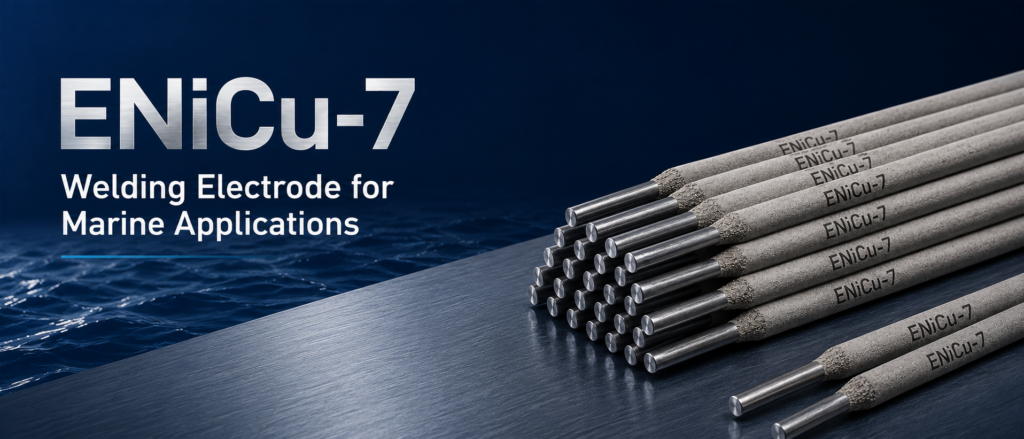
ENiCu-7 Welding Electrode for Marine Applications
Marine equipment operates in one of the most demanding industrial environments. Constant exposure to seawater, salt spray, moisture, pressure changes, vibration, and temperature fluctuations can accelerate corrosion and weaken welded structures. Selecting the correct welding consumable is therefore essential for achieving reliable joints and extending equipment service life.ENiCu-7
The ENiCu-7 welding electrode for marine applications is a nickel-copper alloy covered electrode designed for shielded metal arc welding. It is widely selected for joining compatible nickel-copper alloys, welding nickel-copper alloys to steel, repairing marine components, and depositing corrosion-resistant weld metal on steel surfaces.
Its combination of corrosion resistance, mechanical strength, weldability, and suitability for field repair makes ENiCu-7 a practical solution for shipbuilding, offshore engineering, desalination systems, seawater piping, and other marine projects.
What Is an ENiCu-7 Welding Electrode?
ENiCu-7 is a covered nickel-copper alloy electrode classified under AWS A5.11 for shielded metal arc welding, also known as SMAW or stick welding.
The deposited weld metal contains a high proportion of nickel and copper, with controlled additions of other elements that support arc stability, strength, and sound weld formation. This chemical balance allows the weld deposit to provide performance compatible with many corrosion-resistant nickel-copper base materials.
ENiCu-7 electrodes are commonly used for:
Welding nickel-copper alloys to themselves
Joining nickel-copper alloys to carbon steel
Welding the clad side of nickel-copper-clad steel
Repairing marine equipment exposed to saltwater
Applying nickel-copper surfacing layers to steel
Fabricating piping, tanks, pumps, valves, and heat-transfer equipment
Because ENiCu-7 is a covered electrode, it is especially suitable for maintenance and construction projects where portability and flexible welding positions are important.
Why ENiCu-7 Is Suitable for Marine Applications
Marine welding consumables must withstand more than ordinary atmospheric corrosion. Seawater contains chlorides and dissolved salts that can attack unsuitable metals and accelerate localized corrosion.
ENiCu-7 weld metal is valued in marine environments because nickel-copper alloys can offer strong resistance to seawater and saline solutions when they are correctly selected, welded, and placed in service.
Resistance to Seawater Corrosion
One of the main reasons for selecting ENiCu-7 is its ability to produce nickel-copper weld deposits with good resistance to seawater exposure.
This makes it suitable for components that may experience:
Continuous seawater immersion
Salt spray and humid coastal air
Flowing seawater
Brackish water
Marine condensation
Wet and dry operating cycles
Actual corrosion performance depends on the base material, weld quality, water chemistry, flow velocity, temperature, oxygen content, and equipment design.
Reliable Dissimilar-Metal Welding
Marine equipment often combines corrosion-resistant alloys with carbon steel to balance performance and cost. ENiCu-7 can be used in qualified procedures for joining compatible nickel-copper alloys to steel.
This capability is useful for transition joints, clad structures, repair work, pipe connections, and equipment modifications.
Suitable for Corrosion-Resistant Surfacing
ENiCu-7 can also deposit a nickel-copper alloy layer over steel. This surfacing process helps protect selected areas from corrosive marine media without manufacturing the entire component from a higher-alloy material.
Typical surfacing applications include valve components, pump parts, steel fittings, sealing areas, and localized repair zones.
Practical for Field Welding
Shielded metal arc welding equipment is portable and does not require an external shielding-gas cylinder. This can be advantageous during ship repair, offshore maintenance, dockyard fabrication, and work in restricted areas.
ENiCu-7 electrodes can therefore support both workshop production and on-site maintenance when the correct welding procedure is followed.
Common Marine Applications of ENiCu-7
The ENiCu-7 welding electrode for marine applications can be used across several sectors involving seawater, salt exposure, and corrosion-resistant equipment.
Shipbuilding and Ship Repair
ENiCu-7 may be selected for compatible piping, fittings, valves, pumps, repair sections, and nickel-copper alloy components installed on vessels.
It is also useful for maintenance projects where damaged corrosion-resistant sections must be restored without removing large assemblies.
Offshore Platforms
Offshore installations are continuously exposed to salt spray, moisture, waves, and changing temperatures. ENiCu-7 can be used in qualified welding procedures for compatible seawater-handling components, offshore piping, pump systems, and corrosion-resistant transition joints.
Seawater Piping Systems
Seawater piping is used for cooling, firefighting, ballast handling, filtration, and utility services. Welds in these systems must provide adequate resistance to the transported medium while maintaining structural integrity.
ENiCu-7 can help produce compatible weld deposits in selected nickel-copper piping systems.
Desalination Equipment
Desalination facilities process large volumes of saltwater and require materials that can resist saline corrosion.
Possible ENiCu-7 applications include compatible heat-transfer equipment, piping, pumps, valves, fittings, and repair areas exposed to seawater or concentrated brine.
Marine Pumps and Valves
Pump casings, impellers, shafts, sleeves, valve bodies, and sealing surfaces may operate under flowing seawater conditions.
ENiCu-7 may be used for joining, rebuilding, or surfacing compatible components, depending on the base material and approved repair procedure.
Heat Exchangers and Condensers
Marine heat exchangers and condensers often contain corrosion-resistant tubing, plates, shells, and piping connections.
Where compatible nickel-copper materials are involved, ENiCu-7 can be considered for fabrication and maintenance welding.
Main Benefits of ENiCu-7 Welding Electrodes
Good Corrosion Resistance
The nickel-copper weld deposit provides useful resistance to seawater, saline solutions, and several industrial environments.
Strong and Durable Weld Deposits
When applied with an approved procedure, ENiCu-7 can produce sound weld metal with suitable strength and toughness for demanding marine service.
Versatile Joining Capability
The electrode can be used for similar-alloy welding, selected dissimilar joints, clad-steel welding, and corrosion-resistant surfacing.
Convenient Welding Process
SMAW equipment is widely available, portable, and suitable for fabrication, repair, and maintenance work.
Useful for Complex Repair Locations
Stick electrodes can be practical in areas where access is limited or where gas-shielded processes are difficult to operate.
ENiCu-7 Compatible Base Materials
ENiCu-7 is primarily intended for compatible nickel-copper alloys and selected dissimilar-metal combinations.
Common applications may include:
Nickel-copper alloy 400
Nickel-copper alloy R-405
Compatible cast nickel-copper alloys
Nickel-copper alloy to carbon steel joints
Nickel-copper-clad steel
Steel requiring nickel-copper alloy surfacing
Base-metal identification must be confirmed before welding. Similar-looking materials can have significantly different chemical compositions and welding requirements.
For critical marine equipment, the electrode should always be selected through an approved welding procedure specification.
ENiCu-7 Recommended Welding Practices
Correct technique is essential for obtaining the corrosion resistance and mechanical performance expected from ENiCu-7.
Clean the Joint Thoroughly
Remove oil, grease, moisture, paint, rust, oxide, dirt, and other contamination from the weld area.
Nickel-alloy welds can be sensitive to contamination, so dedicated stainless-steel brushes and clean tools are recommended.
Keep the Electrodes Dry
Moisture in the electrode coating can contribute to arc instability, porosity, and weld defects.
Store ENiCu-7 electrodes in dry conditions and follow the recommended storage and reconditioning instructions.
Use Controlled Heat Input
Excessive heat input can increase distortion, enlarge the heat-affected zone, and reduce control of the weld pool.
Use suitable amperage, a short arc, and controlled travel speed.
Avoid Excessive Weaving
Stringer beads or limited weaving generally provide better control than excessively wide weave beads.
Narrower beads can help manage heat input and support consistent slag removal.
ENiCu-7 Remove Slag Between Passes
Clean every weld pass thoroughly before depositing the next bead. Trapped slag can reduce weld integrity and create areas where corrosion may initiate.
Control Interpass Temperature
Allow the joint to cool as required by the approved procedure. Excessive interpass temperature can affect weld quality and increase distortion.
Fill Arc Craters
Before breaking the arc, fill the crater carefully. Unfilled craters may develop cracks or surface defects.
How to Select the Right ENiCu-7 Electrode
Several factors should be evaluated before purchasing or approving an ENiCu-7 welding electrode for marine applications.
Standard Classification
Confirm that the electrode is classified as ENiCu-7 under the required welding consumable standard.
Electrode Diameter
Select the diameter according to:
Base-metal thickness
Welding position
Joint design
Available current
Heat-input restrictions
Accessibility
Smaller diameters may provide better control for root passes, thin sections, and positional welding. Larger diameters may improve deposition rates on thicker sections.
ENiCu-7 Chemical Composition
Review the deposited weld-metal composition and confirm compatibility with the base material and service environment.
Mechanical Properties
Check tensile strength, elongation, and other required mechanical properties against the project specification.
ENiCu-7 Welding Current and Polarity
Use the current range and polarity recommended for the selected electrode diameter. Incorrect settings may cause spatter, poor fusion, undercut, unstable arc behavior, or slag inclusions.
Packaging and Moisture Protection
Select electrodes supplied in secure, moisture-resistant packaging. Damaged or poorly sealed packages can affect coating condition and welding performance.
Quality Documentation
For marine and offshore projects, documentation may include:
Product classification
Batch identification
Chemical composition
Mechanical test results
Manufacturing traceability
Inspection records
Compliance certificates
The documentation requirements should be defined before ordering.
ENiCu-7 Weld Inspection for Marine Service
Marine welds may require visual inspection and additional nondestructive testing, depending on the component and applicable fabrication code.
Inspection methods may include:
Visual testing
Liquid penetrant testing
Radiographic testing
Ultrasonic testing
Leak testing
Pressure testing
Inspectors commonly evaluate surface cracks, porosity, slag inclusions, incomplete fusion, undercut, dimensional accuracy, and weld profile.
For corrosion-resistant equipment, weld cleaning and surface condition are also important.
ENiCu-7 Electrode Storage and Handling
Proper storage protects the electrode coating and supports consistent welding performance.
Recommended practices include:
Keep unopened packages in a clean, dry storage area
Protect electrodes from rain, condensation, and high humidity
Avoid direct contact with floors and walls
Use heated storage when required by the procedure
Follow the specified re-drying instructions
Do not use electrodes with cracked or damaged coatings
Record batch numbers for traceability
Electrodes that have absorbed excessive moisture should not be used until their condition has been evaluated and the approved recovery procedure has been followed.
ENiCu-7 Conclusion
The ENiCu-7 welding electrode for marine applications provides a practical solution for joining and repairing compatible nickel-copper alloy components exposed to seawater and saline conditions.
Its corrosion resistance, dissimilar-metal welding capability, surfacing potential, and suitability for portable SMAW equipment make it useful in shipbuilding, offshore construction, desalination, seawater piping, pumps, valves, and heat-transfer systems.
Reliable performance depends on more than electrode classification alone. Correct base-metal identification, joint preparation, electrode storage, heat-input control, slag removal, procedure qualification, and inspection are essential for producing durable marine welds.
By selecting the correct electrode size and following an approved welding procedure, fabricators can achieve strong, clean, and corrosion-resistant welds for demanding marine service.