
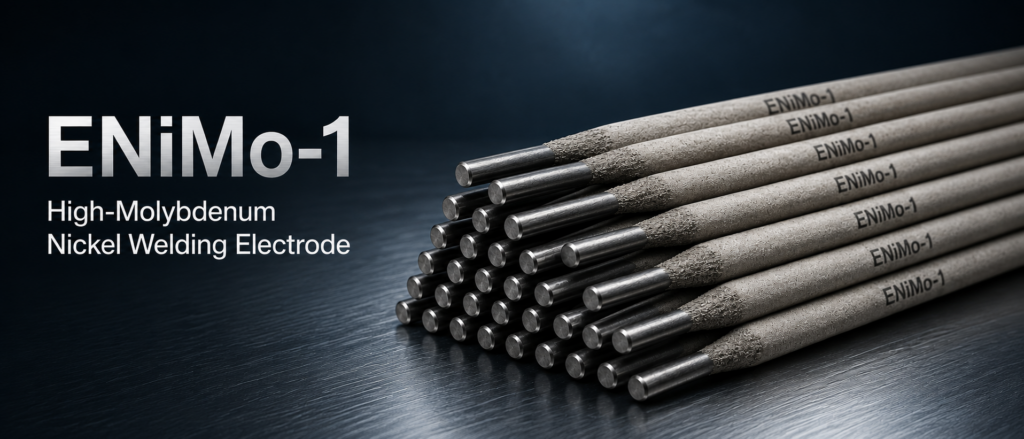
ENiMo-1 High-Molybdenum Nickel Welding Electrode
Industrial equipment used in corrosive environments requires welding consumables that can maintain joint integrity under demanding service conditions. Standard welding electrodes may not provide the chemical compatibility or corrosion resistance needed for nickel-molybdenum alloys.ENiMo-1
The ENiMo-1 high-molybdenum nickel welding electrode is a covered electrode developed for shielded metal arc welding of compatible nickel-molybdenum materials. It is commonly selected for alloy fabrication, clad steel welding, equipment repair, and certain dissimilar-metal joints.
Its nickel-rich weld deposit and high molybdenum content make ENiMo-1 an important consumable for projects involving corrosion-resistant components in chemical processing, industrial maintenance, pressure equipment, and specialized alloy fabrication.
What Is an ENiMo-1 Welding Electrode?
ENiMo-1 is a nickel-molybdenum covered welding electrode designed for shielded metal arc welding, also known as SMAW or stick welding.
The electrode consists of a metallic core wire surrounded by a specially formulated flux coating. During welding, the coating supports arc stability, protects the molten weld pool, and forms a slag layer over the deposited weld metal.
ENiMo-1 weld metal is primarily based on nickel and molybdenum, with a controlled amount of iron and other elements. This composition is designed to match compatible nickel-molybdenum base materials and provide suitable performance in corrosive industrial environments.
Typical uses include:
Welding nickel-molybdenum alloys
Joining compatible nickel-molybdenum components
Welding the alloy side of nickel-molybdenum-clad steel
Joining nickel-molybdenum alloys to selected steels
Joining nickel-molybdenum alloys to other nickel-base materials
Repairing corrosion-resistant industrial equipment
Restoring damaged clad surfaces
Because ENiMo-1 is a covered electrode, it can be used with portable SMAW equipment in fabrication shops, maintenance facilities, and selected field repair locations.
Why Molybdenum Is Important in Nickel Weld Metal
Molybdenum is a key alloying element in many corrosion-resistant nickel materials. A high molybdenum level can help the weld deposit maintain performance in aggressive chemical environments when the electrode is correctly matched to the base material and service conditions.
The combination of nickel and molybdenum provides several important advantages.
Corrosion-Resistant Weld Deposits
ENiMo-1 produces nickel-molybdenum weld metal intended for equipment exposed to corrosive industrial media. The weld deposit can provide better chemical compatibility than ordinary steel electrodes when joining suitable nickel-molybdenum alloys.
Actual corrosion performance depends on several factors, including:
Base-metal composition
Chemical concentration
Operating temperature
Process contamination
Surface condition
Weld-metal dilution
Joint design
Post-weld cleaning
The electrode classification alone does not guarantee performance in every corrosive environment. Material selection should always be based on the complete operating conditions.
Compatibility with Nickel-Molybdenum Alloys
Matching the filler metal to the base alloy is essential when welding corrosion-resistant materials. An unsuitable electrode can change the weld chemistry, reduce corrosion resistance, or create mechanical-property differences across the joint.
ENiMo-1 is formulated to produce a weld deposit compatible with designated nickel-molybdenum base materials.
Support for Clad Steel Fabrication
Nickel-molybdenum-clad steel combines a structural steel backing with a corrosion-resistant alloy surface. This construction can provide mechanical strength while reducing the quantity of expensive alloy material required.
ENiMo-1 can be used to weld or repair the nickel-molybdenum side of compatible clad steel. Careful control of weld-metal dilution is necessary to prevent excessive mixing with the steel backing.
Versatility in Repair Welding
Corrosion-resistant equipment can experience localized damage, erosion, cracking, or surface loss during service. Complete component replacement may be costly and time-consuming.
A qualified ENiMo-1 repair procedure may help restore compatible alloy sections, clad surfaces, and selected dissimilar-metal joints.
Common ENiMo-1 Welding Applications
The ENiMo-1 high-molybdenum nickel welding electrode is mainly used where the weld deposit must be compatible with nickel-molybdenum alloys.
Chemical Processing Equipment
Chemical processing systems may contain reactors, vessels, piping, valves, pumps, and heat-transfer equipment exposed to aggressive media.
ENiMo-1 may be selected for compatible nickel-molybdenum components used in these systems. The exact suitability must be confirmed for the operating chemical, concentration, temperature, and contamination level.
Pressure Vessels and Process Tanks
Process vessels and tanks often require corrosion-resistant internal surfaces. Some designs use nickel-molybdenum alloy plate, while others use clad steel to combine structural strength with corrosion protection.
ENiMo-1 can be used for compatible alloy joints and clad-side welding when supported by an approved welding procedure.
Industrial Piping Systems
Corrosive process piping requires reliable welds at joints, fittings, flanges, branches, and equipment connections.
ENiMo-1 may be used for nickel-molybdenum piping and selected transition joints. Joint preparation, heat input, cleanliness, and interpass control are important for achieving sound welds.
Clad Steel Repair
Damage to a corrosion-resistant clad layer can expose the steel backing to the process medium. ENiMo-1 may be used to rebuild compatible nickel-molybdenum surfaces after the damaged area has been properly prepared.
Repair procedures should control dilution and ensure complete coverage of the exposed steel.
Maintenance of Corrosion-Resistant Equipment
Industrial maintenance teams may use ENiMo-1 for qualified repairs involving:
Vessel linings
Pipe sections
Valve components
Pump parts
Flanges
Nozzles
Clad surfaces
Process equipment connections
The original material must be positively identified before repair welding begins.
Dissimilar-Metal Joints
ENiMo-1 can be considered for selected joints between nickel-molybdenum alloys and steel or other nickel-base materials.
Dissimilar welding requires careful engineering because the two base materials may have different thermal expansion rates, melting behavior, strength levels, and corrosion characteristics.
A qualified procedure should define the joint design, electrode size, amperage, preheat requirements, interpass temperature, and inspection method.
Main Benefits of ENiMo-1 Electrodes
High-Molybdenum Weld Chemistry
The high molybdenum content supports compatibility with designated nickel-molybdenum alloys and helps provide corrosion-resistant weld metal for suitable service environments.
Suitable for SMAW Welding
ENiMo-1 is used with shielded metal arc welding equipment. SMAW is portable, widely available, and practical for fabrication and maintenance work.
The process does not normally require an external shielding-gas supply, which can simplify welding in repair shops and selected field locations.
Useful for Clad-Side Welding
The electrode can be applied to the alloy side of compatible nickel-molybdenum-clad steel. This makes it valuable for vessels, tanks, and other equipment that use corrosion-resistant cladding.
Repair and Maintenance Capability
ENiMo-1 can support localized repairs where damaged nickel-molybdenum welds or clad surfaces must be restored.
Strong Weld Deposits
When used with suitable base materials and a qualified welding procedure, ENiMo-1 can produce sound weld deposits with useful strength and ductility.
Controlled Dissimilar-Metal Joining
The electrode may be used for selected nickel-molybdenum-to-steel and nickel-alloy combinations, subject to engineering approval.
How to Weld with ENiMo-1 Electrodes
Nickel-alloy welding requires disciplined preparation and technique. Contamination, excessive heat input, poor slag removal, or incorrect electrode storage can reduce weld quality.
Confirm the Base Material
Do not select ENiMo-1 based only on the appearance of the component. Different nickel alloys can look similar but require different filler metals.
Review the material certificate, equipment drawing, or positive material identification results before welding.
ENiMo-1 Clean the Joint Thoroughly
Remove all contaminants from the joint and surrounding area, including:
Oil
Grease
Moisture
Paint
Rust
Oxides
Dirt
Cutting residue
Marking compounds
Use clean tools that have not been contaminated by carbon steel. Dedicated stainless-steel brushes and clean grinding equipment are commonly used for nickel-alloy preparation.
Keep the Electrode Dry
Moisture in the flux coating can contribute to porosity, unstable arc behavior, and other welding defects.
Store unopened packages in a dry area. After opening, place the electrodes in suitable heated storage when required by the welding procedure or storage instructions.
Do not use electrodes with cracked, chipped, or excessively damaged coatings.
Use the Correct Polarity
The required welding current and polarity should be confirmed from the applicable electrode data and qualified welding procedure.
Using the wrong polarity may produce:
Unstable arc behavior
Excessive spatter
Poor bead shape
Incomplete fusion
Difficult slag removal
Excessive electrode heating
Maintain a Short Arc
A short, controlled arc helps limit atmospheric contamination and improves control of the molten weld pool.
An excessively long arc can increase spatter, oxidation, porosity risk, and irregular bead shape.
Control Heat Input
Excessive heat input can increase weld-metal dilution, distortion, and heat-affected-zone size. It may also make the weld pool more difficult to control.
Use the recommended amperage, travel speed, bead size, and interpass temperature.
Use Controlled Bead Placement
Stringer beads or limited weaving are often preferred for nickel-alloy welding. Excessively wide weave beads can increase heat input and reduce control of the weld pool.
The maximum permitted weave width should be defined in the welding procedure.
Clean Every Pass
Slag must be completely removed before depositing the next weld bead.
Pay close attention to:
Bead edges
Joint sidewalls
Craters
Starts and stops
Narrow grooves
Overlapping weld areas
Incomplete slag removal can cause inclusions and reduce weld integrity.
Fill the Arc Crater
Before breaking the arc, fill the crater to reduce the risk of crater cracking. Any defective start or stop area should be removed before continuing the weld.
ENiMo-1 Welding Position and Joint Design
ENiMo-1 is commonly associated with flat-position welding applications. Position capability may vary according to electrode size, product formulation, and procedure qualification.
The welding position should therefore be confirmed before production begins.
Joint designs should provide:
Adequate access for the electrode
Sufficient groove angle
Controlled root opening
Complete fusion at the sidewalls
Space for slag removal
Suitable access for inspection
For clad steel, the procedure must also prevent excessive penetration into the steel backing.
How to Select an ENiMo-1 Welding Electrode
Selecting the correct electrode requires more than matching the classification name.
Verify the Electrode Classification
Confirm that the product is classified as ENiMo-1 and is suitable for the required welding process.
ENiMo-1 Review Chemical Composition
Check the deposited weld-metal chemistry against the project specification and base-metal requirements.
Important elements may include:
Nickel
Molybdenum
Iron
Carbon
Silicon
Manganese
Copper
Chromium
Cobalt
Other controlled residual elements
Check Mechanical Properties
Review the required tensile strength, elongation, and other mechanical properties.
Critical equipment may also require additional testing based on design temperature and service conditions.
Select the Correct Diameter
Electrode diameter influences heat input, deposition rate, accessibility, and weld-pool control.
Smaller diameters may be preferred for:
Thin material
Root passes
Confined joints
Controlled heat input
Repair welding
Larger diameters may improve deposition rates in suitable flat-position applications.
ENiMo-1 Confirm Current Range
Each electrode diameter has a recommended amperage range. Excessive current may cause overheating, undercut, and excessive penetration. Insufficient current may cause poor fusion, unstable arc behavior, and slag inclusions.
Evaluate Packaging
Choose electrodes supplied in sealed, moisture-resistant packaging. The package should clearly show the classification, diameter, batch identification, and storage requirements.
ENiMo-1 Review Quality Documentation
Industrial customers may require:
Chemical analysis
Mechanical test results
Batch certificates
Manufacturing traceability
Inspection records
Classification compliance
Packaging identification
Documentation requirements should be confirmed before ordering.
ENiMo-1 Electrode Storage and Handling
Proper storage helps preserve flux-coating integrity and stable welding performance.
Recommended practices include:
Store electrodes in a clean, dry location
Keep packages away from floors and exterior walls
Protect opened electrodes from humidity
Use suitable heated storage when required
Follow approved reconditioning instructions
Avoid mixing different classifications or batch numbers
Return unused electrodes to controlled storage
Discard electrodes with severely damaged coatings
Maintain batch traceability for critical projects
Electrodes should not be re-dried at an arbitrary temperature. Excessive heating may damage the flux coating and change electrode performance.
Common ENiMo-1 Welding Problems
Porosity
Possible causes include moisture, contaminated base material, excessive arc length, poor joint cleaning, or incorrect welding parameters.
ENiMo-1 Slag Inclusions
Slag inclusions can result from incomplete cleaning, narrow joint geometry, low amperage, poor bead placement, or incorrect electrode angle.
Incomplete Fusion
Possible causes include insufficient heat input, excessive travel speed, poor joint preparation, or incorrect electrode manipulation.
Crater Cracking
Crater cracks may form when the arc is stopped without properly filling the end of the weld bead.
Excessive Dilution
In clad steel welding, excessive penetration into the steel backing can change the weld-metal chemistry. Heat input and bead placement must be carefully controlled.
Irregular Bead Shape
An unstable arc, incorrect current, excessive weaving, or poor electrode angle can produce an uneven weld profile.
Inspection of ENiMo-1 Welds
Inspection requirements depend on the equipment design, applicable code, service environment, and project specification.
Common inspection methods include:
Visual testing
Liquid penetrant testing
Radiographic testing
Ultrasonic testing
Leak testing
Pressure testing
Chemical composition verification
Visual inspection should evaluate bead shape, undercut, cracks, overlap, porosity, arc strikes, crater condition, and surface cleanliness.
For corrosion-resistant welds, the final surface condition can be as important as the internal soundness of the joint.
ENiMo-1 Conclusion
The ENiMo-1 high-molybdenum nickel welding electrode is a specialized SMAW consumable for joining compatible nickel-molybdenum alloys, welding clad steel surfaces, completing selected dissimilar-metal joints, and repairing corrosion-resistant industrial equipment.
Its nickel-molybdenum weld chemistry makes it valuable for chemical processing systems, pressure vessels, tanks, piping, pumps, valves, and other equipment operating in demanding environments.
Successful welding depends on correct base-metal identification, clean joint preparation, dry electrode storage, controlled heat input, complete slag removal, appropriate welding position, and qualified inspection procedures.
By matching ENiMo-1 to the correct base material and following an approved welding procedure, fabricators can produce strong, clean, and corrosion-resistant welds for specialized industrial applications.