

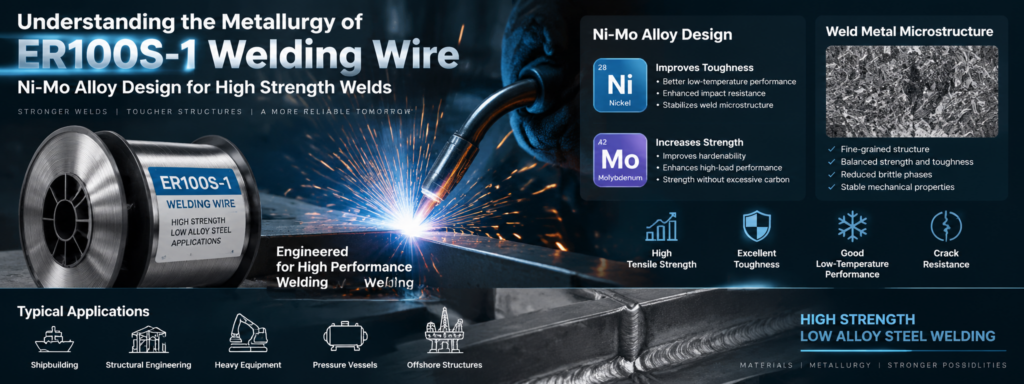
Understanding the Metallurgy of ER100S-1 Welding Wire: Ni-Mo Alloy Design for High Strength Welds
Introduction: Why Metallurgy Matters in ER100S-1 Welding Wire
High-strength steel welding requires more than simply achieving a strong weld deposit. The weld metal must provide a balanced combination of high tensile strength, toughness, crack resistance, and reliable performance under demanding service conditions.ER100S-1
It welding wire is designed for high-strength low-alloy (HSLA) steel applications where weld integrity is critical. Its performance is mainly achieved through carefully controlled alloy chemistry, particularly the optimized addition of nickel (Ni) and molybdenum (Mo). These alloying elements work together to improve hardenability, refine microstructure, and maintain toughness in high-strength weld deposits.
Understanding the metallurgy behind ER100S-1 helps engineers select suitable welding materials, optimize welding procedures, and prevent common problems such as cold cracking and toughness degradation.
1. What Is ER100S-1 Welding Wire?
ER100S-1 is an AWS A5.28 classified solid welding wire developed for welding high-strength low-alloy steels. It is commonly used in applications requiring weld metal strength around the 100 ksi tensile strength level.
Typical applications include:
Heavy structural fabrication
High-strength machinery
Pressure-containing structures
Shipbuilding components
Offshore equipment
Critical load-bearing assemblies
The wire is mainly applied through GMAW (Gas Metal Arc Welding) and related welding processes where consistent mechanical properties and weld quality are required.
The key metallurgical feature of ER100S-1 is its Ni-Mo alloy design, which enables high strength without sacrificing low-temperature toughness.
2. The Role of Nickel in ER100S-1 Alloy Design
Nickel is one of the most important alloying elements in ER100S-1.
2.1 Improving Low-Temperature Toughness
A major challenge for high-strength weld metals is maintaining toughness after increasing strength.
Nickel improves:
Impact resistance
Crack tolerance
Low-temperature ductility
Unlike some strengthening elements that can increase brittleness, nickel helps maintain a tougher weld metal structure.
This is particularly important for structures exposed to:
Cold environments
Dynamic loading
Impact conditions
ER100S-1 weld deposits are designed to retain good toughness at low temperatures because of controlled alloy additions including nickel.
2.2 Stabilizing Weld Microstructure
During welding, molten metal experiences:
Rapid melting
Solidification
Cooling transformation
Nickel influences the transformation behavior of the weld metal by promoting a more favorable balance between strength and toughness.
A properly controlled nickel content helps achieve:
Fine-grained microstructure
Improved toughness
Reduced brittle phase formation
3. The Role of Molybdenum in ER100S-1 Weld Metal
Molybdenum is another key element in ER100S-1 metallurgy.
Its primary function is strengthening and hardenability improvement.
3.1 Increasing Hardenability
High-strength steels require sufficient hardening capability during cooling.
Molybdenum improves:
Transformation resistance
Weld metal strength
High-load performance
By delaying undesirable transformations, molybdenum helps form stronger microstructures after welding.
3.2 Enhancing Strength Without Excessive Carbon
One challenge in high-strength welding is that increasing carbon can increase strength but also increases cracking risk.
Instead, ER100S-1 uses alloy strengthening mechanisms such as:
Nickel strengthening
Molybdenum strengthening
Manganese strengthening
This approach provides high mechanical performance while maintaining better weldability.
4. Ni-Mo Alloy Design and Weld Microstructure Control
The mechanical performance of ER100S-1 depends heavily on the final weld microstructure.
Typical high-strength weld metals aim to achieve controlled structures such as:
Fine-grained ferritic structures
Acicular ferrite components
Low-carbon strengthened matrix
A refined microstructure provides:
| Metallurgical Feature | Effect on Performance |
|---|---|
| Fine grain size | Higher strength and toughness |
| Controlled alloy distribution | Stable mechanical properties |
| Reduced brittle phases | Better crack resistance |
| Balanced Ni-Mo addition | Strength-toughness combination |
The relationship between alloy chemistry and microstructure is the foundation of ER100S-1 performance.
5. How ER100S-1 Achieves High Strength
The strength of ER100S-1 weld metal comes from several strengthening mechanisms.
5.1 Solid Solution Strengthening
Elements such as:
Ni
Mo
Mn
increase lattice resistance and improve yield strength.
5.2 Grain Refinement
Smaller grains improve both:
Strength
Impact toughness
This is especially important because high-strength welding materials must avoid the traditional trade-off between strength and toughness.
5.3 Transformation Strengthening
During cooling, alloying elements influence phase transformation behavior.
Controlled transformation produces a weld structure capable of supporting high stresses.
6. ER100S-1 and Cold Cracking Resistance
Cold cracking is one of the biggest concerns when welding high-strength steels.
It is influenced by:
Hydrogen level
Weld hardness
Residual stress
Cooling rate
Base metal composition
The Ni-Mo alloy design of ER100S-1 helps reduce cracking sensitivity by providing:
Controlled weld hardness
Improved toughness
Better resistance to hydrogen-assisted cracking
However, proper welding procedures remain essential, including:
Preheating when required
Controlling heat input
Maintaining suitable interpass temperature
Using clean welding conditions
7. Heat Input and Metallurgical Stability During Welding
Even with optimized alloy chemistry, welding parameters strongly affect ER100S-1 performance.
Important variables include:
Heat Input
Excessive heat input may cause:
Grain coarsening
Reduced toughness
Lower strength
Cooling Rate
Too rapid cooling may increase:
Hard microstructures
Crack sensitivity
Too slow cooling may reduce:
Strength
Microstructural refinement
Therefore, ER100S-1 welding procedures must balance strength development and toughness retention.
8. ER100S-1 Applications Where Metallurgy Is Critical
Because of its strength-toughness balance, ER100S-1 is suitable for demanding applications such as:
Heavy Equipment
Components exposed to:
High mechanical loads
Repeated stress
Impact conditions
Structural Engineering
Used where:
High yield strength
Reduced weight design
Structural reliability
are required.
Offshore and Marine Fabrication
Requires:
Low-temperature toughness
Crack resistance
Long-term durability
9. Why Ni-Mo Alloy Design Makes ER100S-1 Different
The main advantage of ER100S-1 is not simply achieving high strength.
The real challenge is achieving:
High strength + excellent toughness + reliable weldability
The Ni-Mo alloy system provides:
Nickel → toughness improvement
Molybdenum → strength and hardenability improvement
Controlled carbon → improved weldability
Balanced alloy chemistry → stable weld performance
This combination allows ER100S-1 to meet the requirements of modern high-strength steel fabrication.
Conclusion
ER100S-1 welding wire represents a carefully engineered Ni-Mo alloy system designed for high-strength steel welding applications. Its performance comes from controlled metallurgy rather than simple alloy strengthening.
The combination of nickel and molybdenum provides a balanced weld metal structure with:
High tensile strength
Improved impact toughness
Better crack resistance
Reliable performance in critical applications
For engineers working with HSLA steels, understanding the metallurgy of ER100S-1 is essential for selecting welding materials, optimizing procedures, and achieving durable high-performance welds.