
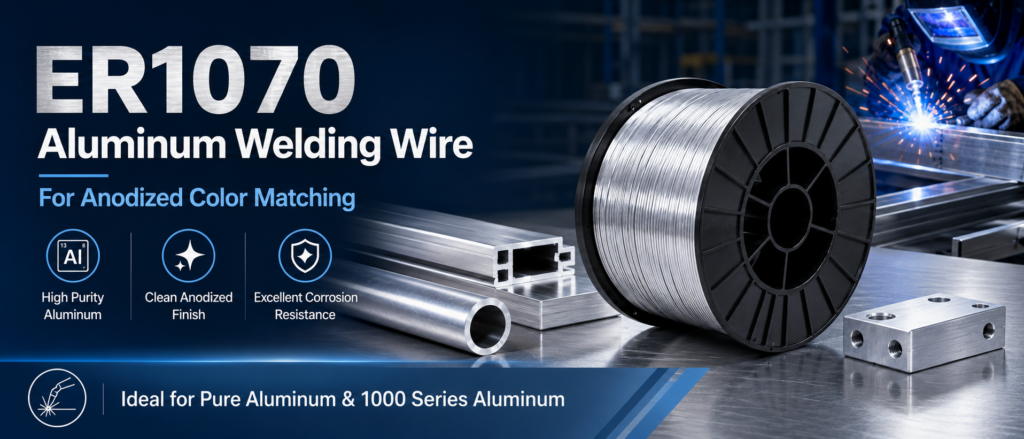
ER1070 Aluminum Welding Wire for Anodized Color Matching
When welding aluminum parts that will be anodized after fabrication, filler metal selection becomes much more important than many people expect. A weld may look clean before surface treatment, but after anodizing, the welded area can appear darker, lighter, gray, or visually inconsistent with the surrounding base metal. For manufacturers who care about surface appearance, color consistency, corrosion resistance, and final product quality, ER1070 aluminum welding wire is a practical choice for anodized color matching.
ER1070 aluminum welding wire is a high-purity aluminum filler metal commonly used for welding commercially pure aluminum and 1000 series aluminum alloys. Because of its high aluminum content and low alloying element level, ER1070 can provide a cleaner visual match after anodizing compared with many alloyed aluminum filler metals. This makes it especially useful for applications where the final surface finish matters as much as weld performance.
What Is ER1070 Aluminum Welding Wire?
ER1070 is a pure aluminum welding wire with an aluminum content of approximately 99.7%. It is designed for welding pure aluminum and compatible aluminum base materials where good corrosion resistance, electrical conductivity, thermal conductivity, and surface finish are important.
This filler metal is commonly used in MIG welding and can also be supplied in suitable forms for TIG welding applications. It is often selected for 1000 series aluminum, electrical components, aluminum sheets, busbars, chemical equipment, decorative parts, and products that require post-weld anodizing.
The key advantage of ER1070 aluminum welding wire is its simple and clean chemical composition. Since anodizing reacts with the surface of aluminum, the filler metal composition can directly affect the final color of the weld area. A filler wire with high silicon, magnesium, or other alloying elements may create a visible color difference after anodizing. ER1070 helps reduce this risk when used with compatible base metals.
Why Anodized Color Matching Matters
Anodizing is widely used to improve aluminum surface hardness, corrosion resistance, wear resistance, and appearance. It creates a controlled oxide layer on the aluminum surface, which can be clear, natural, or dyed in different colors.
However, the anodized appearance is not determined by the base metal alone. The weld metal also reacts during anodizing. If the filler metal has a different chemical composition from the base material, the welded area may absorb dye differently or form an oxide layer with a different shade.
This issue is especially noticeable in products where the weld remains visible after finishing. Examples include architectural aluminum profiles, decorative aluminum panels, lighting housings, electronic enclosures, furniture frames, railings, display fixtures, and precision aluminum components.
For these products, a weld that is mechanically acceptable may still be rejected if the anodized surface looks uneven. Choosing ER1070 aluminum welding wire helps improve visual consistency when welding suitable pure aluminum or 1000 series aluminum materials.
How ER1070 Helps Improve Anodized Color Matching
The main reason ER1070 performs well in anodized color matching is its high-purity aluminum composition. Because it contains fewer alloying elements, the weld metal is closer in appearance and anodizing behavior to pure aluminum base materials.
When the filler metal and base metal are more chemically similar, the anodized weld area is more likely to show a cleaner and more uniform finish. This does not mean every weld will become completely invisible after anodizing, because welding parameters, surface preparation, base alloy, anodizing process, and cleaning quality also matter. However, ER1070 gives fabricators a better starting point for achieving a more consistent final appearance.
Compared with many alloyed aluminum welding wires, ER1070 can help reduce problems such as dark weld lines, gray discoloration, uneven dye absorption, and strong visual contrast between the weld bead and base metal.
Main Benefits of ER1070 Aluminum Welding Wire
ER1070 aluminum welding wire offers several benefits for applications that require both welding quality and attractive surface finishing.
First, it provides excellent color matching potential after anodizing when used with suitable base metals. This is one of the most important reasons manufacturers choose ER1070 for decorative and visible aluminum parts.
Second, it offers strong corrosion resistance. Pure aluminum has excellent resistance to atmospheric and chemical corrosion, making ER1070 suitable for many industrial and architectural environments.
Third, ER1070 has good electrical and thermal conductivity. This makes it useful for electrical components, conductive aluminum parts, heat transfer components, and applications where conductivity matters.
Fourth, it produces a clean weld appearance when proper welding procedures are used. Stable wire feeding, suitable shielding gas, clean base material, and correct heat input can help create smooth weld beads and reduce post-weld finishing work.
Finally, ER1070 is a good choice for fabricators who need a filler metal that supports both functional welding and high-quality anodized finishing.
Common Applications of ER1070 Aluminum Welding Wire
ER1070 aluminum welding wire is widely used in industries where pure aluminum welding and surface appearance are important. Common applications include:
Electrical busbars and conductive aluminum components
Aluminum sheets and plates made from 1000 series alloys
Chemical and food processing equipment
Decorative aluminum products
Architectural aluminum structures
Lighting housings and display frames
Electronic enclosures and panels
Aluminum heat transfer components
Anodized aluminum parts requiring better color consistency
For these applications, the final surface is often visible to customers or end users. Using the right filler metal can help reduce quality issues during finishing and improve the overall appearance of the final product.
ER1070 vs Other Aluminum Welding Wires for Anodizing
Not every aluminum welding wire is ideal for anodized color matching. Some filler metals are designed for strength, crack resistance, or general fabrication, but they may not provide the best appearance after anodizing.
For example, aluminum-silicon filler metals may offer good weldability and crack resistance, but the silicon content can cause the weld area to appear darker after anodizing. Aluminum-magnesium filler metals may provide higher strength, but they can also create a different shade compared with pure aluminum base materials.
ER1070 is not selected mainly for high strength. It is selected when purity, corrosion resistance, conductivity, and anodized appearance are key priorities. For pure aluminum and compatible 1000 series aluminum alloys, ER1070 is often a better option when color matching is a major requirement.
The best filler metal still depends on the base material, joint design, mechanical requirements, and finishing process. For projects where strength is the main concern, another aluminum filler may be more suitable. For projects where anodized appearance is critical, ER1070 deserves serious consideration.
Welding Tips for Better Anodized Results
To get the best performance from ER1070 aluminum welding wire, the entire welding and finishing process must be controlled carefully.
Clean the aluminum surface before welding. Oil, oxide, moisture, and dust can affect weld quality and final anodized appearance. Use proper cleaning methods before welding and avoid contamination during handling.
Use the correct shielding gas. High-purity argon is commonly used for aluminum welding. Stable shielding helps protect the molten weld pool and improves weld appearance.
Control heat input. Excessive heat can affect bead shape, distortion, and surface quality. Proper welding parameters help produce a smoother weld and reduce unnecessary finishing.
Match the filler wire to the base alloy. ER1070 is best used with compatible pure aluminum and 1000 series aluminum materials. Always confirm compatibility before production.
Test before mass production. For anodized products, sample welding and anodizing tests are strongly recommended. A small trial can help confirm whether the weld color meets the final appearance requirement.
Why Choose ER1070 for Anodized Aluminum Products?
If your aluminum product will be anodized and the weld area will remain visible, filler metal choice can directly affect the final appearance. ER1070 aluminum welding wire is a smart option for fabricators who need better color matching on pure aluminum and 1000 series aluminum welds.
Its high-purity composition helps reduce visual contrast after anodizing. Its corrosion resistance and conductivity make it suitable for both decorative and functional aluminum products. For manufacturers producing architectural parts, electrical components, decorative structures, or precision aluminum products, ER1070 can help improve finishing quality and reduce the risk of visible weld discoloration.
FAQ About ER1070 Aluminum Welding Wire
Is ER1070 aluminum welding wire good for anodized color matching?
Yes. ER1070 is a high-purity aluminum welding wire, making it suitable for anodized color matching on compatible pure aluminum and 1000 series aluminum base metals.
What aluminum alloys can ER1070 weld?
ER1070 is mainly used for commercially pure aluminum and 1000 series aluminum alloys. Compatibility should always be checked based on the base material and project requirements.
Why does the weld color change after anodizing?
Weld color can change after anodizing because the filler metal may have a different chemical composition from the base metal. Different alloying elements can react differently during anodizing and create visible color variation.
Is ER1070 stronger than other aluminum welding wires?
ER1070 is not primarily chosen for high strength. It is chosen for high purity, corrosion resistance, conductivity, and better anodized appearance on compatible materials.
Can ER1070 be used for MIG and TIG welding?
Yes. ER1070 can be used for aluminum MIG welding and can also be supplied in suitable forms for TIG welding applications.
Conclusion
ER1070 aluminum welding wire is an excellent choice for applications where anodized color matching, surface quality, corrosion resistance, and conductivity are important. Its high-purity aluminum composition helps create a cleaner and more consistent appearance after anodizing when used with suitable base materials.
For manufacturers working with pure aluminum or 1000 series aluminum products, ER1070 provides a reliable solution for visible welds, decorative aluminum parts, electrical components, and anodized aluminum structures. When appearance and performance both matter, ER1070 aluminum welding wire offers a strong balance of weldability, purity, and finishing quality.