
ER1100 Aluminum Welding Wire with Smooth Feeding: A Reliable Choice for Clean Aluminum Welding
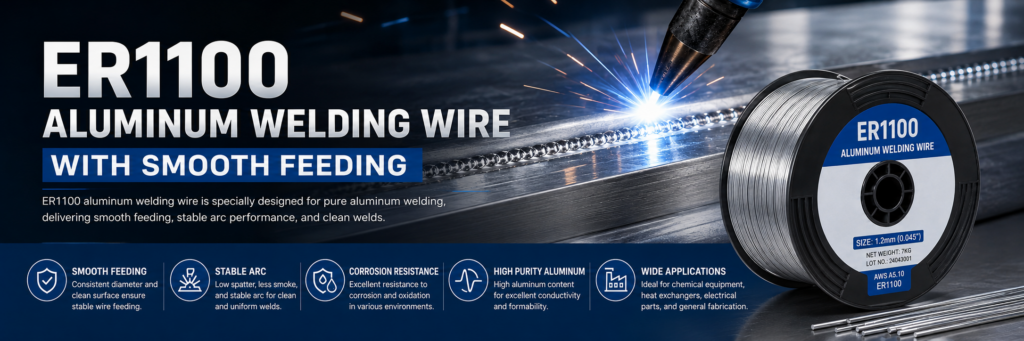
When welding pure aluminum or aluminum alloys that require excellent corrosion resistance and clean weld appearance, ER1100 aluminum welding wire is a dependable filler metal choice. Known for its high aluminum content, stable arc performance, and smooth wire feeding, ER1100 is widely used in applications where weld quality, surface finish, and process stability matter.
For manufacturers, fabricators, and welding professionals, smooth feeding is more than a convenience. It directly affects arc stability, weld bead consistency, production efficiency, and the final appearance of the welded part. ER1100 aluminum welding wire with smooth feeding helps reduce common problems such as wire birdnesting, unstable arcs, excessive spatter, and inconsistent weld beads.
What Is ER1100 Aluminum Welding Wire?
ER1100 is a commercially pure aluminum welding wire commonly used for welding 1100 series aluminum and other compatible aluminum base metals. It offers excellent corrosion resistance, good electrical conductivity, and strong resistance to chemical environments. Because of these properties, ER1100 aluminum welding wire is often selected for applications that require a clean, bright weld surface and reliable performance.
Unlike higher-strength aluminum filler metals, ER1100 is mainly valued for its purity, ductility, corrosion resistance, and smooth weldability. It is suitable for welding applications where strength is not the only priority and where appearance, formability, and corrosion protection are important.
Why Smooth Feeding Matters in Aluminum Welding
Aluminum wire is softer than steel wire, which means feeding performance is especially important. Poor wire feeding can lead to arc interruption, burnback, irregular weld beads, and downtime during production. A high-quality ER1100 aluminum welding wire should be carefully manufactured, evenly wound, and clean on the surface to ensure stable feeding through welding equipment.
Smooth feeding provides several advantages:
It helps maintain a stable arc during welding.
It reduces wire feeding resistance and interruption.
It improves weld bead uniformity and surface appearance.
It lowers the risk of wire tangling and birdnesting.
It supports consistent welding performance in continuous production.
For automated welding, robotic welding, and high-efficiency fabrication, smooth feeding becomes even more important. Stable wire delivery allows the welding process to remain consistent from start to finish.
Key Features of ER1100 Aluminum Welding Wire
ER1100 aluminum welding wire is designed for clean and stable aluminum welding. Its main features include:
Excellent corrosion resistance
ER1100 performs well in environments where corrosion resistance is required, making it suitable for aluminum structures exposed to moisture, chemicals, or outdoor conditions.
Smooth and stable feeding
A well-produced ER1100 wire offers consistent diameter, clean surface quality, and uniform spooling, helping improve welding efficiency.
Clean weld appearance
The wire produces bright, smooth weld beads with good visual quality, which is important for visible aluminum components.
Good electrical and thermal conductivity
Because of its high aluminum content, ER1100 is suitable for applications where conductivity is a key requirement.
Low spatter and stable arc performance
With proper welding parameters, ER1100 aluminum welding wire can provide a stable arc and clean welding process.
Common Applications of ER1100 Aluminum Welding Wire
ER1100 aluminum welding wire is widely used in industries that require pure aluminum welding, corrosion resistance, and attractive weld appearance. Typical applications include:
Chemical equipment and storage tanks
Heat exchangers and aluminum piping
Food processing equipment
Electrical components and conductive parts
Decorative aluminum products
Aluminum sheets and thin plates
General fabrication of pure aluminum structures
Because ER1100 offers good ductility and corrosion resistance, it is especially suitable for applications where the welded part may need forming, bending, or long-term exposure to corrosive environments.
ER1100 Welding Wire for MIG and TIG Welding
ER1100 aluminum welding wire can be used in both MIG welding and TIG welding, depending on the form of the filler metal and the welding requirements. In MIG welding, smooth feeding is essential because aluminum wire must travel through the feeding system without distortion or interruption. In TIG welding, clean wire surface and consistent composition help produce high-quality welds with excellent appearance.
For best results, welders should use proper shielding gas, clean the base metal before welding, and select suitable welding parameters according to material thickness and joint design. Aluminum surfaces are easily affected by oxide layers and contamination, so preparation plays an important role in final weld quality.
How to Improve Welding Results with ER1100 Aluminum Wire
To achieve better welding performance with ER1100 aluminum welding wire, several factors should be controlled carefully:
First, keep the wire clean and dry before use. Aluminum wire can be affected by moisture, dust, and surface contamination, which may reduce weld quality.
Second, use the correct feeding system. For MIG welding, a suitable liner, drive roll, and contact tip can help protect the soft aluminum wire and maintain smooth feeding.
Third, clean the aluminum base metal before welding. Removing oil, dirt, and oxide layers helps improve arc stability and weld penetration.
Fourth, choose proper welding parameters. Excessive heat may cause burn-through on thin aluminum, while insufficient heat may lead to poor fusion.
Finally, store the wire properly. Good packaging and dry storage conditions help preserve the surface quality of the wire and support consistent welding performance.
Why Choose ER1100 Aluminum Welding Wire with Smooth Feeding?
A reliable ER1100 aluminum welding wire should not only meet basic chemical requirements but also perform well during actual welding. Smooth feeding, stable arc performance, clean surface quality, and uniform diameter are all important for professional welding results.
For production environments, smooth feeding can reduce machine stoppage and improve welding efficiency. For manual welding, it helps welders maintain better control of the arc and produce cleaner weld beads. For visible aluminum products, ER1100 can help create a bright and attractive weld finish.
Conclusion
ER1100 aluminum welding wire with smooth feeding is a practical solution for welding pure aluminum and compatible aluminum materials. With excellent corrosion resistance, clean weld appearance, stable arc performance, and reliable feeding behavior, it is suitable for a wide range of aluminum fabrication applications.
For users who need consistent aluminum welding performance, ER1100 offers a strong balance of weldability, surface quality, and process stability. Whether used in general fabrication, chemical equipment, electrical parts, or decorative aluminum products, ER1100 aluminum welding wire is a dependable choice for clean and efficient aluminum welding.