

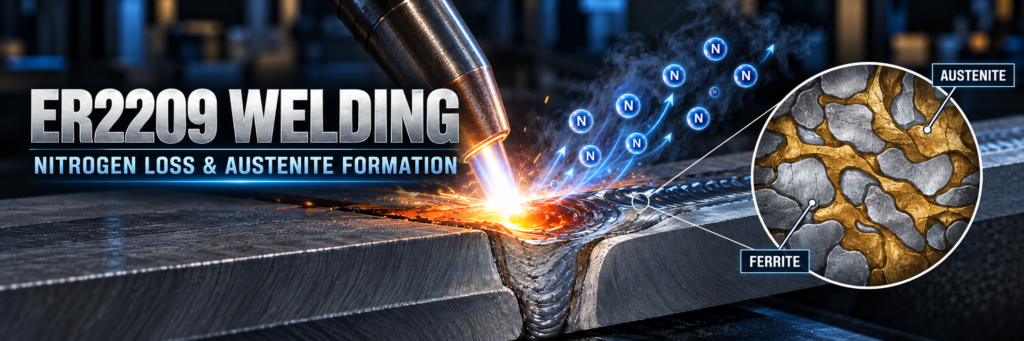
Nitrogen Loss During ER2209 Welding: Effects on Austenite Formation
ER2209 filler metal is commonly used to weld 22% chromium duplex stainless steels such as 2205. Its weld metal must develop a suitable balance of ferrite and austenite to meet the joint’s mechanical and corrosion requirements. Nitrogen is central to that balance: it promotes austenite formation, but some nitrogen can escape from the weld pool during welding.
Understanding nitrogen loss helps explain why ER2209 welds can show excess ferrite, chromium nitride precipitation, or reduced corrosion performance. The outcome depends on the full welding procedure, including filler metal, shielding and backing gas, heat input, and cooling conditions.
Why nitrogen matters in ER2209 weld metal
Duplex stainless steel contains both ferrite and austenite. During welding, the molten metal generally solidifies first as ferrite. As the weld cools, some ferrite transforms into austenite. Nitrogen supports that transformation and helps stabilize the austenitic phase.
ER2209 wire contains nitrogen and is alloyed for duplex welding, but the wire’s nominal composition does not guarantee that the deposited weld will retain the same nitrogen content. Base-metal dilution, shielding conditions, and the welding thermal cycle all influence the final weld-metal chemistry and microstructure.
How nitrogen loss affects austenite formation
If nitrogen escapes from the weld pool, less remains available to support austenite formation during cooling. The resulting weld may contain a higher ferrite fraction than intended. A ferrite-rich structure can also make nitrogen availability uneven: nitrogen has limited solubility in ferrite, which can encourage chromium nitride precipitation under certain conditions.
These changes matter because phase balance and precipitation can affect toughness and localized corrosion resistance. The effect is not determined by nitrogen content alone; the weld’s chemistry, cooling history, and microstructure all contribute.
What can cause nitrogen loss?
Several conditions can influence nitrogen retention:
- Shielding and backing gas: Gas composition affects the weld pool environment. A study of ER2209 GTAW joints found that nitrogen-containing backing gas influenced weld microstructure and pitting behavior. Results from a specific process and setup should not be treated as a universal gas recipe.
- Heat input and cooling rate: A faster thermal cycle can limit the time available for ferrite-to-austenite transformation. Excessive heat input can create other metallurgical risks, so simply increasing heat input is not a reliable fix.
- Joint design and root protection: The root pass may experience different shielding conditions from the face of the weld. Inadequate purging can affect root-side chemistry and corrosion performance.
- Dilution and pass sequence: Mixing with the base metal changes the deposited chemistry, while later passes reheat earlier weld metal and alter its microstructure.
Duplex welding guidance treats heat input as a balance: cooling too quickly can leave excessive ferrite, while an unsuitable thermal cycle can increase the risk of harmful phase formation.
ER2209 Can nitrogen in the shielding gas prevent the problem?
Nitrogen-bearing shielding or backing gas can be considered in some duplex welding procedures, but it should not be added automatically. In a study using ER2209 GTAW, nitrogen in the backing gas changed the weld’s phase structure and pitting response. Separate research on duplex welds also reported that nitrogen-supplemented shielding gas promoted austenite formation and suppressed chromium nitride precipitation under the tested conditions.
Those results do not establish one gas mixture for every ER2209 application. The appropriate gas depends on the welding process, joint configuration, equipment, base metal, and qualified welding procedure. Changes to shielding or backing gas should be assessed through procedure qualification and the required weld tests.
ER2209 How to control nitrogen loss in production
Start with the approved welding procedure specification. Confirm that the ER2209 classification, shielding and backing gases, joint preparation, heat input limits, interpass controls, and pass sequence match the job requirements.
Maintain effective gas coverage, especially at the root. Keep joint surfaces clean, protect the purge from air ingress, and use consistent starts, stops, and travel speed. Record actual welding parameters so changes in heat input or interpass temperature can be traced to test results.
Avoid using a single ferrite measurement as proof of overall weld quality. Ferrite testing can help assess phase balance, but it does not independently confirm nitrogen content, corrosion resistance, or the absence of detrimental precipitates. Use the inspection and testing methods required by the applicable specification and project.
ER2209 How to verify austenite formation and weld performance
A qualified assessment may combine ferrite measurement with metallographic examination and corrosion testing. Where nitrogen loss or root-side performance is a concern, representative test coupons should reproduce the production process, joint geometry, shielding conditions, and pass sequence.
The goal is to verify the complete weld procedure, not just the filler metal. A procedure that produces acceptable phase balance and corrosion behavior in a representative test provides stronger evidence than adjusting gas or heat input based on assumptions.
ER2209 Key takeaways
Nitrogen helps ER2209 weld metal form austenite as it cools. Nitrogen loss can shift the weld toward excess ferrite and, under some conditions, contribute to chromium nitride precipitation. Shielding and backing gas, heat input, cooling rate, dilution, and pass sequence all influence the result.
Control these variables through a qualified procedure, then verify the weld using the tests required for its service conditions. Nitrogen-bearing gas may be beneficial in some setups, but its use should be validated for the specific process and joint.