

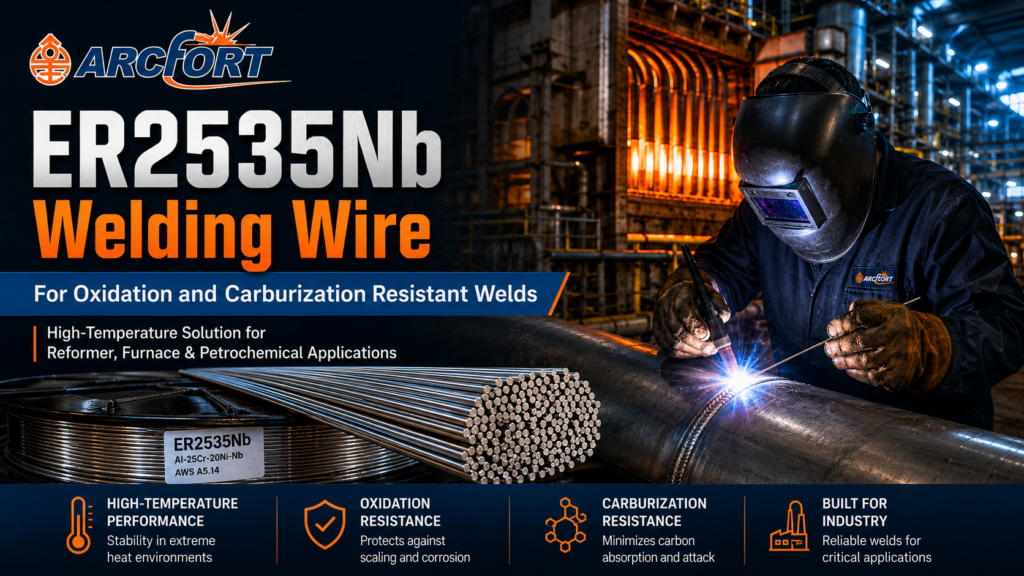
ER2535Nb Welding Wire for Oxidation and Carburization Resistant Welds
ER2535Nb welding wire is a high-temperature filler metal developed for joining and surfacing heat-resistant chromium-nickel cast steels used in petrochemical, furnace, reformer and thermal-processing equipment. In demanding environments where welds must resist oxidation, carburization, creep and thermal fatigue, ER2535Nb provides a reliable weld deposit with a balanced 25Cr-35Ni-Nb alloy system.
The alloy is commonly associated with 25/35 Nb welding wire, 2535Nb TIG rod, and W.Nr. 1.4853. It is used for similar and matching heat-resistant CrNi cast steels such as 1.4848, 1.4852 and 1.4857, especially in reforming ovens and centrifugal or mould-cast furnace components.
What Is ER2535Nb Welding Wire?
ER2535Nb is a high-carbon, niobium-stabilized chromium-nickel welding wire designed for high-temperature service. The “25/35” designation refers to the approximate chromium and nickel content of the weld metal, while “Nb” indicates niobium addition.
A typical 2535Nb weld deposit contains approximately 25% chromium, 35% nickel and about 1% niobium, with carbon intentionally present to support high-temperature creep strength. Publicly listed chemistry ranges for 2535Nb include nickel around 32–37%, chromium around 24–27%, niobium around 0.7–1.5%, and carbon around 0.35–0.45%, with iron as balance. (NiWire)
This chemistry makes ER2535Nb suitable for welds exposed to high heat, carbon-rich atmospheres and long-term service in industrial furnaces.
Why ER2535Nb Is Used for Oxidation and Carburization Resistant Welds
High-temperature equipment in petrochemical and furnace service often operates under severe thermal and chemical stress. Welds may be exposed to oxidizing gases, carburizing atmospheres, thermal cycling and creep loading. Standard stainless filler metals may not provide enough long-term stability in these conditions.
ER2535Nb welding wire is engineered to solve this problem through three key alloying effects:
1. Chromium for Oxidation Resistance
Chromium supports the formation of a protective oxide scale at elevated temperatures. This helps the weld resist scaling and oxidation in furnace and heat-treatment atmospheres.
2. Nickel for Austenitic Stability and Carburization Resistance
The high nickel content helps maintain an austenitic structure and improves resistance to carburizing environments, which are common in reformer and pyrolysis furnace service.
3. Niobium for High-Temperature Strength
Niobium contributes to carbide formation and microstructural stability. This helps the weld deposit maintain creep strength during long-term exposure at high temperatures. 25/35 Nb filler wires are widely discussed for creep, oxidation, carburization and scaling resistance in petrochemical applications. (Nicorex Alloys)
Typical Applications of ER2535Nb Welding Wire
ER2535Nb is selected where welds must survive aggressive high-temperature service rather than only meet room-temperature mechanical requirements.
Common applications include:
| Application Area | Typical Components |
|---|---|
| Petrochemical plants | Reformer tubes, catalyst tubes, outlet manifolds, furnace parts |
| Ethylene production | Pyrolysis coils, radiant coils, high-temperature cast components |
| Industrial furnaces | Furnace rollers, muffles, trays, baskets, radiant tubes |
| Heat treatment systems | High-temperature fixtures and castings |
| Repair and surfacing | HP-type cast steel, CrNi cast steel, heat-resistant alloys |
UTP A 2535 Nb documentation states that the weld deposit is applicable in low-sulphur, carbon-enriching atmospheres up to 1150°C, such as reformer ovens in petrochemical installations.
ER2535Nb Chemical Composition
The exact composition depends on the manufacturer, specification and mill test certificate. A typical ER2535Nb / 2535Nb chemistry is shown below:
| Element | Typical Range / Value |
|---|---|
| Carbon C | 0.35–0.45% |
| Chromium Cr | 24–27% |
| Nickel Ni | 32–37% |
| Niobium Nb | 0.7–1.5% |
| Silicon Si | Max 2.0% |
| Manganese Mn | Max 2.0% |
| Iron Fe | Balance |
NiWire lists 2535Nb with Ni 32.0–37.0%, Cr 24.0–27.0%, Nb 0.7–1.5% and C 0.35–0.45%, while UTP A 2535 Nb lists a typical analysis of C 0.4%, Cr 25.5%, Ni 35.5% and Nb 1.2%.
Mechanical Properties of ER2535Nb Weld Metal
ER2535Nb is not designed primarily for high ductility at room temperature. It is designed for high-temperature strength, creep resistance and stability in harsh atmospheres.
Typical as-welded values listed for 2535Nb include:
| Property | Typical Value |
|---|---|
| Tensile Strength | >620 MPa to >680 MPa |
| Yield Strength | >390 MPa to >480 MPa |
| Elongation | >8% |
NiWire lists tensile strength above 620 MPa, yield strength above 390 MPa and elongation above 8%, while UTP A 2535 Nb lists yield strength above 480 MPa, tensile strength above 680 MPa and elongation above 8%. (NiWire)
Welding Guidelines for ER2535Nb
For successful ER2535Nb welding, control of heat input and cleanliness is important. The welding area should be cleaned carefully to remove oil, scale, oxides and contamination. UTP A 2535 Nb guidance states that no preheating or post-weld heat treatment is required, and recommends keeping heat input as low as possible with interpass temperature at a maximum of 150°C.
General welding recommendations:
| Process | Notes |
|---|---|
| GTAW / TIG | Suitable for precision welding, repair and controlled heat input |
| GMAW / MIG | Suitable for higher productivity and longer welds |
| Shielding Gas | High-purity argon is commonly used for TIG |
| Heat Input | Keep low to minimize hot cracking and distortion |
| Interpass Temperature | Keep controlled, commonly max. 150°C depending on procedure |
Always qualify the welding procedure according to the actual base material, service temperature, wall thickness and project code.
ER2535Nb vs Standard Stainless Welding Wire
Standard stainless welding wires may perform well in general corrosion environments, but they are often not suitable for high-temperature carburizing or reformer service. ER2535Nb is different because it is specifically designed for heat-resistant CrNi cast steels and high-temperature furnace components.
| Feature | Standard Stainless Wire | ER2535Nb Welding Wire |
|---|---|---|
| High-temperature creep resistance | Limited | Stronger for furnace service |
| Carburization resistance | Moderate | Excellent for carbon-rich atmospheres |
| Oxidation resistance | Good depending on grade | Designed for high-temperature oxidation |
| Typical use | General stainless welding | Reformer, pyrolysis and furnace components |
| Alloy system | Varies | 25Cr-35Ni-Nb heat-resistant system |
Why Choose ER2535Nb for Reformer and Furnace Welds?
Choosing the correct welding wire is critical because high-temperature weld failure can lead to expensive shutdowns, safety risks and repeated repair cycles. ER2535Nb helps extend service life by creating a weld deposit compatible with heat-resistant CrNi cast steels.
Key benefits include:
Strong oxidation resistance at elevated temperatures
Excellent resistance to carburization in furnace atmospheres
Good creep strength for long-term service
Compatibility with 1.4848, 1.4852 and 1.4857 cast steels
Suitable for joining, repair and surfacing of heat-resistant cast components
Available as TIG rod and MIG wire depending on welding process
How to Order ER2535Nb Welding Wire
When requesting a quotation for ER2535Nb welding wire, include the following information:
Product name: ER2535Nb welding wire / 2535Nb TIG rod / 25/35 Nb welding wire
Welding process: TIG, MIG or other process
Diameter: for example 1.2 mm, 1.6 mm, 2.4 mm or 3.2 mm
Form: straight TIG rod, spool MIG wire or customized packaging
Quantity: kilograms, spools or tubes
Required certificates: MTC, EN 10204 3.1, chemical analysis, mechanical test report
Application: reformer tube, furnace casting, pyrolysis coil, heat-resistant steel repair
A reliable supplier should provide full traceability, batch-specific chemical composition, mechanical properties and technical support for procedure development.
Frequently Asked Questions About ER2535Nb
What is ER2535Nb welding wire used for?
ER2535Nb welding wire is used for joining and surfacing heat-resistant CrNi cast steels, especially furnace components, reformer tubes, pyrolysis coils and petrochemical equipment exposed to high temperature, oxidation and carburization.
Is ER2535Nb the same as 25/35 Nb welding wire?
In many commercial contexts, ER2535Nb is used to refer to 25Cr-35Ni-Nb type welding wire. It may also be listed as 2535Nb, 25/35 Nb, A 2535 Nb or W.Nr. 1.4853 depending on the supplier and standard.
What base materials can ER2535Nb weld?
ER2535Nb is commonly used with similar high-temperature CrNi cast steels, including materials such as 1.4848, 1.4852 and 1.4857. (NiWire)
Can ER2535Nb be used in carburizing atmospheres?
Yes. ER2535Nb is specifically selected for carbon-rich and high-temperature furnace environments. UTP A 2535 Nb documentation lists use in low-sulphur, carbon-enriching atmospheres up to 1150°C.
Does ER2535Nb require preheating?
Public UTP A 2535 Nb welding guidance states that no preheating or post-weld heat treatment is required, while also recommending low heat input and a maximum interpass temperature of 150°C. Actual procedures should still be qualified for the base material and service conditions.
Conclusion
ER2535Nb welding wire is a specialized filler metal for oxidation and carburization resistant welds in high-temperature industrial service. With its 25Cr-35Ni-Nb alloy system, it provides the creep strength, oxidation resistance and carburization resistance needed for reformer ovens, pyrolysis furnaces, CrNi cast steel components and other demanding thermal-processing applications.
For buyers looking for a dependable ER2535Nb welding wire supplier, the most important factors are stable chemistry, correct diameter availability, full material traceability and technical support for welding procedure qualification. When weld performance matters at elevated temperature, ER2535Nb is one of the most suitable choices for heat-resistant CrNi cast steel welding.