

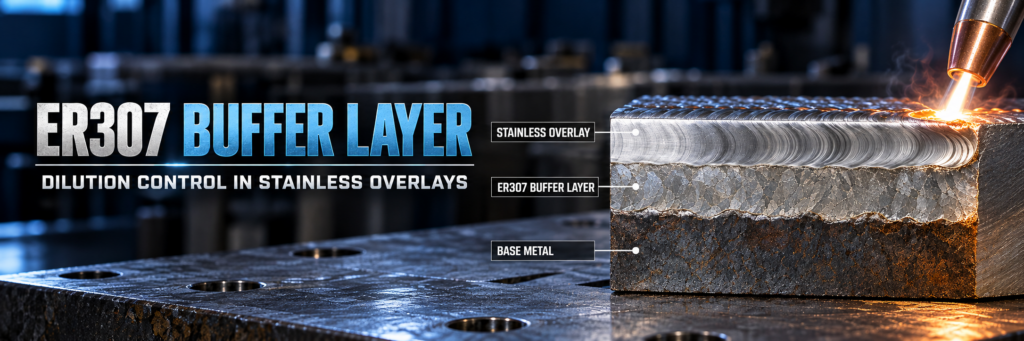
ER307 as a Buffer Layer in Stainless Steel Overlays: Managing Dilution
Stainless steel weld overlays are often deposited on carbon or low-alloy steel to provide a corrosion-resistant surface. The challenge is that the first weld layer mixes with the base metal. This dilution can change the deposit’s chemistry and affect whether the overlay meets its required properties.ER307
ER307 may be considered as a buffer or transition layer in selected overlay and repair applications. Its manganese-rich austenitic weld metal is used for certain dissimilar joints, difficult-to-weld steels, and cushioning layers. However, ER307 is not a universal substitute for stainless filler metals selected to meet a specific corrosion-resistant overlay chemistry. The right choice depends on the base metal, service conditions, final overlay requirements, and qualified welding procedure.
What dilution means in weld overlays
Dilution is the portion of melted base metal that mixes with the filler metal in the weld pool. A high dilution rate can shift the deposited metal’s composition away from the filler wire’s nominal composition. In a corrosion-resistant overlay, this may reduce alloy content near the fusion boundary.
A simplified cross-section estimate is:
Dilution (%) = melted base-metal area ÷ total fused weld area × 100
This estimate is useful for understanding a weld, but it does not replace chemical analysis or procedure qualification. Heat input, travel speed, joint geometry, welding position, and the selected process can all affect dilution.
How ER307 can function as a buffer layer
A buffer layer creates a transition between the base metal and the final overlay. ER307 may be suitable where the application calls for an austenitic, relatively tough intermediate deposit, such as selected dissimilar-metal joints, high-manganese steel repairs, or buildup before hardfacing.
The layer can help separate the final functional deposit from direct mixing with the base metal. Its role is to provide a suitable transition for the next welding operation; it does not automatically guarantee that the surface layer will have the required corrosion resistance or chemistry. Those properties depend on the complete multilayer procedure and the final deposited metal.
When ER307 may be appropriate
Consider ER307 only after checking the requirements of the application. It may be worth evaluating when:
- The job involves a dissimilar or difficult-to-weld steel combination.
- A cushioning layer is needed before a hardfacing or subsequent weld deposit.
- The base metal and service conditions are compatible with the expected ER307 weld-metal properties.
- The qualified procedure confirms that the final overlay meets its required chemistry and performance.
For a corrosion-resistant overlay, the filler metal for the final layer must be selected against the specified alloy and service environment. Depending on the application, a different stainless filler may be required for the first layer, the final layer, or both. Do not select ER307 solely because it is described as a buffer material.
How to manage dilution
Control heat input within the qualified procedure. Higher heat input can increase base-metal melting, but reducing it too far may cause incomplete fusion or poor bead shape. Set current, voltage, travel speed, and wire feed rate through welding trials and procedure qualification. In corrosion-resistant overlays, dilution is a major process concern, and changes to essential parameters may require procedure requalification under the applicable code.
Use a consistent bead technique. Stringer beads and controlled overlap can help produce uniform deposits. Excessive weaving, irregular travel speed, and inconsistent arc placement may create uneven penetration and dilution.
Prepare the surface and joint carefully. Remove scale, oil, moisture, and other contaminants. Confirm that the surface geometry allows stable access and consistent fusion across the overlay area.
Plan the layer sequence. The buffer layer must be thick enough that the next layer is not excessively affected by the base metal or buffer-layer dilution. There is no single thickness suitable for every job; determine it through procedure qualification and testing.
How to verify the overlay
Visual inspection can identify surface issues, but it cannot confirm deposit chemistry. A sound qualification plan may include cross-sectional examination, chemical analysis at the specified location, and mechanical or corrosion testing required by the application. The test location matters: measuring only the exposed top surface may not show the composition of the first layer or the region affected by dilution.
Document the welding process, filler classification and batch, parameters, pass sequence, interpass conditions, and inspection results. This gives the production team a repeatable procedure and helps show whether ER307 is suitable for the intended buffer-layer role.
Key points for selecting ER307
ER307 can be a useful buffer-layer candidate for certain dissimilar-metal, repair, and buildup applications. Its suitability for a stainless steel overlay depends on the full welding procedure—not the filler designation alone. Control dilution, qualify the layer sequence, and verify the final deposit against the project’s chemistry and service requirements.