

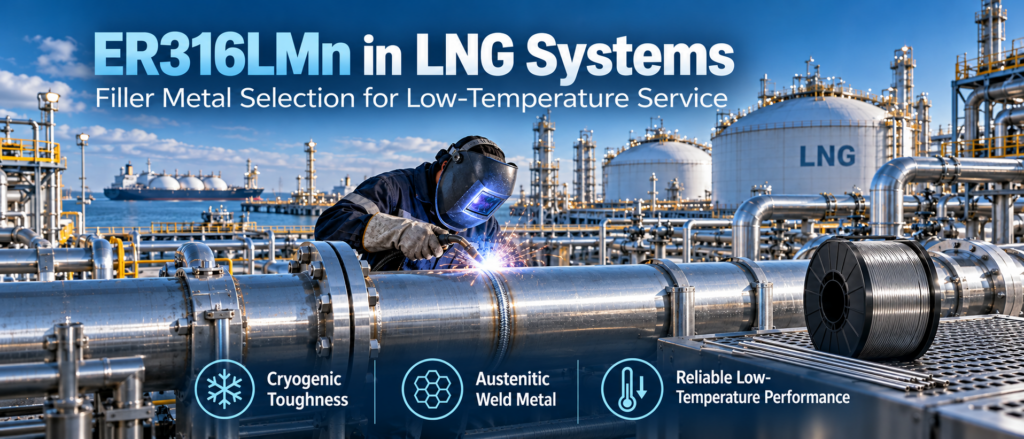
ER316LMn in LNG Systems: Filler Metal Selection for Low-Temperature Service
Liquefied natural gas (LNG) systems operate under demanding cryogenic conditions, making welding consumable selection a critical factor in equipment safety, structural integrity, and long-term reliability. LNG is typically stored at approximately -162°C (-260°F), where welded joints must maintain the mechanical properties required by the design throughout their intended service life.ER316LMn
ER316LMn is a specialized austenitic stainless steel filler metal characterized by high manganese content and a low-ferrite weld metal structure. Its metallurgical characteristics make it relevant to selected cryogenic welding applications, particularly where low-temperature toughness and weld metal composition are important considerations.
However, selecting ER316LMn for LNG service requires more than evaluating its nominal chemical composition. Engineers must consider the base metal, operating temperature, joint configuration, welding process, mechanical testing requirements, and applicable construction standards.
This article examines the properties of ER316LMn, its potential applications in LNG systems, and the key factors that determine whether it is an appropriate filler metal for low-temperature service.
1. Understanding ER316LMn Welding Wire
ER316LMn is an austenitic stainless steel filler metal classification associated with AWS A5.9. It is distinguished from conventional 316L-type filler metals by its higher manganese content and metallurgical design for applications requiring very low ferrite content.
The principal alloying elements typically include chromium, nickel, manganese, molybdenum, and controlled nitrogen. Their combined effects influence austenite stability, strength, corrosion resistance, and the solidification characteristics of the deposited weld metal.
The primary characteristics of ER316LMn include:
Low-ferrite weld metal: Supports applications with specific requirements for weld metal microstructure.
Austenitic structure: Provides a metallurgical basis for selected low-temperature welding applications.
High manganese content: Contributes to austenite stabilization and influences solidification behavior.
Nitrogen alloying: Supports strength and austenite stability.
Chromium and molybdenum additions: Contribute to corrosion resistance in appropriate service environments.
The actual chemical composition, ferrite content, and mechanical properties must be verified against the applicable classification, certified product data, and deposited weld metal test results.
Importantly, the classification alone does not guarantee that every ER316LMn consumable or welded joint will satisfy the requirements of a particular LNG project.
2. Why Filler Metal Selection Matters in LNG Systems
Cryogenic service places additional demands on welded joints. Materials that exhibit satisfactory strength at room temperature may behave differently at extremely low temperatures, particularly when impact loading, stress concentrations, or crack propagation become relevant.
Three factors are especially important when evaluating ER316LMn for LNG applications.
2.1 Cryogenic Toughness
Cryogenic toughness describes a material’s ability to resist fracture and absorb energy under specified low-temperature conditions.
For LNG equipment, the required toughness depends on the design temperature, base material, joint configuration, applicable code, and project specification. Testing may be required at the actual design temperature or at another specified temperature.
ER316LMn is relevant to applications where austenitic weld metal and low ferrite content are desirable. Nevertheless, suitability must be established through the required mechanical tests rather than inferred from the filler metal designation.
Engineers should review impact test results, specimen orientation, test temperature, and acceptance criteria before approving a consumable for critical cryogenic service.
2.2 Microstructural Stability
The microstructure of deposited weld metal influences its mechanical behavior, solidification characteristics, and susceptibility to certain welding defects.
ER316LMn is designed to produce a predominantly austenitic weld deposit with very low ferrite content. This can be advantageous when a particular application requires tight control of ferrite levels.
However, very low ferrite content does not automatically eliminate solidification cracking. Fully austenitic weld metals may be more susceptible to certain solidification cracking mechanisms under unfavorable chemical, thermal, or restraint conditions.
Appropriate joint preparation, welding parameters, filler metal chemistry, and procedure qualification are therefore essential.
2.3 Mechanical Strength and Joint Integrity
LNG piping, storage equipment, valves, and process components may experience pressure loads, thermal contraction, vibration, and localized stresses.
The selected filler metal must provide suitable tensile strength, yield strength, ductility, and low-temperature toughness for the intended joint.
Thermal expansion differences between dissimilar materials, local stress concentrations, and repeated temperature changes may also affect joint performance.
For this reason, ER316LMn should be evaluated as part of the complete welded joint rather than as an isolated consumable.
3. How Alloy Chemistry Influences ER316LMn Performance
Understanding the contribution of each alloying element helps engineers evaluate ER316LMn for demanding welding applications.
| Alloying element | Primary function |
|---|---|
| Chromium (Cr) | Supports corrosion resistance by promoting a protective passive film. |
| Nickel (Ni) | Stabilizes the austenitic structure and influences toughness and ductility. |
| Manganese (Mn) | Promotes austenite stability and affects weld metal solidification behavior. |
| Molybdenum (Mo) | Improves resistance to localized corrosion in suitable environments. |
| Nitrogen (N) | Contributes to austenite stability and solid-solution strengthening. |
| Carbon (C) | Requires appropriate control to limit undesirable effects on corrosion performance and microstructure. |
These elements work together to determine the properties of the deposited weld metal. Their effects depend on the final composition, solidification conditions, and interaction with the base material.
Dilution is particularly important because the molten base metal mixes with the filler metal during welding. The resulting weld composition may therefore differ from the nominal chemistry of the original wire.
For critical LNG applications, certified filler metal chemistry should be reviewed alongside deposited weld metal test data and welding procedure qualification results.
4. Potential Applications of ER316LMn in LNG Systems
ER316LMn may be considered for selected cryogenic stainless steel joints and certain dissimilar-metal applications when its properties satisfy the relevant engineering requirements.
4.1 Cryogenic Stainless Steel Piping
Some LNG process systems incorporate austenitic stainless steel piping, instrument connections, and associated components.
ER316LMn may be appropriate when the base material is compatible with the filler metal and the deposited weld meets the required mechanical, corrosion, and microstructural criteria.
Before selection, engineers should verify the material grade, design temperature, pressure requirements, corrosion exposure, and applicable piping code.
4.2 Cryogenic Valves and Process Equipment
Valves, pumps, and other LNG process components may contain welded stainless steel sections that require reliable performance at low temperatures.
In these applications, the filler metal must be compatible with the base material and the intended operating conditions. Engineers should also evaluate potential thermal cycling, mechanical loading, inspection requirements, and the consequences of weld failure.
ER316LMn should only be approved when the relevant material documentation and qualified welding procedure support its use.
4.3 Selected Dissimilar-Metal Joints
Certain LNG systems contain joints between different steel grades or alloy systems.
ER316LMn may be considered for specific dissimilar-metal combinations, but its suitability depends on dilution, strength matching, thermal expansion, weld metal chemistry, and the requirements of the joint design.
A consumable that performs successfully in one material combination should not automatically be approved for another. Qualification testing must represent the intended materials and welding conditions.
4.4 LNG Storage Tanks Made from 9% Nickel Steel
Nine-percent nickel steel is widely associated with cryogenic LNG storage applications. Selecting its welding consumables requires particular attention to low-temperature mechanical properties and the applicable construction requirements.
ER316LMn has been used in certain cryogenic nickel-steel welding applications. However, it is not universally interchangeable with nickel-based filler metals, which are also used for 9% nickel steel joints.
The correct choice depends on the tank design, applicable code, joint configuration, required strength and toughness, and qualified welding procedure. Engineers must confirm that ER316LMn is specifically permitted and demonstrated to meet the requirements of the intended joint.
This distinction is essential: the fact that a filler metal is associated with cryogenic service does not make it suitable for every LNG tank or piping application.
5. ER316LMn vs. ER316L: Key Differences for Low-Temperature Service
ER316LMn and ER316L are both associated with austenitic stainless steel welding, but their alloy designs and typical weld metal characteristics differ.
| Comparison factor | ER316LMn | ER316L |
|---|---|---|
| Alloy design | Higher manganese content with controlled nitrogen addition | Conventional low-carbon 316-type stainless steel chemistry |
| Ferrite characteristics | Designed for very low-ferrite weld metal | Ferrite content depends on chemistry, dilution, and welding conditions |
| Cryogenic suitability | Relevant to selected applications requiring specific low-temperature properties | May also be suitable when the consumable and welding procedure meet the required criteria |
| Corrosion resistance | Chromium and molybdenum contribute to corrosion resistance | Chromium and molybdenum contribute to corrosion resistance |
| Selection priority | Specific metallurgical and application requirements | Base-metal compatibility and required weld performance |
Neither filler metal is automatically the better choice for every LNG application.
ER316LMn may be preferable when a qualified application requires a very low-ferrite austenitic weld deposit. ER316L may be appropriate where conventional 316-type filler metal chemistry and its qualified mechanical properties meet the design requirements.
The final decision should be based on documented performance, not simply on the classification name.
6. Welding Parameters and Process Control
Correct filler metal selection must be supported by a controlled welding procedure. Process conditions affect weld metal chemistry, microstructure, defect formation, and final mechanical properties.
6.1 Welding Process Compatibility
The appropriate process depends on the available consumable form, joint geometry, production requirements, and qualified procedure.
Gas tungsten arc welding (GTAW), gas metal arc welding (GMAW), and other suitable processes may be considered where compatible filler metal products and qualified procedures are available.
Wire diameter, shielding gas, current, voltage, travel speed, and deposition technique must be established for the selected process. Parameters should not be transferred between processes without appropriate technical evaluation.
6.2 Heat Input and Interpass Temperature
Heat input affects the weld’s thermal history and solidification behavior. Excessive or poorly controlled heat input may influence microstructure, distortion, and weld quality.
Travel speed, bead sequence, joint restraint, and interpass temperature should be controlled within the limits established by the qualified welding procedure.
The objective is to maintain a proven process window that produces the required weld properties while minimizing the risk of unacceptable defects.
6.3 Weld Metal Dilution
Dilution occurs when base metal mixes with molten filler metal during welding.
In cryogenic applications, dilution can alter the concentrations of chromium, nickel, manganese, molybdenum, and other elements in the deposited weld. These changes may affect ferrite content, solidification behavior, and mechanical performance.
The effect can be especially significant in dissimilar-metal joints or applications with strict microstructural requirements.
Where necessary, the impact of dilution should be assessed during procedure qualification rather than assumed from the original filler wire composition.
6.4 Cleanliness and Weld Quality
Surface contamination, unsuitable consumable handling, inadequate shielding, and poor joint preparation can compromise weld integrity.
For LNG equipment, the welding procedure should define appropriate cleaning, storage, handling, inspection, and repair requirements.
Visual inspection and the required nondestructive examination methods should be applied according to the governing code and project specification.
7. Testing and Qualification Requirements
A reliable filler metal selection process requires documented evidence that the consumable and welding procedure meet the requirements of the intended application.
The principal evaluation areas include:
Chemical composition: Confirm that the filler metal and deposited weld metal comply with the applicable requirements.
Tensile properties: Verify that the welded joint meets the specified strength and ductility criteria.
Impact toughness: Confirm acceptable performance at the required test temperature using the specified test method and acceptance limits.
Ferrite content: Where low ferrite is required, measure the deposited weld metal using the specified method.
Welding procedure qualification: Demonstrate that the combination of base metal, filler metal, process, and essential variables produces an acceptable joint.
Nondestructive examination: Apply the inspection methods required by the construction code and project specification.
Depending on the service conditions, additional fracture toughness, corrosion, or other specialized testing may be necessary.
It is also important to distinguish between filler metal classification, consumable certification, and welding procedure qualification. Each serves a different purpose, and none replaces the others.
8. Common Mistakes in ER316LMn Selection
Several errors can lead to unsuitable consumable selection for LNG service.
Assuming All Cryogenic Filler Metals Are Interchangeable
Different filler metals may have different chemical compositions, strength levels, toughness characteristics, and microstructures. Their suitability must be assessed for the specific joint.
Selecting ER316LMn Solely Because of Its Low Ferrite Content
Low ferrite may be important, but it does not establish compatibility with every base material or guarantee adequate strength, toughness, or crack resistance.
Ignoring the Requirements of 9% Nickel Steel
Cryogenic nickel steel and austenitic stainless steel have different metallurgical considerations. The consumable must meet the specific requirements of the material combination and qualified joint.
Relying Only on Room-Temperature Data
Room-temperature tensile properties do not demonstrate adequate impact toughness or fracture resistance at LNG operating temperatures.
Overlooking Dilution and Procedure Qualification
The final weld metal may differ from the nominal filler metal composition. Qualification should account for the actual materials and welding conditions.
9. Practical Checklist for Selecting ER316LMn
Before approving ER316LMn for LNG service, engineers should:
Identify the exact base-metal grades and joint configuration.
Establish the design temperature and required mechanical properties.
Verify that the consumable is permitted by the applicable code and project specification.
Review certified chemical composition and mechanical test data.
Confirm low-temperature impact toughness at the specified test temperature.
Evaluate ferrite content and dilution where these factors affect the design.
Confirm the welding process and procedure qualification requirements.
Define inspection, testing, traceability, and acceptance criteria.
Verify that the proposed filler metal is suitable for any dissimilar-metal or 9% nickel steel joint involved.
This approach helps ensure that filler metal selection is based on engineering evidence rather than general product descriptions.
Frequently Asked Questions
Is ER316LMn suitable for LNG welding?
ER316LMn may be suitable for selected cryogenic stainless steel applications and certain qualified nickel-steel or dissimilar-metal joints. Its suitability depends on the base materials, design temperature, required mechanical properties, and applicable construction requirements.
Why is low ferrite content important in ER316LMn?
Low ferrite content may be required for specific weld metal microstructures and low-temperature applications. However, ferrite content is only one part of the selection process. Toughness, cracking susceptibility, joint compatibility, and qualification results must also be considered.
Can ER316LMn be used at -162°C?
ER316LMn may be considered for applications at LNG storage temperatures when the particular consumable and qualified welding procedure satisfy the applicable low-temperature performance requirements. Suitability should be verified through the relevant test data and project specifications.
Is ER316LMn always the best choice for 9% nickel steel?
No. ER316LMn and nickel-based filler metals may be used in different qualified applications involving cryogenic nickel steel. The correct choice depends on the joint design, required mechanical properties, governing code, and qualified welding procedure.
What should engineers check before purchasing ER316LMn welding wire?
Engineers should review the applicable classification, certified chemical composition, mechanical test results, low-temperature impact data, consumable form, traceability documentation, and suitability for the intended welding process.
Conclusion
ER316LMn is a specialized austenitic stainless steel filler metal with high manganese content and a design intended to produce very low-ferrite weld metal. These characteristics make it relevant to selected cryogenic welding applications where microstructural control and low-temperature mechanical performance are important.
For LNG systems, successful filler metal selection requires a comprehensive assessment of base-metal compatibility, weld metal dilution, strength, impact toughness, corrosion conditions, welding procedure qualification, and applicable construction standards.
Rather than selecting ER316LMn solely because it is associated with cryogenic service, engineers should verify its suitability for each specific joint using documented test results and qualified procedures.
A systematic selection process supports weld integrity, operational reliability, and the long-term performance of LNG equipment operating under demanding low-temperature conditions.