

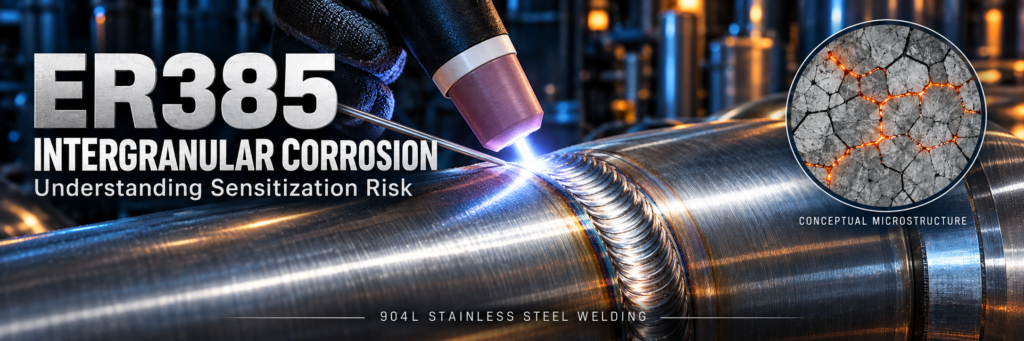
ER385 Intergranular Corrosion: Understanding Sensitization Risk
ER385 is a low-carbon, highly alloyed stainless steel filler metal commonly used for welding 904L. Its corrosion resistance makes it useful for equipment handling aggressive process fluids. However, understanding ER385 intergranular corrosion requires looking beyond the filler metal designation to the chemistry and thermal history of the completed joint.
Under properly controlled welding conditions, conventional chromium-carbide sensitization is generally a low risk in low-carbon 904L joints made with suitable ER385 filler. Prolonged thermal exposure, unfavorable dilution, or contamination can change that assessment. The practical question is whether fabrication or service creates locally depleted regions that become vulnerable in the operating environment.
What Is Intergranular Corrosion?
Intergranular corrosion is preferential attack along grain boundaries or the regions immediately beside them. These narrow zones can become less corrosion resistant than the surrounding material when precipitation changes their local chemistry.
In austenitic stainless steels, the classic mechanism involves chromium-rich carbides forming at grain boundaries. Their formation draws chromium from adjacent material. If chromium depletion becomes sufficient, those regions have less ability to maintain a protective passive film.
A corrosive environment can then attack the depleted paths while much of the grain interior remains relatively unaffected.
Sensitization and intergranular corrosion are related, but they are not identical. Sensitization describes a susceptible metallurgical condition. Intergranular corrosion is the damage that may develop when that condition encounters a sufficiently aggressive environment.
Why ER385 Has Low Conventional Sensitization Risk
ER385 belongs to the chromium-nickel-molybdenum-copper family of stainless steel welding consumables. Its low carbon content limits the carbon available for chromium-carbide precipitation.
That matters because carbide formation depends on both available carbon and thermal exposure. Reducing carbon generally delays the development of significant chromium depletion, making normal welding cycles less likely to produce conventional sensitization.
The alloying elements serve different purposes:
| Element | Main relevance to weld performance |
|---|---|
| Chromium | Supports formation of the protective passive film |
| Nickel | Stabilizes the austenitic structure |
| Molybdenum | Improves resistance to localized corrosion in suitable environments |
| Copper | Supports corrosion resistance in certain reducing acid environments |
| Carbon | Must be controlled to limit chromium-carbide sensitization |
High overall alloy content does not eliminate the importance of local chemistry. A weld can contain substantial chromium and molybdenum while still developing small regions with reduced corrosion resistance after unfavorable thermal exposure.
What Can Increase ER385 Sensitization Risk?
1. Extended Exposure to Elevated Temperatures
Sensitization is a time-temperature-dependent process.
For austenitic stainless steels, conventional chromium-carbide sensitization is often discussed within a broad range of approximately 450–850°C. This is a general reference range, not an ER385-specific operating limit or a prediction that a brief excursion will cause damage.
Low-carbon ER385 weld metal may tolerate a short welding thermal cycle without significant carbide sensitization. Extended holding or repeated exposure requires a separate assessment.
Potential sources include:
- Unnecessary thermal stress relief.
- Slow cooling during an unsuitable heat treatment.
- Repeated repair welding.
- Long-term service at temperatures that promote precipitation.
The complete exposure history matters more than peak temperature alone.
2. Repeated Welding Thermal Cycles
Multipass welding reheats previously deposited metal and portions of the base material. Repair welding adds further thermal cycles.
This does not mean that multipass ER385 welding inevitably causes intergranular corrosion. It means that excessive heat accumulation and repeated repairs can make thermal control more important.
Heat input, travel speed, pass sequence, and interpass temperature should work together within a qualified welding procedure. Reducing heat input without considering fusion is not an effective solution: incomplete fusion introduces its own serious integrity problems.
3. Dilution from the Base Metal
The composition of deposited weld metal differs from that of the original filler wire because the weld pool also contains melted base material.
When ER385 joins matching 904L, dilution is relatively compatible with the intended alloy system. In dissimilar joints or overlays on lower-alloy substrates, dilution can substantially change carbon and alloy content.
For example, dilution from carbon steel may increase carbon while reducing chromium, nickel, and molybdenum concentrations in the deposit. The resulting layer should not be assumed to have the same corrosion behavior as undiluted ER385.
For corrosion-resistant overlays, the relevant chemistry is that of the finished service surface. Layer count, deposition technique, and penetration control all influence that result.
4. Contamination During Fabrication
Poor preparation can compromise corrosion performance and complicate failure analysis.
Oil, grease, marking residues, and other contaminants should be removed before welding. Tools used for surface preparation should also avoid introducing embedded iron or other foreign material.
Surface iron contamination and heat tint do not, by themselves, prove sensitization. They can cause separate corrosion problems that may resemble a material-selection failure during an initial inspection.
Can Intermetallic Phases Also Affect Corrosion Resistance?
Yes. Chromium-carbide precipitation is not the only concern in highly alloyed austenitic stainless steels.
During sufficiently unfavorable thermal exposure, intermetallic phases can form and redistribute elements such as chromium and molybdenum. This can reduce corrosion resistance in adjacent regions and may also impair toughness.
Low carbon therefore addresses one important mechanism without preventing every precipitation-related problem.
For ER385 welds exposed to extended elevated temperatures, an assessment should consider:
- The actual deposited composition.
- Thermal exposure duration and temperature.
- Weld segregation.
- Possible intermetallic precipitation.
- The intended corrosive environment.
An explanation based only on carbon content can miss the controlling mechanism.
ER385 Weld Metal and the 904L Heat-Affected Zone
A welded joint contains several metallurgically distinct regions:
| Region | Main assessment focus |
|---|---|
| Weld metal | Filler chemistry, dilution, segregation, and reheating |
| Heat-affected zone | Base-metal composition and welding thermal cycle |
| Fusion boundary | Local composition changes and transition conditions |
| Exposed surface | Oxidation, contamination, and surface treatment |
Using ER385 cannot compensate for an unsuitable base material or an inappropriate thermal treatment.
Likewise, a corrosion-resistant weld deposit does not establish that every part of the joint has equivalent resistance. Examination and testing should include the regions most likely to experience unfavorable conditions.
How to Reduce ER385 Intergranular Corrosion Risk
Verify the Materials
Confirm the filler classification, base-metal grade, and material certificates before fabrication.
For critical service, review actual chemical analysis where available. A consumable designation establishes classification requirements; it does not fully describe the chemistry of a diluted weld deposit.
Control Heat Through a Qualified Procedure
Use a welding procedure appropriate to the joint thickness, restraint, welding process, and service requirements.
The objective is to achieve sound fusion while avoiding unnecessary thermal exposure. Control interpass temperature, deposition sequence, and repair practices rather than relying on a single heat-input number.
ER385 Evaluate Dilution Where It Matters
Dissimilar joints and corrosion-resistant overlays deserve particular attention.
For overlays, assess whether the final exposed layer meets the required composition and performance criteria. First-layer chemistry may be strongly influenced by the substrate.
ER385 Avoid Unspecified Stress Relief
A conventional stress-relief cycle suitable for carbon steel may be inappropriate for a highly alloyed austenitic joint.
Do not add post-weld heat treatment without a material-specific justification. Where solution treatment is considered, temperature, holding time, and cooling requirements must suit the materials and component geometry.
ER385 Restore Surface Condition
Remove detrimental welding oxides and contamination using suitable cleaning and finishing procedures.
Pickling and passivation serve surface-related purposes. They do not reverse internal chromium depletion or dissolve harmful grain-boundary precipitates. Surface restoration and metallurgical control address different parts of corrosion performance.
How Should ER385 Welds Be Tested?
Testing should answer a defined service or fabrication question.
Visual inspection alone cannot establish resistance to intergranular corrosion. A suitable evaluation may combine metallography, chemical analysis, and corrosion testing.
Metallographic examination can help identify grain-boundary attack and suspicious precipitates. Further analysis may be needed to determine phase identity or local composition.
Chemical analysis is particularly useful for diluted deposits and overlays. It helps establish whether the finished weld chemistry matches the intended corrosion-resistant alloy system.
Intergranular corrosion testing may use a relevant practice from a recognized standard, such as ASTM A262, where applicable. The practice, specimen condition, and acceptance criteria must be appropriate to the alloy and project specification.
A test for intergranular attack should not be treated as proof of resistance to pitting, crevice corrosion, or every process fluid. Those mechanisms may require separate evaluation.
ER385 Conclusion
ER385 offers low conventional sensitization risk when used with suitable materials and controlled welding procedures. Maintaining that advantage requires attention to deposited chemistry, dilution, repeated thermal cycles, and any subsequent elevated-temperature exposure.
For demanding service, evaluate the completed joint and its operating environment together. The filler designation is the starting point; the finished weld’s chemistry, microstructure, and surface condition determine its actual corrosion performance.