

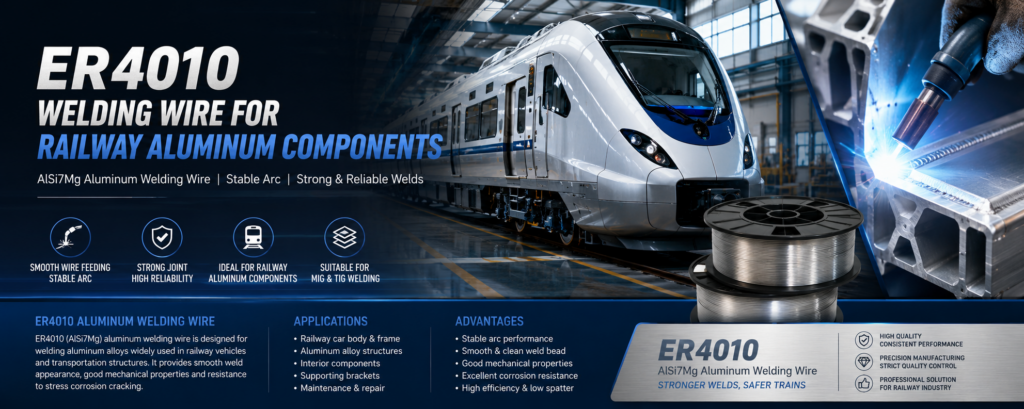
ER4010 Welding Wire for Railway Aluminum Components
Railway manufacturing requires welding materials that can support strength, stability, and long-term service performance. From train body structures to aluminum alloy components used in modern rail systems, every welded joint must meet strict requirements for durability, clean appearance, and reliable mechanical performance. ER4010 welding wire for railway aluminum components is designed for applications where aluminum welding quality and joint consistency are essential.
ER4010 is an aluminum-silicon-magnesium welding wire, commonly known as AlSi7Mg. It is used as a filler metal for welding aluminum alloys that require good strength, smooth weld formation, and stable welding performance. In railway aluminum fabrication, ER4010 welding wire is especially valued for its suitability in aluminum alloy structures, rail vehicle components, and other transportation-related aluminum parts.
What Is ER4010 Welding Wire?
ER4010 welding wire is an aluminum alloy filler wire containing silicon and magnesium. This alloy design helps improve weldability, joint strength, and overall welding stability. Compared with general-purpose aluminum welding wires, ER4010 is often selected for applications that need a balance of mechanical performance and good welding appearance.
For railway aluminum components, welds are not only required to hold parts together. They must also support vibration resistance, dimensional accuracy, corrosion resistance, and long-term operation under changing service conditions. ER4010 welding wire helps manufacturers achieve clean weld beads, stable arc performance, and dependable joint quality when proper welding procedures are followed.
Why ER4010 Welding Wire Is Used in Railway Aluminum Components
Modern rail vehicles use aluminum alloys to reduce weight while maintaining structural strength. Lighter components can improve energy efficiency, reduce operating load, and support better overall vehicle performance. However, aluminum welding also requires careful filler metal selection because the weld joint must match the performance needs of the base material.
ER4010 welding wire is suitable for many railway aluminum applications because it offers:
Good weldability on compatible aluminum alloys
Stable arc performance during MIG and TIG welding
Smooth weld bead appearance
Reliable joint strength after proper welding
Good performance for aluminum structural fabrication
Suitability for transportation and rail-related components
These characteristics make ER4010 aluminum welding wire a practical choice for railway manufacturers, maintenance workshops, and aluminum fabrication projects.
Main Applications of ER4010 Welding Wire in Railway Manufacturing
ER4010 welding wire can be used in different railway aluminum component applications, depending on the base material, design requirement, and welding procedure. Common uses include rail vehicle body structures, aluminum alloy frames, supporting brackets, interior structural parts, and other fabricated aluminum components.
In railway aluminum welding, stable wire feeding and clean weld formation are very important. Poor wire quality may cause arc instability, porosity, uneven weld beads, or rework. A high-quality ER4010 welding wire helps improve production efficiency and reduce welding defects when used with the correct shielding gas, welding parameters, and surface preparation.
Advantages of ER4010 Aluminum Welding Wire
Stable Arc and Smooth Feeding
Stable arc performance is one of the key advantages of ER4010 welding wire. In railway component production, long weld seams and repeated welding operations require wire that feeds smoothly and melts consistently. Stable feeding helps reduce spatter, arc interruption, and welding downtime.
Strong and Reliable Weld Joints
Railway aluminum components often face vibration, load changes, and environmental exposure. ER4010 welding wire provides good joint strength when used with suitable aluminum alloys and proper welding procedures. This helps support long-term component reliability.
Clean Weld Appearance
A clean weld bead is important for both structural quality and visual inspection. ER4010 welding wire can produce smooth weld surfaces, making it easier to inspect weld quality and reduce post-weld finishing work.
Suitable for MIG and TIG Welding
ER4010 welding wire can be used for MIG and TIG welding applications. MIG welding is often preferred for production efficiency, while TIG welding is suitable for precise welding, repair work, and applications requiring fine control.
Good Choice for Aluminum Alloy Fabrication
ER4010 welding wire is suitable for aluminum alloy fabrication where weldability, strength, and consistency are required. This makes it useful not only for railway components but also for other transportation and industrial aluminum structures.
Welding Tips for ER4010 Railway Aluminum Components
To achieve the best welding results with ER4010 welding wire, proper preparation and process control are important.
First, the aluminum surface should be clean, dry, and free from oil, oxide layers, moisture, and other contaminants. Aluminum is sensitive to surface contamination, and poor cleaning can lead to porosity or weak welds.
Second, pure argon shielding gas is commonly used for aluminum welding. Proper gas flow helps protect the molten weld pool and improves bead quality.
Third, welding parameters should be adjusted according to wire diameter, base material thickness, joint design, and welding position. Correct current, voltage, travel speed, and wire feed speed help achieve stable penetration and smooth weld formation.
Finally, storage conditions are also important. ER4010 welding wire should be kept in a dry and clean environment to prevent moisture absorption and contamination before welding.
ER4010 Welding Wire Quality Requirements
For railway aluminum component production, welding wire quality must remain consistent from batch to batch. Important quality points include accurate chemical composition, clean wire surface, stable diameter tolerance, smooth feeding performance, and reliable packaging.
A high-quality ER4010 welding wire should support continuous welding without frequent wire feeding problems. It should also provide consistent melting behavior, stable arc performance, and clean weld results. These details are especially important in rail vehicle manufacturing, where production efficiency and welding reliability directly affect project quality.
How to Choose ER4010 Welding Wire for Railway Projects
When selecting ER4010 welding wire for railway aluminum components, buyers should consider the following factors:
Compatibility with the aluminum base material
MIG or TIG welding process requirements
Wire diameter and packaging form
Mechanical performance requirements
Surface cleanliness and feeding stability
Supplier quality control capability
Availability of technical documents and quality certificates
Choosing the right ER4010 welding wire is not only about price. It is also about weld quality, production stability, and long-term component performance.
Conclusion
ER4010 welding wire for railway aluminum components is a reliable aluminum filler metal for applications requiring stable welding performance, strong joints, and clean weld appearance. Its AlSi7Mg composition makes it suitable for aluminum alloy fabrication in rail vehicle structures and transportation-related components.
For manufacturers and distributors working in the railway aluminum industry, ER4010 welding wire offers a strong combination of weldability, consistency, and practical performance. With proper surface preparation, shielding gas, welding parameters, and quality-controlled wire, ER4010 can help produce durable aluminum welds for demanding railway applications.