

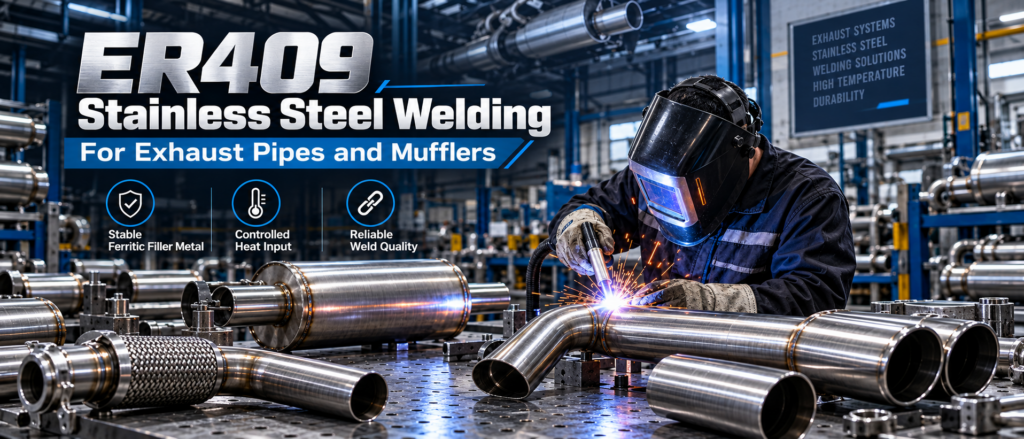
ER409 Stainless Steel Welding for Exhaust Pipes and Mufflers
Automotive exhaust systems operate under demanding conditions, including elevated temperatures, repeated thermal cycling, vibration, and exposure to moisture and corrosive road contaminants. Selecting the right stainless steel filler metal and welding process is essential for producing durable exhaust pipes and mufflers. ER409
ER409 stainless steel welding wire is commonly used for joining Type 409 ferritic stainless steel components in automotive exhaust applications. Its compatibility with 409 stainless steel makes it a practical option for fabricating exhaust tubing, muffler shells, connecting pipes, and related components when the base material and service requirements are appropriate.
This guide explains the properties of ER409 welding wire, its applications in exhaust manufacturing, suitable welding processes, heat control techniques, and common factors that influence weld quality.
What Is ER409 Stainless Steel Welding Wire?
ER409 is a ferritic stainless steel filler metal classification associated with welding Type 409 stainless steel. Type 409 is a chromium-containing stainless steel stabilized primarily with titanium to improve resistance to sensitization under suitable conditions.
Unlike austenitic stainless steels, Type 409 has a ferritic microstructure and is widely used in automotive exhaust systems because it offers a practical balance of corrosion resistance, oxidation resistance, formability, and cost.
The main considerations when selecting ER409 welding wire include:
Material compatibility: Designed for applications involving Type 409 and compatible ferritic stainless steel grades.
Oxidation resistance: Suitable for exhaust components exposed to elevated temperatures, within the limitations of the material and operating environment.
Thermal performance: Appropriate material selection helps accommodate repeated heating and cooling cycles.
Manufacturing efficiency: Compatible with welding processes commonly used for thin-gauge exhaust components.
The actual performance of a welded joint depends on the filler metal composition, base material, welding procedure, joint design, and service environment. ER409 should not be considered interchangeable with every stainless steel filler metal.
Why Is ER409 Used for Exhaust Pipes and Mufflers?
1. Compatibility with Type 409 Stainless Steel
Material compatibility is a primary consideration when manufacturing automotive exhaust components. Using a suitable filler metal helps maintain the intended metallurgical characteristics of the joint.
ER409 is a logical candidate for joining Type 409 stainless steel when the component design and applicable welding requirements support a matching ferritic filler metal.
For mixed-material joints, such as connections between different stainless steel grades or stainless steel and carbon steel, filler metal selection requires a separate technical assessment.
2. Resistance to Exhaust Operating Conditions
Exhaust pipes and mufflers experience repeated temperature changes during engine startup, operation, and shutdown. They may also encounter condensation, road salt, water, and other corrosive substances.
Type 409 stainless steel is used in these applications because of its oxidation resistance and practical corrosion performance. However, its resistance depends on temperature, exposure conditions, surface condition, and the presence of corrosive deposits.
A properly selected ER409 filler metal, combined with an appropriate welding procedure, helps create joints suitable for the intended service conditions. Welding alone cannot compensate for an unsuitable material grade or an excessively aggressive operating environment.
3. Suitability for Thin-Wall Fabrication
Many exhaust pipes and muffler components are manufactured from relatively thin stainless steel sheet or tubing. These materials require careful control of welding heat to prevent burn-through, distortion, and excessive changes in the heat-affected zone.
ER409 welding wire can be used in suitable procedures for thin-section exhaust fabrication. The wire diameter, welding current, travel speed, joint fit-up, and shielding gas must be selected according to the equipment, material thickness, and qualified procedure.
Common Applications of ER409 Welding Wire
ER409 stainless steel welding wire is relevant to several exhaust system manufacturing operations.
Exhaust pipes: Used for joining compatible Type 409 stainless steel tubing, bends, and connecting sections. Consistent weld penetration and sound joints are important for maintaining exhaust gas containment.
Muffler assemblies: Suitable for joining compatible ferritic stainless steel shells, internal components, and connecting pipes where the specified material and welding procedure permit its use.
Exhaust manifolds and connecting sections: May be considered for selected components made from compatible Type 409 materials. Higher thermal loads and thermal fatigue requirements should be evaluated before selecting the filler metal.
Automotive exhaust tubing: Applicable to fabrication and assembly operations involving formed stainless steel tubes, where dimensional accuracy and repeatable weld quality are important.
The final filler metal choice should always reflect the component specification, base metal grade, operating temperature, corrosion exposure, and applicable automotive or manufacturing requirements.
Which Welding Process Is Suitable for ER409?
The most appropriate welding process depends on production volume, component geometry, material thickness, and quality requirements.
MIG Welding
Gas metal arc welding (GMAW), commonly called MIG welding, is frequently used in production environments because it supports efficient, repeatable fabrication.
For ER409 welding wire, manufacturers should establish suitable settings for wire diameter, current, voltage, wire feed speed, travel speed, and shielding gas. The shielding gas must be compatible with the specific filler metal and welding procedure.
MIG welding is particularly useful for repetitive exhaust pipe joints and selected muffler assembly operations. Automated or robotic systems can improve consistency when joint preparation, fixturing, and process parameters are properly controlled.
TIG Welding
Gas tungsten arc welding (GTAW), commonly called TIG welding, offers precise control of the weld pool. It can be useful for thin tubing, prototype work, repair operations, and joints requiring careful appearance or dimensional control.
TIG welding requires suitable shielding gas coverage and controlled heat input. Excessive heat can cause distortion or undesirable microstructural changes, particularly in thin ferritic stainless steel sections.
Choosing Between MIG and TIG
MIG welding is often preferred for production speed and automation, while TIG welding is useful when precise heat and weld-pool control are priorities.
Neither process guarantees a defect-free joint. Actual results depend on material preparation, joint design, welder skill or automation quality, and a validated welding procedure.
Best Practices for ER409 Exhaust Welding
1. Prepare the Base Material Properly
Remove oil, grease, moisture, dirt, and other contaminants before welding. Use dedicated stainless steel cleaning tools to avoid contamination from carbon steel particles.
Cutting and forming operations should produce clean joint edges. For thin-wall tubing, consistent fit-up and a controlled root gap help reduce burn-through and incomplete fusion.
2. Control Heat Input
Heat management is especially important when welding thin ferritic stainless steel.
Excessive heat input can contribute to distortion, grain growth, burn-through, and changes in local mechanical properties. Conversely, insufficient heat or excessively fast travel may result in incomplete fusion.
Establish the welding current, voltage, travel speed, and other parameters through procedure qualification or appropriate process trials. Use the lowest heat input that consistently achieves the required penetration and joint quality.
3. Select the Correct Shielding Gas
Shielding gas protects the molten weld metal from atmospheric contamination. Gas selection should follow the filler metal manufacturer’s recommendations and the applicable welding procedure.
An unsuitable gas mixture or inadequate gas coverage may contribute to oxidation, porosity, or unstable arc behavior. Gas flow, nozzle condition, drafts, and torch positioning should also be checked during production.
4. Maintain Proper Joint Fit-Up
Exhaust components often involve curved tubing, formed sheet metal, and complex assemblies. Gaps that vary significantly along a joint can lead to inconsistent penetration and distortion.
Use suitable fixtures, tack welds, and a controlled welding sequence to maintain alignment. For automated production, verify component positioning and dimensional tolerances before welding begins.
5. Inspect Weld Quality
Inspection should be matched to the component’s function and acceptance criteria. Common checks include visual examination for cracks, porosity, undercut, excessive reinforcement, and incomplete fusion where detectable.
For exhaust components, leak testing may be required to verify gas containment. Additional nondestructive testing or destructive procedure qualification may be necessary for specific applications.
Common ER409 Welding Problems and Solutions
Burn-through on thin exhaust tubing
Burn-through can result from excessive heat input, poor fit-up, or inappropriate welding parameters. Review the wire diameter, current, travel speed, and joint gap, and validate adjustments through controlled trials.
Distortion of exhaust pipes or muffler shells
Excessive or uneven heating can change component dimensions. Improve fixturing, use a balanced welding sequence, minimize unnecessary heat input, and verify dimensions after welding.
Porosity in the weld
Porosity may be associated with contaminated surfaces, inadequate shielding, gas leakage, or unsuitable welding conditions. Check material cleanliness, gas delivery, nozzle condition, and shielding coverage.
Cracking or premature joint failure
Cracking and premature failure may involve unsuitable filler metal selection, excessive restraint, weld defects, thermal fatigue, or service conditions beyond the material’s capabilities. Investigate the failure mechanism before changing the welding process or filler metal.
Excessive oxidation or poor weld appearance
Poor shielding, excessive heat, or contamination can contribute to heavy oxidation and inconsistent bead appearance. Correct gas coverage and process settings, and evaluate post-weld cleaning requirements where applicable.
How to Select ER409 Welding Wire for Exhaust Manufacturing
Before purchasing ER409 welding wire, manufacturers should evaluate the following factors:
Base material: Confirm that the components are Type 409 stainless steel or another material compatible with the proposed filler metal.
Wire diameter: Select a diameter appropriate for material thickness, welding position, equipment, and production requirements.
Chemical composition: Review the product’s technical data and applicable classification requirements.
Mechanical properties: Confirm that the deposited weld metal meets the requirements of the intended application.
Welding process: Verify compatibility with the selected MIG, TIG, or other qualified welding procedure.
Quality documentation: Request relevant inspection records, certificates, and traceability documentation when required by the purchasing specification.
Operating environment: Consider maximum temperature, thermal cycling, condensation, road salt, and other corrosive exposures.
A lower material cost does not necessarily translate into a lower total manufacturing cost. Consistent wire quality, stable feeding, reliable welding performance, and reduced rework can all influence overall production efficiency.
Frequently Asked Questions
Is ER409 suitable for automotive exhaust pipes?
ER409 can be suitable for joining Type 409 stainless steel exhaust pipes when the filler metal, welding procedure, and component requirements are compatible. The intended operating temperature and corrosion exposure should also be evaluated.
Can ER409 welding wire be used for mufflers?
Yes. ER409 may be used for compatible Type 409 stainless steel muffler components, including selected shells and connecting pipes. The suitability of each joint depends on its base materials, design, and service conditions.
Is ER409 suitable for MIG welding?
ER409 can be used in appropriate gas metal arc welding applications when the supplied product is intended for that process. Confirm the wire specifications, shielding gas recommendations, and operating parameters before production.
What causes distortion when welding ER409 stainless steel?
Distortion commonly results from excessive or uneven heat input, poor fixturing, inconsistent joint gaps, and an unsuitable welding sequence. Controlled parameters and consistent assembly practices help minimize these problems.
How should ER409 be compared with ER409Nb?
ER409Nb contains niobium as a stabilizing element, whereas ER409 is generally associated with titanium-stabilized Type 409 compositions. Their suitability depends on the base material, stabilization requirements, service conditions, and applicable specifications. They should not be treated as interchangeable without technical review.
Conclusion
ER409 stainless steel welding wire is a practical filler metal option for selected automotive exhaust pipes, mufflers, and related components manufactured from Type 409 stainless steel. Its suitability depends on material compatibility, welding process, joint design, and the demands of the operating environment.
For reliable results, manufacturers should prioritize proper surface preparation, controlled heat input, suitable shielding gas, consistent fit-up, and systematic weld inspection. Evaluating the filler metal against the actual component specification helps improve weld consistency, reduce manufacturing defects, and support the long-term performance of exhaust assemblies.