

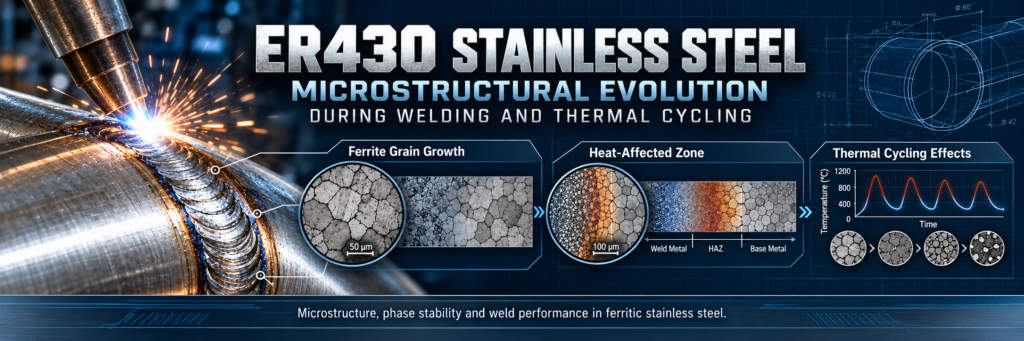
ER430 Stainless Steel: Microstructural Evolution During Welding and Thermal Cycling
ER430 stainless steel is a chromium-rich ferritic stainless steel welding filler metal used in applications requiring corrosion resistance, oxidation resistance, and metallurgical compatibility with ferritic stainless steel substrates. Its welding performance is closely related to microstructural evolution during solidification, cooling, and subsequent thermal exposure.
Unlike austenitic stainless steel weld metals, ER430 deposits are predominantly ferritic and can exhibit substantial grain growth under certain welding conditions. Depending on alloy composition, substrate dilution, and thermal history, secondary phases such as martensite, chromium carbides, and nitrides may also develop.
These microstructural changes directly influence weld toughness, ductility, hardness, corrosion resistance, and susceptibility to cracking.
Understanding ER430 stainless steel microstructural evolution during welding and thermal cycling is therefore essential for engineers seeking to optimize welding parameters, control heat-affected zone degradation, and improve the reliability of welded components.
This article examines the metallurgical mechanisms governing ER430 weld metal behavior, including ferritic solidification, grain coarsening, phase transformations, precipitation reactions, and the effects of repeated thermal cycles.
1. Metallurgical Characteristics of ER430 Stainless Steel
ER430 belongs to the ferritic stainless steel welding filler metal family and contains approximately 16% chromium, with composition limits defined by the applicable filler metal classification.
Its microstructural characteristics differ from those of austenitic and martensitic stainless steels.
Ferritic stainless steels primarily contain a body-centered cubic (BCC) iron-chromium matrix. This structure influences thermal expansion, diffusion behavior, grain growth, and mechanical response during welding.
1.1 Chemical Composition and Alloying Effects
The chemical composition of ER430 filler metal plays a critical role in controlling phase stability and weld metal properties.
| Element | Metallurgical function | Effect on welding performance |
|---|---|---|
| Chromium (Cr) | Stabilizes ferrite and promotes corrosion resistance | Influences ferritic phase stability and oxidation resistance |
| Carbon (C) | Promotes carbide formation and affects austenite stability | Can influence hardness, sensitization, and phase transformation |
| Nitrogen (N) | Influences phase balance and nitride formation | Can contribute to precipitation and localized hardening |
| Silicon (Si) | Acts primarily as a deoxidizing element | Influences weld pool chemistry and oxide formation |
| Manganese (Mn) | Contributes to deoxidation and phase balance | Affects solidification chemistry and weld quality |
| Iron (Fe) | Forms the primary metallic matrix | Provides the structural foundation of the weld deposit |
The final weld metal composition can differ from the original filler wire because of dilution with the base material.
This distinction is particularly important when ER430 is deposited on substrates with different chromium, carbon, or nickel concentrations.
1.2 Ferritic Microstructure and Phase Stability
Ferrite remains the dominant phase in many ER430 weld deposits.
However, the microstructure is not necessarily completely ferritic under every welding condition.
Depending on the chemical composition and thermal cycle, austenite may form locally at elevated temperatures.
During subsequent cooling, this austenite may transform into martensite.
As a result, certain ER430 welds can contain ferrite together with localized martensitic regions and precipitates.
The final phase distribution depends on the interactions between alloy chemistry, peak temperature, cooling rate, and repeated thermal exposure.
2. Microstructural Evolution During ER430 Weld Solidification
The first major stage of ER430 microstructural development occurs as the molten weld pool solidifies.
During welding, heat is extracted rapidly from the molten metal into the surrounding substrate.
This generates steep thermal gradients and directional solidification conditions.
2.1 Primary Ferritic Solidification
ER430 weld metal typically has a strong tendency toward primary ferritic solidification because of its chromium-rich composition.
Ferrite nucleates and grows as the liquid metal cools.
The resulting solidification structure may contain columnar or equiaxed ferritic grains, depending on the thermal gradient and solidification conditions.
Columnar grains often develop along the direction of heat extraction.
Their orientation is influenced by crystallographic growth preferences and the geometry of the weld pool.
In some cases, existing substrate grains near the fusion boundary act as growth sites for the newly solidifying weld metal.
This phenomenon is known as epitaxial solidification.
2.2 Columnar Grain Growth
Columnar ferrite formation is a significant characteristic of many ER430 fusion welds.
The growth of elongated grains is controlled by several factors:
Weld pool temperature gradient.
Solidification velocity.
Heat input and travel speed.
Substrate thermal conductivity.
Weld pool geometry.
Local chemical composition.
Large columnar grains can produce direction-dependent mechanical behavior.
Under unfavorable conditions, this structural anisotropy may influence fracture propagation and deformation behavior.
However, grain morphology alone does not determine weld integrity. Weld defects, grain-boundary chemistry, and loading conditions must also be considered.
2.3 Microsegregation During Solidification
During solidification, alloying elements may partition unevenly between the liquid and solid phases.
This can create localized variations in chemical composition.
Such microsegregation affects the stability of ferrite, austenite, and secondary phases.
Rapid cooling may preserve some of these compositional differences because there is insufficient time for complete diffusion and homogenization.
Subsequent welding passes can modify the segregated regions through additional heating, diffusion, and precipitation.
Consequently, ER430 weld metal may exhibit significant microstructural variation even when the original filler wire composition remains constant.
3. Ferrite Grain Growth in the Heat-Affected Zone
One of the most important challenges in ER430 ferritic stainless steel welding is excessive grain growth in the heat-affected zone.
The heat-affected zone, commonly abbreviated as HAZ, is the region of base material exposed to high temperatures without undergoing melting.
Although the material remains solid, its microstructure can change substantially.
3.1 Mechanism of Ferrite Grain Coarsening
Grain boundaries contain excess energy relative to the interior of grains.
At elevated temperatures, grain boundaries become increasingly mobile.
Larger grains may grow at the expense of smaller neighboring grains, reducing the overall grain-boundary area.
This process is thermodynamically driven by the reduction of grain-boundary energy.
Ferritic stainless steels can be particularly susceptible to grain coarsening because some regions do not experience phase transformations capable of substantially refining the grain structure during cooling.
The extent of grain growth depends on:
Peak temperature.
Exposure duration.
Initial grain size.
Grain-boundary mobility.
Precipitate distribution.
Alloy composition.
Number of welding thermal cycles.
The coarse-grained heat-affected zone near the fusion boundary is often the region of greatest concern.
3.2 Influence of Welding Heat Input
Welding heat input strongly influences the temperature distribution and cooling characteristics of the welded joint.
For conventional arc welding processes, effective heat input per unit length can be approximated as:
Q = ηVI / v
Where:
Q represents effective heat input per unit length.
η represents process thermal efficiency.
V represents welding voltage.
I represents welding current.
v represents welding travel speed.
For voltage in volts, current in amperes, and travel speed in millimeters per second, the calculated value is expressed in joules per millimeter.
Higher heat input can increase the width of the HAZ and extend the time that material remains at elevated temperatures.
Under such conditions, ferrite grains may grow significantly.
However, excessively low heat input can produce incomplete fusion or insufficient penetration.
Therefore, heat input optimization requires balancing microstructural control with adequate weld formation.
3.3 Mechanical Effects of Coarse Ferrite Grains
Grain coarsening can influence yield strength, ductility, and fracture resistance.
The relationship between grain size and yield strength is frequently described by the Hall–Petch equation:
σy = σ0 + kd^(-1/2)
Where:
σy is the yield strength.
σ0 is the friction stress.
k is a material-dependent strengthening coefficient.
d is the average grain diameter.
Within the applicable range, larger grains generally provide less grain-boundary strengthening.
Coarse ferritic structures may also exhibit reduced resistance to cleavage fracture, especially at lower temperatures.
For ER430 welded components, limiting excessive HAZ grain coarsening can therefore be important for maintaining reliable mechanical performance.
4. Phase Transformations During Welding and Cooling
Although ER430 is classified as a ferritic stainless steel filler metal, its thermal behavior can involve phase transformations under certain conditions.
The development of secondary phases depends strongly on the actual chemical composition of the weld region.
4.1 Austenite Formation at Elevated Temperatures
Conventional Type 430 stainless steel substrates may enter a ferrite-plus-austenite phase region during high-temperature exposure.
The amount of austenite that forms depends on chromium concentration, carbon and nitrogen content, and thermal history.
In fusion welding, rapid heating and cooling can prevent equilibrium phase fractions from developing.
Consequently, the actual structure may differ from predictions based solely on equilibrium phase diagrams.
4.2 Martensite Formation During Cooling
If austenite forms during welding, some of it may transform into martensite during cooling.
This transformation can produce localized hard regions, particularly near grain boundaries.
Martensite formation may affect weld behavior through:
Localized increases in hardness.
Reduced ductility in susceptible regions.
Changes in fracture behavior.
Increased microstructural heterogeneity.
Greater sensitivity to certain cracking mechanisms.
The presence of martensite should be verified through suitable microstructural examination.
It should not be assumed that every ER430 weld contains a substantial martensitic fraction.
4.3 Cooling Rate and Phase Transformation
Cooling rate influences whether diffusion-controlled transformations can proceed.
Rapid cooling may restrict some precipitation reactions, but it can also favor martensitic transformation if austenite has formed.
Slower cooling provides more time for diffusion and can influence carbide or nitride precipitation.
Therefore, a slower cooling rate does not necessarily produce a better microstructure.
The optimum thermal cycle depends on the balance between grain growth, phase transformation, precipitation, and residual stress.
5. Carbide and Nitride Precipitation in ER430 Weld Metal
Carbon and nitrogen significantly influence the microstructural stability of ferritic stainless steel welds.
During welding and thermal exposure, these elements may participate in the formation of chromium-rich carbides and nitrides.
5.1 Chromium Carbide Formation
Chromium-rich carbides may precipitate at grain boundaries or within the ferritic matrix.
Their formation depends on local carbon content, temperature, and exposure time.
Certain thermal conditions may favor M23C6-type carbide precipitation.
The presence of these precipitates can influence both mechanical properties and corrosion resistance.
Carbide precipitation near grain boundaries may reduce the chromium concentration of the adjacent matrix.
This localized chromium depletion is particularly important when evaluating intergranular corrosion susceptibility.
5.2 Sensitization and Intergranular Corrosion
Sensitization occurs when microstructural or chemical changes make grain-boundary regions more susceptible to corrosion.
In ER430 welds, chromium-rich carbide or carbonitride precipitation can contribute to such conditions.
If the chromium concentration near grain boundaries becomes insufficient to maintain corrosion resistance in the intended environment, preferential intergranular attack may occur.
The severity of sensitization depends on:
Carbon and nitrogen concentration.
Chromium availability.
Thermal exposure temperature.
Time at temperature.
Cooling conditions.
Prior microstructural history.
Not every ER430 weld will experience severe sensitization.
The risk should be evaluated according to the actual weld metal composition, thermal cycle, and corrosive environment.
5.3 Chromium Nitride Precipitation
Nitrogen can also contribute to secondary phase formation.
Under suitable conditions, chromium nitrides may develop and influence local hardness and corrosion behavior.
Because carbides and nitrides may coexist, comprehensive characterization can be necessary to understand grain-boundary degradation.
Chemical analysis combined with appropriate phase identification techniques provides a more reliable assessment than visual inspection alone.
6. Effects of Repeated Thermal Cycling on ER430 Microstructure
In multipass welding, previously deposited material is reheated during subsequent welding passes.
Each reheating event introduces an additional thermal cycle.
As a result, the final weld microstructure reflects the combined effects of initial solidification and repeated thermal exposure.
6.1 Reheating of Previously Deposited Weld Metal
When another welding pass is deposited, underlying weld metal may experience partial reheating.
Depending on peak temperature and exposure duration, this can produce:
Additional grain growth.
Redistribution of alloying elements.
Carbide or nitride precipitation.
Dissolution of existing precipitates.
Partial phase transformation.
Tempering of previously formed martensite.
Changes in residual stress.
The intensity of these changes varies throughout the weld because different regions experience different temperature histories.
6.2 Microstructural Heterogeneity
Repeated welding passes may produce distinct microstructural regions within the deposit.
Some regions may contain relatively coarse ferrite grains, while others exhibit smaller grains, localized transformation products, or altered precipitate distributions.
These differences can lead to variations in hardness, toughness, and corrosion behavior.
For critical applications, evaluating the entire weld cross-section is more informative than examining only the final deposited surface.
6.3 Interpass Temperature Control
Interpass temperature is the temperature of the weld region before the next welding pass begins.
Excessive interpass temperatures can prolong thermal exposure and influence grain growth or precipitation reactions.
Conversely, very low interpass temperatures may increase thermal gradients and create other welding concerns depending on the material and joint.
The appropriate interpass temperature should be established through a qualified welding procedure considering substrate characteristics and required service properties.
7. Thermal Aging and Embrittlement of ER430 Stainless Steel
Long-term thermal exposure can alter ferritic stainless steel microstructures even in the absence of additional welding.
These changes are important for components operating at elevated temperatures.
7.1 The 475°C Embrittlement Phenomenon
Ferritic stainless steels containing sufficient chromium can exhibit embrittlement during prolonged exposure within certain intermediate-temperature ranges.
This phenomenon is often associated with the decomposition of ferrite into iron-rich and chromium-rich regions.
The compositional separation can increase hardness while reducing fracture toughness.
Its significance depends on chromium concentration, temperature, and aging duration.
For ER430 welds used in elevated-temperature service, this mechanism may warrant consideration.
However, short welding thermal cycles should not automatically be treated as equivalent to prolonged thermal aging.
7.2 Sigma Phase Formation
Sigma phase is a brittle chromium-rich intermetallic phase that may form in susceptible stainless steel compositions after sufficient thermal exposure.
Its formation depends strongly on alloy chemistry and time-temperature conditions.
Conventional ER430 compositions are generally less susceptible to extensive sigma phase formation than more highly alloyed stainless steels.
Therefore, sigma phase should not be assumed to occur in ordinary ER430 welds without supporting characterization evidence.
7.3 Long-Term Effects on Mechanical Properties
Thermal aging may influence weld performance by changing hardness, toughness, precipitate distribution, and phase stability.
The consequences become particularly important when elevated temperatures interact with cyclic mechanical loads.
For long-service-life components, the thermal exposure history should be included in the material performance assessment.
8. Relationship Between ER430 Microstructure and Weld Properties
The mechanical and corrosion properties of ER430 welds are controlled by several interacting microstructural factors.
| Microstructural feature | Potential effect on weld properties |
|---|---|
| Coarse ferrite grains | Reduced toughness and grain-boundary strengthening |
| Localized martensite | Increased hardness and possible reduction in ductility |
| Chromium carbide precipitation | Potential sensitization and grain-boundary corrosion |
| Nitride precipitation | Changes in local chemistry and mechanical response |
| Microsegregation | Variations in phase stability and corrosion behavior |
| Thermal aging | Possible embrittlement and hardness changes |
| Repeated thermal cycling | Microstructural heterogeneity and property variation |
8.1 Hardness Distribution
Hardness testing provides useful information about changes in the weld metal and HAZ.
Microhardness mapping can reveal localized hardening or softening caused by grain growth, phase transformations, and precipitation.
However, a higher hardness value does not necessarily indicate better weld quality.
Hardness results should always be interpreted alongside metallographic observations.
8.2 Toughness and Ductility
Toughness describes the ability of a material to absorb energy before fracture.
In ferritic stainless steel welds, coarse grains and brittle microstructural constituents may reduce fracture resistance.
This issue becomes particularly important under impact loading or low-temperature service.
Mechanical testing should be selected according to the intended application and the relevant failure mechanisms.
8.3 Corrosion Resistance
Corrosion resistance depends on the chromium-rich matrix, grain-boundary chemistry, surface condition, and operating environment.
Thermal exposure may alter carbide distributions and produce localized chromium depletion.
Surface oxidation and heat tint can also influence corrosion performance.
Consequently, weld quality evaluation should consider both internal microstructure and surface condition.
9. Characterization Methods for ER430 Weld Microstructure
A systematic metallurgical investigation requires suitable examination techniques.
9.1 Optical Microscopy
Optical metallography is commonly used to examine ferrite grain morphology, weld geometry, and HAZ characteristics.
It can provide an initial assessment of grain growth and microstructural heterogeneity.
9.2 Scanning Electron Microscopy
Scanning electron microscopy allows higher-resolution examination of grain boundaries, precipitates, and fracture surfaces.
It is useful for studying localized structural features that cannot be adequately resolved through optical microscopy.
9.3 Electron Backscatter Diffraction
Electron backscatter diffraction can characterize crystallographic orientation, grain size, and grain-boundary distributions.
It also supports phase mapping when the relevant phases can be distinguished crystallographically.
9.4 X-Ray Diffraction
X-ray diffraction provides information about crystalline phase constitution.
It can help identify phase changes associated with welding and thermal exposure.
However, very fine or low-volume-fraction secondary phases may require additional analytical methods.
9.5 Microhardness Testing
Microhardness measurements across the fusion zone, HAZ, and base metal can reveal local property differences.
Combining these results with microscopy improves the interpretation of welding-induced microstructural changes.
10. Optimizing ER430 Welding Parameters for Microstructural Control
Controlling microstructural evolution requires coordinated management of welding heat input, cooling rate, dilution, and thermal exposure.
10.1 Optimize Heat Input
Excessive heat input may increase grain coarsening and widen the heat-affected zone.
Insufficient heat input may produce inadequate fusion.
The objective is to establish welding parameters that ensure sound deposition while limiting unnecessary thermal exposure.
10.2 Control Welding Travel Speed
Travel speed affects the amount of heat introduced per unit weld length.
Higher travel speeds may reduce nominal heat input when other variables remain constant.
However, excessive speed can negatively affect bead geometry, penetration, and weld consistency.
Travel speed should therefore be optimized together with current, voltage, and joint configuration.
10.3 Manage Interpass Temperature
Appropriate interpass temperature control can help limit excessive reheating during multipass welding.
The selected temperature range should be consistent with material requirements and welding procedure qualification.
10.4 Control Weld Dilution
Dilution changes the composition and phase stability of ER430 weld metal.
Maintaining controlled dilution helps reduce unexpected variations in the resulting microstructure.
Particular attention should be given to dissimilar metal welding and applications involving significant compositional differences between the filler and substrate.
10.5 Evaluate Heat Treatment Requirements
Heat treatment can influence residual stresses, phase distribution, and precipitation behavior.
However, unsuitable thermal exposure may increase sensitization or promote excessive microstructural changes.
Any proposed post-weld heat treatment should be evaluated against the required mechanical properties and corrosion performance.
11. Common ER430 Welding Microstructure Problems and Solutions
| Problem | Metallurgical cause | Recommended approach |
|---|---|---|
| Excessive HAZ grain growth | High peak temperature or prolonged exposure | Optimize heat input and thermal cycle |
| Localized hard zones | Martensite formation or precipitation | Examine phase constitution and cooling conditions |
| Reduced toughness | Coarse ferrite grains or brittle constituents | Control thermal exposure and evaluate weld metallurgy |
| Intergranular corrosion | Chromium depletion associated with precipitation | Review chemistry and sensitization conditions |
| Inconsistent weld hardness | Microstructural heterogeneity | Optimize multipass sequencing and heat input |
| Unfavorable weld metal chemistry | Excessive substrate dilution | Control penetration and deposition conditions |
| Thermal embrittlement | Long-term phase or composition changes | Evaluate service temperature and exposure duration |
12. Frequently Asked Questions About ER430 Stainless Steel Welding
What happens to the microstructure of ER430 during welding?
ER430 weld metal typically undergoes ferritic solidification followed by cooling-related structural changes. Depending on composition and thermal history, ferrite grain growth, localized martensite formation, and carbide or nitride precipitation may occur.
Why does ferrite grain growth occur in ER430 welds?
Ferrite grain growth occurs because elevated temperatures increase grain-boundary mobility. Prolonged thermal exposure can allow larger grains to grow at the expense of smaller grains, potentially reducing toughness.
Does ER430 stainless steel form martensite during welding?
Martensite may form if austenite develops during the welding thermal cycle and subsequently transforms during cooling. Its presence depends on the local chemical composition and phase stability.
How does heat input affect ER430 welding?
Heat input influences the size of the heat-affected zone, cooling conditions, and grain growth. Excessive heat input may promote coarse grains, while insufficient heat input can produce incomplete fusion.
Can ER430 stainless steel experience intergranular corrosion after welding?
Yes. Under certain conditions, carbide or carbonitride precipitation can cause localized chromium depletion near grain boundaries, increasing susceptibility to intergranular corrosion in appropriate environments.
What is the effect of repeated thermal cycling on ER430?
Repeated thermal cycling may cause additional grain growth, precipitate formation or dissolution, phase transformations, and variations in mechanical properties throughout the weld deposit.
How can ER430 weld microstructure be improved?
Microstructural consistency can be improved through suitable heat input control, optimized welding speed, controlled interpass temperature, appropriate dilution management, and qualified welding procedures.
13. Conclusion
The microstructural evolution of ER430 stainless steel during welding and thermal cycling is governed by interactions between alloy composition, solidification behavior, ferrite grain growth, phase transformations, and precipitation reactions.
Ferrite grain coarsening is a major concern because excessive thermal exposure can reduce toughness and affect mechanical performance. Under certain conditions, localized martensite formation and chromium-rich precipitates may further influence hardness, ductility, and corrosion resistance.
Repeated thermal cycling introduces additional complexity by modifying previously formed microstructures and producing variations between different weld regions.
For welding engineers and material specialists, successful ER430 welding requires more than achieving adequate penetration and an acceptable weld appearance. It requires control of the thermal history and a clear understanding of the resulting microstructure.
By optimizing welding parameters, limiting unnecessary thermal exposure, managing dilution, and applying appropriate metallurgical characterization, manufacturers can improve ER430 weld consistency, reduce failure risks, and enhance the long-term reliability of ferritic stainless steel components.