

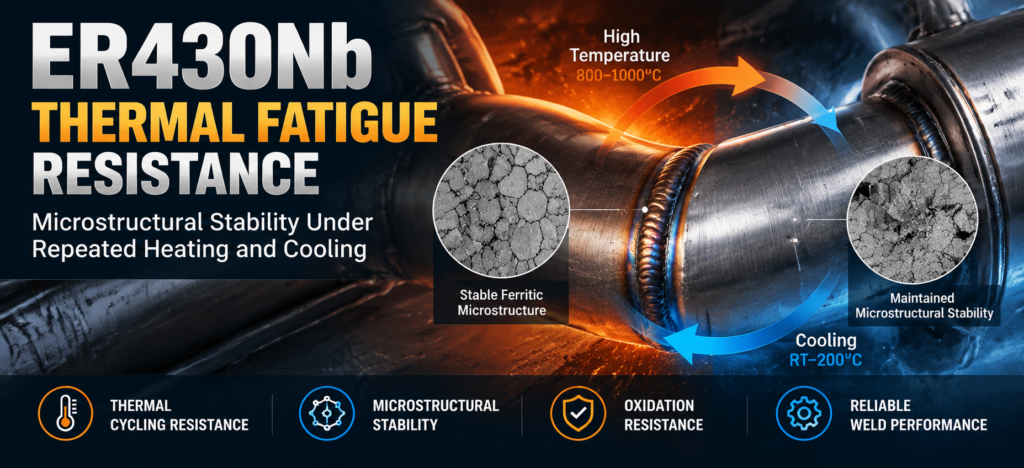
ER430Nb Thermal Fatigue Resistance: Microstructural Stability Under Repeated Heating and Cooling
Thermal fatigue is a critical consideration when ferritic stainless steel welded components operate under repeated heating and cooling. Temperature fluctuations generate cyclic thermal stresses that can gradually damage the weld metal, heat-affected zone (HAZ), and surrounding base material. Over time, these stresses may initiate cracks, accelerate oxidation-related degradation, and reduce component service life.ER430Nb
ER430Nb is associated with niobium-stabilized ferritic stainless steel welding materials. Niobium plays an important metallurgical role by binding carbon and nitrogen through stable precipitates, helping control certain undesirable microstructural reactions. However, niobium stabilization alone does not guarantee superior thermal fatigue resistance. Actual performance depends on chemical composition, welding conditions, joint geometry, temperature range, oxidation exposure, and the frequency of thermal cycling.
Understanding ER430Nb thermal fatigue resistance therefore requires examining how its microstructure responds to repeated temperature changes and how welding-related factors influence long-term joint reliability.
1. Understanding Thermal Fatigue in ER430Nb Welded Joints
Thermal fatigue occurs when repeated temperature variations produce cyclic stresses that contribute to progressive material damage. Unlike conventional mechanical fatigue, where externally applied loads are the primary driving force, thermal fatigue is strongly influenced by temperature gradients and constraints on thermal expansion and contraction.
When a welded component heats up, different regions expand at different rates. During cooling, these regions contract again. If expansion or contraction is restricted, thermal stresses develop across the joint.
Several factors influence ER430Nb welded joint performance:
Temperature range: Larger temperature fluctuations can increase cyclic strain and stress.
Heating and cooling rate: Rapid temperature changes can generate steep thermal gradients.
Geometric constraints: Rigid supports, sharp transitions, and restrained joints can increase local stress.
Microstructural condition: Grain size, phase distribution, precipitates, and local hardness influence crack initiation and propagation.
Oxidation environment: High-temperature oxidation can progressively damage exposed surfaces and affect crack development.
These factors interact rather than acting independently. A welded joint with a favorable microstructure may still experience premature failure if thermal gradients, residual stresses, or surface oxidation are severe.
2. How Niobium Stabilization Influences Microstructural Stability
Niobium stabilization is an important metallurgical feature of ferritic stainless steel welding materials. Its principal benefit is associated with controlling carbon- and nitrogen-related reactions that can influence corrosion resistance and mechanical behavior.
2.1 Control of Carbon and Nitrogen
Niobium has a strong affinity for carbon and nitrogen and can form niobium-rich carbides, nitrides, or carbonitrides, depending on the chemical composition and processing history.
By binding these interstitial elements, niobium can reduce their availability for certain chromium-rich carbide and nitride precipitation reactions. This helps limit chromium depletion near susceptible grain boundaries under appropriate conditions.
For welded components exposed to repeated heating and cooling, controlling these reactions can help preserve the intended metallurgical condition and reduce the risk of certain forms of corrosion-related degradation.
However, stabilization is not absolute. Its effectiveness depends on the niobium-to-carbon and nitrogen balance, the actual composition of the deposited weld metal, and the thermal history experienced during fabrication and service.
2.2 Grain Structure and High-Temperature Exposure
Grain size is another important factor affecting the thermal fatigue behavior of ferritic stainless steel welds.
Welding exposes the weld metal and adjacent HAZ to high temperatures. Depending on the alloy composition and thermal cycle, these regions may develop coarse ferritic grains or other microstructural features that influence toughness and crack propagation.
Niobium-containing weld metals may exhibit favorable grain structures under suitable conditions, but the presence of niobium does not automatically prevent grain coarsening.
Excessive heat input, prolonged high-temperature exposure, and repeated welding thermal cycles can still affect grain morphology and local mechanical properties.
For this reason, ER430Nb thermal fatigue performance should be evaluated through actual microstructural examination rather than inferred solely from the filler metal designation.
2.3 Precipitate Evolution During Thermal Cycling
Repeated heating and cooling may alter the size, distribution, and stability of precipitates within the weld metal and HAZ.
Depending on the temperature range and exposure duration, precipitation, coarsening, or partial dissolution may occur. These changes can influence local strength, ductility, and resistance to crack initiation.
The resulting behavior depends on the alloy chemistry and the specific time-temperature history. It is therefore important to distinguish the known stabilization mechanism of niobium from experimentally verified precipitate evolution in a particular ER430Nb welded joint.
3. Thermal Fatigue Mechanisms in ER430Nb Welded Components
Thermal fatigue damage typically develops through a sequence of stress accumulation, crack initiation, and crack propagation.
3.1 Cyclic Thermal Stress and Residual Stress
Welding introduces residual stresses because the weld metal and surrounding base material heat and cool unevenly. During subsequent service, repeated temperature changes impose additional thermal stresses on this already nonuniform stress field.
Local stress concentrations may develop near weld toes, roots, geometric transitions, and regions with abrupt changes in stiffness.
If cyclic stresses are sufficiently high, small surface imperfections or microstructural discontinuities may become crack initiation sites.
Practical control measures include:
Optimizing joint design to reduce unnecessary stress concentrations.
Maintaining consistent weld bead geometry.
Controlling welding heat input and sequence.
Evaluating restraint conditions during fabrication.
Inspecting areas exposed to severe thermal gradients.
3.2 Oxidation-Assisted Surface Degradation
High-temperature oxidation can contribute to thermal fatigue damage, particularly in components exposed to hot gases and repeated cooling.
Ferritic stainless steels rely on chromium-rich protective oxide scales to limit further oxidation. However, oxide scales may crack or detach when thermal cycling produces repeated expansion and contraction.
Once the protective scale becomes damaged, fresh metal may be exposed to the environment. Repeated oxidation and scale disruption can progressively degrade the surface.
Surface roughness, local composition, temperature, and the chemical environment all influence this process.
Niobium stabilization may improve certain aspects of material performance, but it should not be treated as a substitute for adequate chromium content, appropriate material selection, or environmental compatibility.
3.3 Crack Propagation Through the Weld Metal and HAZ
Once a crack initiates, its propagation depends on cyclic stress, local strain, microstructure, and environmental conditions.
The weld metal and HAZ may respond differently because they experience different thermal histories and can contain different grain structures, phase distributions, and hardness levels.
A coarse-grained region may exhibit reduced toughness under certain conditions. Localized hard phases or abrupt hardness variations may also influence strain distribution and crack development.
Consequently, thermal fatigue assessment should examine the complete welded joint rather than focusing exclusively on the deposited weld metal.
4. Factors Affecting ER430Nb Thermal Fatigue Resistance
4.1 Welding Heat Input
Heat input influences the weld pool, HAZ width, grain growth, and cooling behavior.
Excessive heat input can increase high-temperature exposure and promote grain coarsening. Insufficient heat input, on the other hand, may lead to incomplete fusion or inadequate penetration.
The objective is to establish a suitable process window that provides sound fusion without unnecessarily increasing thermal damage.
Heat input should be controlled according to the qualified welding procedure, base metal thickness, joint configuration, and applicable fabrication requirements.
4.2 Shielding Gas and Weld Metal Chemistry
Shielding gas affects arc stability, weld pool protection, and the chemical composition of the deposited metal.
Unsuitable gas composition or inadequate shielding can increase oxidation and alter the final weld metal chemistry. Changes in carbon content and alloying-element retention may influence phase formation and microstructural characteristics.
Because niobium stabilization depends on the relationship between niobium, carbon, nitrogen, and other alloying elements, shielding conditions should be selected according to the applicable filler metal specification and welding procedure.
4.3 Cooling Conditions and Thermal Gradients
Cooling conditions influence the temperature distribution and the microstructural transformations that occur after welding.
Rapid cooling and slow cooling can produce different outcomes depending on the composition of the base metal and weld deposit. Neither condition should be considered universally beneficial without examining the specific alloy system.
During service, rapid heating and cooling may also generate steep temperature gradients that increase local thermal stress.
Designing for more uniform temperature distribution, where practical, can help reduce the severity of thermal fatigue loading.
4.4 Joint Geometry and Mechanical Restraint
Even when material selection and welding procedures are appropriate, unfavorable geometry may lead to localized thermal stress concentrations.
Sharp corners, abrupt thickness changes, poorly aligned components, and rigid constraints can increase local stress during expansion and contraction.
Smooth transitions, suitable joint dimensions, and appropriate support arrangements can help distribute thermal strains more evenly.
5. How to Evaluate ER430Nb Thermal Fatigue Performance
A reliable assessment should combine thermal cycling tests, microstructural characterization, mechanical evaluation, and examination of the final fracture condition.
5.1 Thermal Cycling Tests
Representative welded specimens can be subjected to repeated heating and cooling under controlled conditions.
Important test parameters include:
Maximum and minimum temperatures.
Heating and cooling rates.
Dwell time at each temperature.
Number of thermal cycles.
Mechanical restraint during cycling.
Oxidizing or corrosive test environment.
The test conditions should reflect the intended service application as closely as practical.
For comparative testing, the specimen geometry, welding procedure, surface condition, and thermal cycle should be consistent. Otherwise, observed differences may result from experimental variables rather than material performance.
5.2 ER430Nb Metallographic Examination
Optical microscopy and scanning electron microscopy can help identify changes in grain morphology, phase distribution, precipitates, and crack paths.
Before-and-after comparisons can reveal whether thermal exposure has produced measurable microstructural changes.
Where necessary, additional methods such as energy-dispersive X-ray spectroscopy or electron backscatter diffraction can help characterize precipitate chemistry and grain structure.
These techniques are particularly useful when investigating whether cracking is associated with grain boundaries, local phase changes, or oxidation-related damage.
5.3 ER430Nb Mechanical Testing and Crack Analysis
Hardness measurements can identify local variations across the weld metal, fusion boundary, and HAZ. Tensile or fatigue testing may provide additional information about mechanical performance, depending on the application.
Fractographic examination can help distinguish fatigue-related crack growth from other failure mechanisms.
Importantly, conventional fatigue strength measured under mechanical loading is not equivalent to thermal fatigue resistance. A material that performs well in one test does not necessarily exhibit the same ranking under cyclic temperature changes.
5.4 ER430Nb Oxidation and Corrosion Assessment
For components operating in hot, oxidizing environments, thermal cycling should be considered together with oxidation testing.
Relevant observations include mass change, oxide scale adherence, surface cracking, metal loss, and the condition of the underlying material.
Where salt deposits, condensates, or corrosive gases are present, testing should reproduce the relevant environmental exposure rather than relying exclusively on dry-air oxidation results.
6. Practical Strategies for Improving Welded Joint Durability
Improving ER430Nb welded joint durability requires coordinated control of material selection, fabrication, and service conditions.
First, verify material compatibility. Confirm the filler metal classification, chemical composition, base metal grade, and intended service temperature. Do not assume that all niobium-stabilized ferritic stainless steel materials have identical properties.
Second, qualify the welding procedure. Establish appropriate heat input, shielding gas, travel speed, and interpass conditions. Verify fusion quality and avoid unnecessary high-temperature exposure.
Third, reduce local stress concentrations. Optimize joint geometry, weld profile, alignment, and mechanical restraint to limit severe cyclic strains.
Fourth, control surface condition. Remove contamination and evaluate oxidation protection where the operating environment requires it. Inspect exposed weld surfaces for cracking, scale damage, and other signs of deterioration.
Fifth, validate performance through representative testing. Where thermal fatigue is a critical design requirement, use controlled thermal cycling tests and post-test examination to verify that the joint meets its intended service requirements.
Post-weld heat treatment should not be applied automatically. Its suitability depends on the specific material classification, joint requirements, and qualified procedure.
7. ER430Nb Thermal Fatigue Resistance: Frequently Asked Questions
Does niobium improve thermal fatigue resistance?
Niobium can improve the stability of certain ferritic stainless steel microstructures by binding carbon and nitrogen and influencing precipitation behavior. However, its effect on thermal fatigue depends on the complete alloy composition, weld microstructure, thermal cycle, and service environment.
Why can ER430Nb welded joints crack after repeated heating and cooling?
Repeated temperature changes can generate cyclic thermal stresses, particularly when expansion and contraction are restrained. Residual stress, weld geometry, local microstructural variations, oxidation, and surface imperfections may contribute to crack initiation and propagation.
Does a finer grain structure always provide better thermal fatigue performance?
Not necessarily. Grain size influences mechanical behavior, but thermal fatigue resistance also depends on ductility, phase distribution, precipitates, residual stress, oxidation, and the applied temperature cycle. A complete assessment requires representative testing.
Is thermal fatigue resistance the same as high-temperature oxidation resistance?
No. Thermal fatigue concerns damage caused by repeated temperature changes and associated cyclic stresses. High-temperature oxidation concerns chemical reactions between the material and its environment. Both mechanisms may interact during service, but they require different evaluation methods.
How can ER430Nb thermal fatigue resistance be verified?
The most reliable approach combines representative thermal cycling tests with metallographic examination, mechanical testing where appropriate, and analysis of crack initiation and propagation. Results should be interpreted against the intended service conditions and applicable acceptance criteria.
ER430Nb Conclusion
ER430Nb thermal fatigue resistance depends on the interaction between niobium stabilization, weld microstructure, thermal stress, oxidation, and fabrication quality. Niobium can help control carbon- and nitrogen-related metallurgical reactions, but it cannot independently prevent grain coarsening, cyclic cracking, or oxidation-assisted degradation.
For components exposed to repeated heating and cooling, reliable performance requires a systematic approach: select compatible materials, control the welding thermal cycle, minimize stress concentrations, assess the operating environment, and validate the welded joint under representative conditions.
By combining metallurgical analysis with practical welding controls and thermal cycling evaluation, engineers can better understand ER430Nb welded joint behavior and make informed decisions about long-term durability.