
ER5356 Aluminum MIG Welding: Best Shielding Gas for Clean and Strong Welds
ER5356 is one of the most widely used aluminum MIG welding wires for applications requiring good strength, corrosion resistance, and reliable performance. However, selecting the correct shielding gas is just as important as choosing the right filler wire.
The shielding gas affects arc stability, weld penetration, bead appearance, cleaning action, travel speed, and overall weld quality. Using an unsuitable gas can lead to porosity, excessive soot, unstable arcs, incomplete fusion, or unattractive weld beads.
This guide explains the best shielding gas for ER5356 aluminum MIG welding, compares common gas options, and provides practical recommendations for different aluminum thicknesses and welding conditions.
What Is ER5356 Aluminum MIG Welding Wire?
ER5356 is an aluminum-magnesium filler metal containing approximately 5% magnesium. It is commonly used for welding aluminum alloys that require higher tensile strength than welds made with general-purpose aluminum-silicon filler metals.
Typical applications include:
Marine structures
Aluminum boats
Storage tanks
Truck bodies
Trailers
Automotive components
Bicycle frames
Pressure vessels
Structural aluminum fabrication
General aluminum repair
ER5356 offers good corrosion resistance, strong weld deposits, and excellent color matching after anodizing. It is frequently used for welding 5XXX-series aluminum alloys and certain 6XXX-series base materials.
To obtain these benefits, the weld pool must be protected from oxygen, nitrogen, hydrogen, and other atmospheric contaminants. This protection is provided by the shielding gas.
What Is the Best Shielding Gas for ER5356 Aluminum MIG Welding?
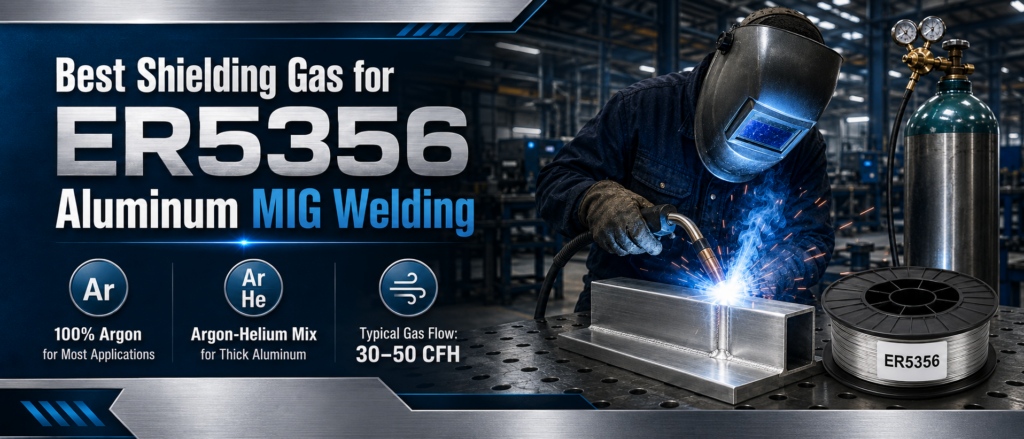
For most ER5356 aluminum MIG welding applications, 100% argon is the best shielding gas.
Pure argon provides:
Easy arc starting
Stable metal transfer
Smooth weld bead appearance
Good oxide-cleaning action
Low spatter
Reliable shielding coverage
Good performance on thin and medium-thickness aluminum
Argon is especially suitable for short-circuit, pulsed-spray, and spray-transfer MIG welding processes used on aluminum.
For thicker aluminum sections or applications requiring deeper penetration and faster travel speeds, an argon-helium mixture may provide better results.
Why ER5356 100% Argon Is the Standard Choice
Aluminum reacts quickly with the surrounding atmosphere when heated. Pure argon creates an inert shielding environment around the arc and molten weld pool, preventing atmospheric contamination.
Stable Arc Performance
Argon has a relatively low ionization potential, making it easier to establish and maintain the welding arc. This is important when welding aluminum because aluminum wire is soft and requires consistent feeding and arc behavior.
A stable arc helps reduce:
Arc wandering
Irregular bead shape
Excessive spatter
Burnback
Inconsistent penetration
Good Cleaning Action
Aluminum surfaces naturally develop a thin oxide layer. This oxide has a much higher melting temperature than the aluminum underneath it.
Although the base material should always be cleaned before welding, argon supports effective cathodic cleaning around the arc. This helps break up remaining surface oxides and improves weld-pool wetting.
Smooth Bead Appearance
Pure argon generally produces a smooth, bright, and well-defined weld bead. It is an excellent choice when appearance is important, such as on visible marine, automotive, architectural, and decorative aluminum components.
Suitable for Thin Aluminum
Argon produces a more concentrated and controllable arc than helium-rich mixtures. This makes it easier to weld thin aluminum without excessive heat input, distortion, or burn-through.
Can You Use an Argon-Helium Mixture with ER5356?
Yes. Argon-helium mixtures can be used with ER5356 aluminum MIG wire, especially when welding thicker aluminum.
Helium increases the heat energy transferred into the workpiece. This can improve penetration and allow higher welding speeds.
Argon-helium mixtures may be useful for:
Thick aluminum plates
Large structural components
High-production welding
Joints with high heat-loss characteristics
Applications requiring deeper penetration
Welding aluminum with high thermal conductivity
Common mixtures contain argon as the primary gas with a smaller percentage of helium. Higher helium content produces greater heat input but may also make arc starting and control more difficult.
ER5356 Advantages of Argon-Helium Shielding Gas
Compared with pure argon, an argon-helium mixture can provide several benefits.
Deeper Weld Penetration
Helium produces a hotter arc, allowing more energy to reach the base material. This is useful when welding thick aluminum sections where pure argon may not provide sufficient penetration at practical travel speeds.
Higher Welding Speed
The additional heat from helium can improve weld-pool fluidity and allow the operator to increase travel speed while maintaining proper fusion.
Improved Fusion on Thick Material
Aluminum transfers heat away from the weld area very quickly. Helium helps compensate for this rapid heat loss, reducing the risk of cold lap or incomplete fusion.
Wider Weld Bead
Argon-helium mixtures often produce a wider and flatter weld profile. This may be beneficial for certain groove welds, fillet welds, and multi-pass welding procedures.
Disadvantages of Argon-Helium Mixtures
Although helium can improve penetration, it is not always the best option.
Possible disadvantages include:
More difficult arc starting
Higher gas consumption
Increased heat input
Greater risk of distortion on thin aluminum
Less stable arc behavior
Higher operating cost
More complicated parameter adjustment
For most general fabrication work, pure argon remains the most practical and economical choice.
Can CO₂ Be Used for ER5356 Aluminum MIG Welding?
Carbon dioxide should not be used for MIG welding aluminum with ER5356 wire.
CO₂ is an active gas that reacts with molten aluminum. It can cause severe oxidation, contamination, porosity, excessive soot, and poor weld quality.
Even small amounts of CO₂ in the shielding gas can create problems when welding aluminum.
Gas mixtures designed for carbon steel MIG welding are therefore unsuitable for ER5356 aluminum welding.
Can Oxygen Be Added to the Shielding Gas?
Oxygen should not be intentionally added to shielding gas for aluminum MIG welding.
Small oxygen additions are sometimes used when welding certain ferrous metals, but aluminum requires an inert shielding environment. Oxygen can react with the molten aluminum and produce oxide inclusions, surface contamination, porosity, and unstable weld characteristics.
For ER5356 welding, use pure argon or an appropriate argon-helium mixture.
Can Nitrogen Be Used as a Shielding Gas?
Nitrogen is generally not recommended as the primary shielding gas for ER5356 aluminum MIG welding.
Nitrogen can react with aluminum at welding temperatures and may contribute to contamination, porosity, and reduced mechanical performance.
Inert gases such as argon and helium are safer and more reliable choices.
Pure Argon vs. Argon-Helium for ER5356
The correct shielding gas depends mainly on material thickness, joint design, welding position, equipment capacity, and production requirements.
Choose 100% Argon When:
Welding thin or medium-thickness aluminum
Performing general fabrication
Welding in different positions
Appearance is important
Easy arc starting is required
Using pulsed MIG welding
Heat input must be controlled
Lower gas costs are preferred
Choose an Argon-Helium Mixture When:
Welding thick aluminum plate
Greater penetration is required
Travel speed needs to be increased
The joint absorbs heat rapidly
Welding large aluminum components
Pure argon does not provide sufficient fusion
For many workshops, 100% argon can handle the majority of ER5356 welding jobs.
Recommended Shielding Gas Flow Rate
The correct flow rate depends on the torch design, nozzle size, welding current, joint configuration, and working environment.
A typical starting range for aluminum MIG welding is approximately:
15 to 25 liters per minute
The flow rate may need to be increased when using a large nozzle or high welding current. However, excessive gas flow can create turbulence and pull surrounding air into the shielding zone.
Too much shielding gas can cause the same problems as insufficient gas coverage, including porosity and oxidation.
Adjust the flow rate until the weld pool is fully protected without creating unnecessary turbulence.
Signs of Incorrect Gas Flow
Possible signs of insufficient shielding gas include:
Porosity inside or on the weld surface
Black soot around the weld
Oxidized or dull weld beads
Irregular arc behavior
Poor weld-pool wetting
Contaminated weld surfaces
Possible signs of excessive gas flow include:
Turbulent gas noise
Unstable arc behavior
Air being drawn into the shielding zone
Increased gas consumption
Random porosity
Check the gas regulator, flowmeter, hoses, torch connections, and nozzle before adjusting welding parameters.
How Wind Affects Aluminum MIG Shielding Gas
Aluminum MIG welding is highly sensitive to air movement. Even a small draft can disturb the argon shield and expose the molten weld pool to the atmosphere.
Common sources of airflow include:
Open doors
Cooling fans
Exhaust systems
Outdoor wind
Compressed-air tools
Nearby machinery
When welding outdoors, use suitable wind barriers or welding screens. Simply increasing the gas flow is not always effective because high flow can create turbulence.
The best solution is to control the airflow around the welding area.
Gas Nozzle Selection and Maintenance
The gas nozzle helps distribute shielding gas evenly around the wire and weld pool.
For consistent shielding:
Use the correct nozzle size for the application
Keep the nozzle free from spatter and debris
Check the gas diffuser for damage
Inspect O-rings and torch connections
Avoid excessive contact-tip recess or extension
Replace damaged nozzles promptly
A partially blocked nozzle can create uneven gas coverage even when the flowmeter shows the correct gas flow.
Preparing Aluminum Before Welding
The best shielding gas cannot compensate for poor surface preparation. Aluminum must be clean before welding.
Remove Oil and Grease
Use a suitable solvent to remove oil, grease, cutting fluid, adhesive residue, and other hydrocarbons.
Always remove grease before brushing the surface. Brushing an oily surface can spread contamination and push it deeper into surface scratches.
Remove the Oxide Layer
Use a clean stainless-steel brush dedicated only to aluminum. Do not use a brush that has previously been used on carbon steel or stainless steel.
Brush the joint area shortly before welding to reduce the formation of a new oxide layer.
Keep ER5356 Wire Clean and Dry
Store aluminum welding wire in a dry, clean location. Moisture and surface contamination can introduce hydrogen into the weld pool and increase the risk of porosity.
Do not leave wire exposed to dust, humidity, grinding particles, or chemical vapors.
Preventing Porosity in ER5356 Aluminum Welds
Porosity is one of the most common problems in aluminum MIG welding. It is usually caused by hydrogen or atmospheric contamination entering the molten weld pool.
To reduce porosity:
Use pure, high-quality argon
Check all gas connections for leaks
Maintain the correct flow rate
Protect the welding area from drafts
Clean the base material thoroughly
Keep the wire dry
Remove moisture from the workpiece
Maintain a consistent torch angle
Keep the nozzle close enough for proper coverage
Avoid an excessively long arc
If porosity continues, inspect the entire gas delivery system instead of only increasing the gas flow.
Torch Angle and Gas Coverage
A push technique is generally recommended for aluminum MIG welding.
Pointing the torch slightly in the direction of travel allows the shielding gas to cover the leading edge of the weld pool and supports better oxide-cleaning action.
An excessive torch angle can expose the weld pool to the atmosphere. Maintain a moderate push angle and keep the contact-tip-to-work distance consistent.
A stable torch position improves:
Gas coverage
Arc control
Bead shape
Penetration consistency
Weld-pool visibility
Choosing the Right Gas for Different Aluminum Thicknesses
Thin Aluminum
For thin aluminum sheet, 100% argon is usually the best option. It provides stable arc performance and controlled heat input, reducing the risk of burn-through and distortion.
Medium-Thickness Aluminum
Pure argon remains suitable for most medium-thickness applications, especially when using pulsed MIG or spray-transfer welding.
Proper joint preparation and adequate welding current are important for achieving full fusion.
Thick Aluminum
For thick plate, an argon-helium mixture may improve penetration and productivity. Preheating may also be considered when appropriate, but excessive preheat should be avoided because ER5356 can lose strength when exposed to prolonged high temperatures.
Best Overall Recommendation
For general ER5356 aluminum MIG welding, use 100% argon as the first choice.
It offers the best balance of:
Arc stability
Weld cleanliness
Bead appearance
Operator control
Process flexibility
Availability
Cost efficiency
For thick aluminum, high-speed production, or joints requiring greater heat input, consider an argon-helium mixture.
Avoid shielding gases containing carbon dioxide, oxygen, or other reactive components because they can contaminate aluminum and reduce weld quality.
Frequently Asked Questions
What gas should I use with ER5356 wire?
Use 100% argon for most ER5356 aluminum MIG welding applications. An argon-helium mixture can be used for thicker materials requiring additional penetration.
Is pure argon good for aluminum MIG welding?
Yes. Pure argon is the standard shielding gas for aluminum MIG welding because it provides stable arc starting, effective shielding, smooth weld beads, and good cleaning action.
Can I use a 75% argon and 25% CO₂ mixture for ER5356?
No. Argon-CO₂ mixtures are intended mainly for ferrous metals. CO₂ reacts with molten aluminum and can cause oxidation, porosity, soot, and poor weld quality.
Does helium improve aluminum MIG welding?
Helium increases arc heat, penetration, and potential travel speed. It is useful for thick aluminum but may make arc control more difficult and increase operating costs.
Why is my ER5356 weld porous even with argon?
Possible causes include gas leaks, drafts, contaminated aluminum, wet wire, blocked nozzles, incorrect flow rate, poor torch angle, or an excessively long contact-tip-to-work distance.
What shielding gas flow rate should I use?
A starting range of 15 to 25 liters per minute is common. The correct setting depends on nozzle size, current, joint design, torch position, and surrounding airflow.
ER5356 Conclusion
The best shielding gas for ER5356 aluminum MIG welding is 100% argon for most thin, medium, and general fabrication applications. It provides reliable arc stability, good cleaning action, low spatter, and an attractive weld appearance.
When welding thick aluminum or when deeper penetration and faster travel speeds are required, an argon-helium mixture may be a better choice.
Regardless of the gas selected, successful aluminum MIG welding also depends on correct gas flow, clean materials, proper wire storage, good torch technique, and protection from drafts. Combining these practices with ER5356 filler wire will help produce clean, strong, and consistent aluminum welds.