

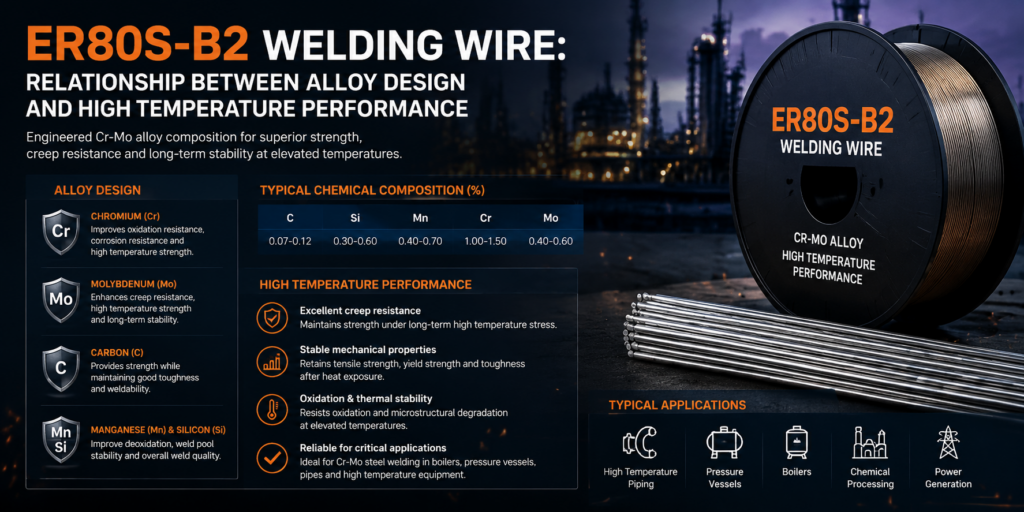
ER80S-B2 Welding Wire: Relationship Between Alloy Design and High Temperature Performance
ER80S-B2 welding wire is a low alloy steel filler metal specially designed for welding heat-resistant Cr-Mo steels where stable mechanical performance at elevated temperatures is required. Its excellent high temperature capability is mainly determined by its carefully controlled alloy design, especially the balance of chromium (Cr), molybdenum (Mo), carbon, manganese, and silicon.
Unlike conventional carbon steel welding wires, ER80S-B2 is engineered to maintain strength, toughness, and structural stability under prolonged thermal exposure. Understanding the relationship between alloy composition and high temperature performance helps engineers select the appropriate filler metal for demanding welding applications.
1. Alloy Design of ER80S-B2 Welding Wire
The performance of ER80S-B2 welding wire comes from its optimized Cr-Mo alloy system. The typical composition includes approximately 1.25% chromium and 0.5% molybdenum, combined with controlled levels of carbon, manganese, and silicon.
Each alloying element contributes a specific function:
Chromium (Cr): Improving Heat Resistance and Oxidation Stability
Chromium is one of the most important elements in ER80S-B2 welding wire.
Its main functions include:
Enhancing oxidation resistance at elevated temperatures
Improving corrosion resistance
Increasing hardenability of weld metal
Maintaining microstructural stability during thermal exposure
The addition of chromium helps the weld metal resist degradation when exposed to high temperature environments.
Molybdenum (Mo): Enhancing Creep Resistance
Molybdenum plays a critical role in high temperature applications.
Its advantages include:
Improving high temperature strength
Increasing resistance to creep deformation
Stabilizing the weld structure during long-term service
At elevated temperatures, materials are vulnerable to gradual deformation under constant stress. The presence of molybdenum helps ER80S-B2 weld metal maintain load-bearing capability over extended periods.
Carbon Control: Balancing Strength and Toughness
Carbon contributes to weld metal strength by forming strengthening phases. However, excessive carbon can reduce toughness and increase brittleness.
Therefore, ER80S-B2 welding wire uses controlled carbon content to achieve a balance between:
Tensile strength
Weldability
Impact toughness
Long-term reliability
This balance is particularly important for components operating under thermal cycling conditions.
2. How Alloy Design Determines High Temperature Performance
High temperature welding applications require more than initial strength. The weld metal must maintain stable properties after prolonged exposure to heat.
The alloy design of ER80S-B2 provides several key performance advantages.
2.1 Improved Creep Resistance
Creep resistance is one of the most important requirements for high temperature steel welding.
During long-term operation, metals exposed to high temperature and constant stress may slowly deform. ER80S-B2 achieves improved creep resistance through:
Chromium strengthening
Molybdenum solid solution strengthening
Stable weld microstructure
These characteristics allow the welded joint to maintain mechanical integrity during extended service conditions.
2.2 Stable Mechanical Properties After Heat Treatment
Post-weld heat treatment (PWHT) is commonly required for Cr-Mo steel welding applications.
A properly designed ER80S-B2 weld metal can maintain:
High tensile strength
Suitable yield strength
Good elongation
Improved structural stability
After heat treatment, the alloy system helps reduce residual stress while maintaining the required mechanical performance.
2.3 Resistance to Thermal Degradation
High temperature environments can cause:
Microstructural changes
Strength reduction
Embrittlement
Loss of toughness
The Cr-Mo alloy system in ER80S-B2 reduces these risks by providing better thermal stability compared with ordinary carbon steel filler metals.
3. Relationship Between ER80S-B2 Composition and Weld Quality
A high-performance welding wire requires not only alloy strength but also excellent weldability.
The controlled composition of ER80S-B2 contributes to:
ER80S-B2 Smooth Welding Performance
Balanced silicon and manganese levels help improve:
Deoxidation ability
Weld pool stability
Bead appearance
ER80S-B2 Reduced Defect Risk
Controlled impurity levels help minimize issues such as:
Cracking sensitivity
Embrittlement tendency
Reduced toughness
Reliable Joint Performance
A well-designed filler metal ensures that the weld zone can achieve properties closer to the base material.
4. Applications of ER80S-B2 Welding Wire
Because of its high temperature capability, ER80S-B2 welding wire is commonly used for Cr-Mo steel welding applications, including:
High temperature piping systems
Pressure vessels
Boiler components
Heat-resistant steel structures
Energy and chemical processing equipment
These applications require welded joints that can withstand elevated temperatures, pressure conditions, and long service periods.
5. Why Alloy Design Matters in High Temperature Welding
Selecting a welding wire for high temperature service is not only about achieving sufficient strength during fabrication. The most important consideration is whether the weld metal can maintain performance throughout its service life.
The alloy design of ER80S-B2 demonstrates how controlled additions of chromium and molybdenum can improve:
High temperature strength
Creep resistance
Oxidation resistance
Long-term reliability
Therefore, understanding the relationship between composition and performance is essential for achieving durable welded structures.
ER80S-B2 Conclusion
ER80S-B2 welding wire represents a carefully engineered Cr-Mo filler metal designed for demanding high temperature welding applications. Its performance is directly related to its alloy design, where chromium provides heat resistance and molybdenum improves creep strength.
By balancing alloy elements, ER80S-B2 achieves a combination of strength, toughness, weldability, and long-term thermal stability. This makes it a reliable choice for welding applications where high temperature performance and structural durability are critical.