

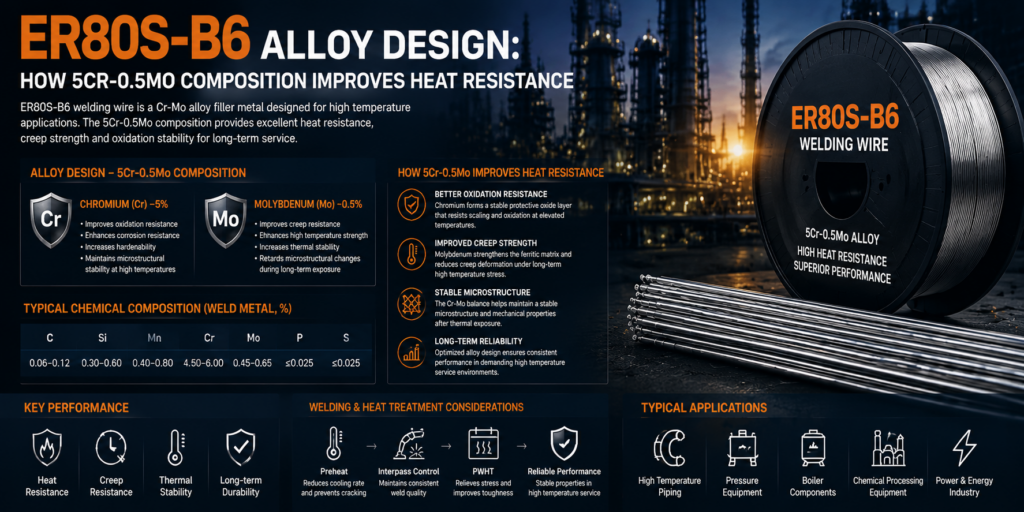
ER80S-B6 Alloy Design: How 5Cr-0.5Mo Composition Improves Heat Resistance
ER80S-B6 welding wire is a chromium-molybdenum low alloy filler metal developed for high temperature welding applications where strength, heat resistance, and long-term reliability are critical. Its outstanding performance comes from its carefully balanced 5% chromium (Cr) and 0.5% molybdenum (Mo) alloy system.
Unlike conventional carbon steel welding wires, ER80S-B6 is designed to maintain stable mechanical properties under elevated temperatures and prolonged service conditions. The combination of chromium and molybdenum improves oxidation resistance, creep resistance, and microstructural stability, making it suitable for welding heat-resistant Cr-Mo steels used in demanding industrial environments.
Understanding the relationship between alloy design and high temperature performance is essential for selecting the right filler metal for pressure equipment, high temperature piping, and other thermal service applications.
1. Understanding the 5Cr-0.5Mo Alloy Design of ER80S-B6
The performance of It is mainly determined by its chromium-molybdenum alloy composition. The typical weld metal contains approximately 4.5–6.0% chromium and 0.45–0.65% molybdenum, combined with controlled levels of carbon, manganese, silicon, and other elements.
Each alloying element contributes differently to the final weld performance.
Chromium (Cr): Improving Heat Resistance and Oxidation Stability
Chromium is the key element responsible for the heat-resistant characteristics of ER80S-B6.
The addition of chromium provides several important benefits:
Improves oxidation resistance at elevated temperatures
Enhances corrosion resistance
Increases hardenability of weld metal
Helps maintain stable microstructure during thermal exposure
At high temperatures, oxidation can gradually damage steel surfaces and reduce mechanical strength. Chromium forms more stable oxide layers, helping protect the weld metal from degradation.
The higher chromium content compared with lower-alloy Cr-Mo welding wires allows ER80S-B6 to provide improved resistance in more demanding thermal environments.
2. The Role of Molybdenum in High Temperature Strength
Molybdenum is another essential element in ER80S-B6 alloy design.
Its primary functions include:
Improving Creep Resistance
Creep is a slow deformation process that occurs when metals are exposed to high temperature and constant stress for long periods.
Molybdenum improves resistance to creep deformation by:
Strengthening the ferritic matrix
Improving high temperature hardness
Retarding microstructural changes during service
This allows ER80S-B6 weld metal to maintain load-bearing capability during long-term operation.
Enhancing Thermal Stability
High temperature applications often involve repeated heating and cooling cycles. These conditions can cause:
Grain structure changes
Strength reduction
Loss of toughness
The Cr-Mo alloy system improves structural stability and helps the weld maintain reliable mechanical properties after thermal exposure.
3. How 5Cr-0.5Mo Composition Improves Heat Resistance
The combination of chromium and molybdenum creates a balanced alloy system with multiple advantages.
3.1 Better Resistance to High Temperature Oxidation
High temperature environments accelerate oxidation reactions.
Chromium in ER80S-B6 helps reduce oxidation damage by improving the protective characteristics of the weld surface.
This is especially important for components exposed to:
Hot gases
Steam environments
Chemical processing conditions
Thermal cycling
3.2 Improved Creep Strength
For high temperature equipment, strength at room temperature is not enough. The weld metal must maintain performance after thousands of hours of service.
The 5Cr-0.5Mo alloy design improves:
Long-term strength retention
Resistance to creep deformation
Structural reliability under thermal stress
This makes ER80S-B6 suitable for applications requiring extended high temperature operation.
3.3 Stable Weld Microstructure
A stable microstructure is essential for maintaining weld quality.
The alloy design helps control:
Phase transformation behavior
Hardness distribution
Mechanical property stability
After welding and heat treatment, ER80S-B6 can achieve a balanced combination of strength and toughness.
4. ER80S-B6 Welding Performance and Heat Treatment Considerations
Because It is an air-hardening Cr-Mo filler metal, welding procedures require careful control of thermal conditions.
Important factors include:
Preheating
Preheating reduces the cooling rate of the weld area and helps minimize:
Hydrogen-related cracking
Excessive hardness
Residual stress
Interpass Temperature Control
Maintaining proper interpass temperature helps achieve consistent weld microstructure and mechanical properties.
Post Weld Heat Treatment (PWHT)
PWHT is commonly applied to Cr-Mo steel welding applications.
Benefits include:
Reduction of residual stress
Improvement of toughness
Stabilization of weld structure
Optimization of mechanical properties
Proper heat treatment allows ER80S-B6 weld metal to achieve its designed high temperature performance.
5. Applications of ER80S-B6 Welding Wire
Due to its 5Cr-0.5Mo alloy design, ER80S-B6 is widely used for welding heat-resistant steels in industries requiring reliable high temperature performance.
Typical applications include:
ER80S-B6 High Temperature Piping
ER80S-B6 is suitable for welded joints exposed to elevated temperatures and pressure conditions.
Pressure Equipment
The combination of strength and thermal stability makes it suitable for pressure-containing components operating under demanding conditions.
ER80S-B6 Chemical Processing Equipment
The improved corrosion and oxidation resistance provided by chromium makes it suitable for environments involving heat and chemical exposure.
ER80S-B6 Energy Industry Components
ER80S-B6 is commonly selected where welded structures require long-term mechanical stability at elevated temperatures.
6. ER80S-B6 vs Conventional Welding Wire: Why Alloy Design Matters
The main difference between ER80S-B6 and ordinary carbon steel welding wires is the ability to maintain performance at high temperatures.
Conventional welding wires may experience:
Reduced strength
Faster oxidation
Microstructural degradation
after prolonged thermal exposure.
In contrast, ER80S-B6 benefits from:
| Performance Feature | Contribution |
|---|---|
| Chromium addition | Heat resistance and oxidation protection |
| Molybdenum addition | Creep resistance and high temperature strength |
| Controlled carbon content | Strength-toughness balance |
| Alloy stability | Long-term service reliability |
The alloy design allows ER80S-B6 to provide consistent performance in applications where ordinary filler metals cannot meet service requirements.
ER80S-B6 Conclusion
ER80S-B6 welding wire demonstrates how carefully controlled alloy design can significantly improve high temperature welding performance.
The 5Cr-0.5Mo composition provides a balanced combination of oxidation resistance, creep strength, thermal stability, and mechanical reliability. Chromium improves heat resistance, while molybdenum enhances high temperature strength and resistance to long-term deformation.
For industries requiring durable welded structures under elevated temperatures, ER80S-B6 offers a reliable solution through advanced Cr-Mo alloy engineering.
Understanding the connection between alloy composition and performance helps engineers select the correct filler metal and achieve safer, longer-lasting welded components.