

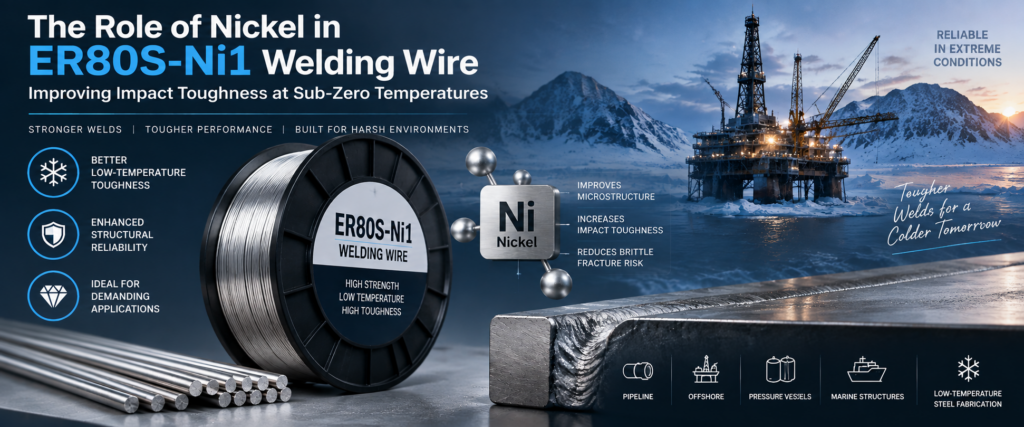
The Role of Nickel in ER80S-Ni1 Welding Wire: Improving Impact Toughness at Sub-Zero Temperatures
In low-temperature welding applications, maintaining high strength while preventing brittle fracture is one of the biggest challenges for engineers. As operating temperatures decrease, conventional carbon steel weld metals may experience reduced ductility and increased risk of cracking.ER80S-Ni1
ER80S-Ni1 welding wire is specifically designed for applications requiring reliable mechanical performance under sub-zero conditions. The key element that differentiates ER80S-Ni1 from conventional low-alloy welding wires is nickel (Ni). A controlled addition of nickel improves weld metal toughness, enhances microstructural stability, and helps maintain impact resistance at low temperatures.
This article explains how nickel works in ER80S-Ni1 welding wire and why it plays an important role in high-strength steel welding applications.
What Is ER80S-Ni1 Welding Wire?
ER80S-Ni1 is a low-alloy solid welding wire classified under AWS A5.28 specifications. It is commonly used for welding fine-grained steels and low-alloy steels where high strength and low-temperature toughness are required.
The wire typically contains approximately 1% nickel alloying, combined with elements such as manganese and silicon to achieve balanced weld metal properties. The addition of nickel allows the deposited weld metal to maintain good impact toughness when exposed to cold service environments.
Typical applications include:
Low-temperature structural steel fabrication
Pressure equipment welding
Offshore structures
Heavy engineering components
High-strength steel joints
The primary advantage of ER80S-Ni1 is not only its tensile strength, but its ability to resist brittle fracture when temperatures drop.
Why Low Temperatures Reduce Weld Metal Toughness
Steel behavior changes significantly under cold conditions.
At normal temperatures, many steels can absorb considerable impact energy through plastic deformation. However, when temperature decreases, some steel structures may transition from ductile behavior to brittle fracture.
This phenomenon is related to:
Reduced dislocation mobility
Changes in crystal deformation mechanisms
Increased sensitivity to microstructural defects
Higher crack propagation tendency
For welded structures, the weld metal and heat-affected zone are critical areas because welding thermal cycles can modify grain size and phase distribution.
Therefore, welding materials used in cold environments must provide:
High impact absorption capacity
Stable microstructure
Resistance to crack initiation
Reliable toughness after welding
This is where nickel alloying becomes important.
How Nickel Improves ER80S-Ni1 Welding Wire Performance
1. Nickel Enhances Low-Temperature Impact Toughness
The primary function of nickel in ER80S-Ni1 is improving impact toughness at reduced temperatures.
Nickel is an effective alloying element because it helps maintain ductility by stabilizing the weld metal structure. Even when exposed to sub-zero temperatures, nickel-containing weld metals can retain better energy absorption capability compared with non-nickel low-alloy weld metals.
The result is:
Improved Charpy impact performance
Reduced brittle fracture tendency
Better reliability in cold environments
ER80S-Ni1 welding wire is commonly selected when weld joints must maintain toughness at temperatures around -40°C to -50°C ranges, depending on welding conditions and requirements.
2. Nickel Helps Control Weld Metal Microstructure
The mechanical properties of weld metal are strongly influenced by its microstructure.
During cooling after welding, the deposited metal undergoes phase transformation. Nickel affects this transformation process by modifying the stability of different phases and supporting the formation of tougher microstructural constituents.
A properly controlled ER80S-Ni1 weld metal structure can contain:
Fine ferritic structures
Tough acicular ferrite components
Reduced coarse brittle regions
A finer and more balanced microstructure improves resistance to crack propagation.
3. Nickel Reduces the Risk of Brittle Fracture
Brittle fracture is especially dangerous in:
Offshore structures
Cold climate equipment
Storage tanks
Heavy steel fabrication
When temperature decreases, cracks can propagate rapidly through brittle regions.
Nickel contributes to improved fracture resistance by:
Increasing weld metal toughness
Improving deformation capability
Lowering sensitivity to low-temperature cracking
This makes ER80S-Ni1 a suitable choice for applications where safety and long-term reliability are critical.
Nickel Content and Welding Performance Balance
Although nickel improves toughness, its amount must be carefully controlled.
Too little nickel may not provide sufficient low-temperature performance.
Excessive nickel can:
Increase material cost
Influence weld metal transformation behavior
Affect strength-toughness balance
Therefore, ER80S-Ni1 uses a controlled nickel level to achieve a balance between:
Tensile strength
Yield strength
Impact toughness
Weldability
The approximately 1% nickel design provides an effective solution for high-strength low-temperature welding applications.
ER80S-Ni1 Compared with Conventional Carbon Steel Welding Wire
Compared with standard carbon steel welding wires, ER80S-Ni1 provides several advantages:
| Performance Area | ER80S-Ni1 Advantage |
|---|---|
| Low-temperature toughness | Higher impact resistance |
| Cold environment reliability | Improved fracture resistance |
| High-strength steel welding | Better mechanical compatibility |
| Structural safety | Reduced brittle failure risk |
| Service temperature range | Suitable for sub-zero applications |
For projects exposed to harsh environments, selecting the correct welding wire is essential for maintaining structural integrity.
Welding Considerations for ER80S-Ni1
To achieve the expected performance of ER80S-Ni1 welding wire, welding parameters must also be properly controlled.
Important factors include:
Heat Input Control
Excessive heat input may result in:
Larger grain size
Reduced toughness
Changes in weld microstructure
Optimized heat input helps maintain the desired mechanical properties.
Shielding Gas Selection
Proper shielding gas selection affects:
Arc stability
Weld appearance
Porosity control
Mechanical performance
Stable welding conditions help maximize the advantages of nickel alloying.
Storage and Handling
Moisture control is important for preventing:
Hydrogen-related defects
Porosity
Cold cracking risks
Correct storage practices ensure consistent weld quality.
Applications Where Nickel-Enhanced ER80S-Ni1 Welding Wire Provides Advantages
ER80S-Ni1 is widely considered for applications requiring reliable performance in cold environments, including:
ER80S-Ni1 Offshore and Marine Structures
Marine structures often experience:
Low ambient temperatures
Dynamic loading
High safety requirements
High impact toughness is essential for preventing unexpected failures.
ER80S-Ni1 Pressure Equipment
Pressure vessels and storage systems require welding materials capable of maintaining strength and toughness throughout service conditions.
ER80S-Ni1 Low-Temperature Steel Fabrication
For equipment operating in cold regions, nickel-containing weld metals provide improved resistance against brittle fracture.
ER80S-Ni1 Conclusion
Nickel plays a critical role in ER80S-Ni1 welding wire by improving low-temperature impact toughness, stabilizing weld metal microstructure, and enhancing resistance against brittle fracture.
Through controlled nickel alloying, ER80S-Ni1 provides a balanced combination of strength, weldability, and cold-temperature performance. This makes it an important welding material for high-strength steel applications where reliability under sub-zero conditions is required.
For engineers selecting welding materials for demanding environments, understanding the role of nickel is essential for achieving safe and durable welded structures.