
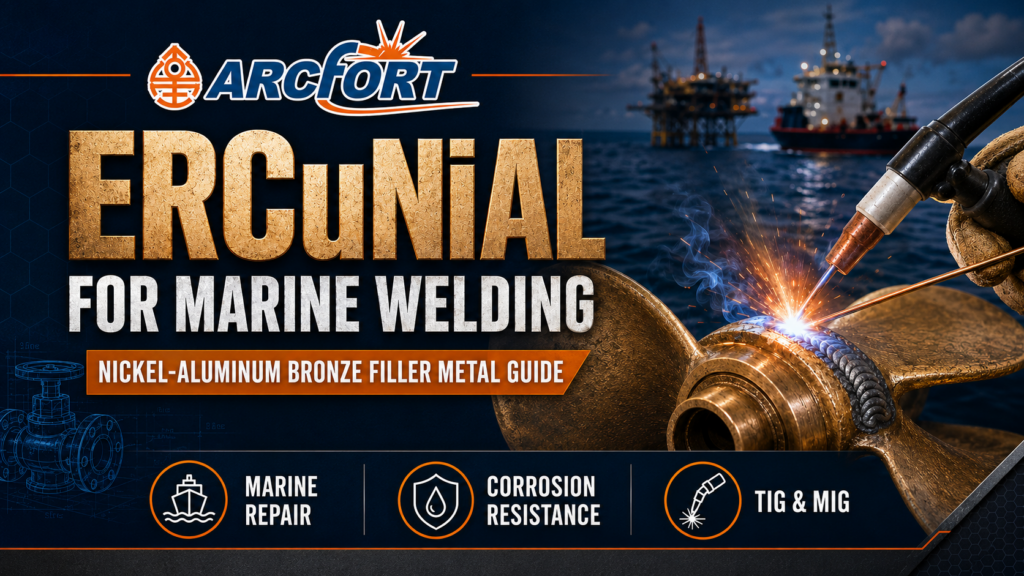
ERCuNiAl for Marine Welding: Nickel-Aluminum Bronze Filler Metal Guide
Marine welding is one of the most demanding areas in metal fabrication. Welded components must resist seawater, erosion, vibration, impact, and long-term mechanical stress. In this environment, filler metal selection is not only about joining metal. It is also about service life, corrosion resistance, and reliability.ERCuNiAl
This is where ERCuNiAl becomes important.
ERCuNiAl is a nickel-aluminum bronze welding wire used for marine welding, offshore repair, shipbuilding, and industrial components exposed to saltwater or brackish water. It is often selected for welding cast and wrought nickel-aluminum bronze parts, especially when the welded area must resist corrosion, erosion, and cavitation.
For ship propellers, pumps, valves, seawater systems, and marine fittings, ERCuNiAl can offer a strong combination of weldability and performance. That makes it a valuable filler metal for companies working in ship repair, offshore engineering, marine equipment manufacturing, and heavy industrial maintenance.
What Is ERCuNiAl Welding Wire?
ERCuNiAl is a copper-based welding filler metal known as nickel-aluminum bronze. It is commonly classified under AWS A5.7 ERCuNiAl and is available as TIG rods, MIG wires, and other welding consumable forms.
The alloy system is based mainly on copper, aluminum, nickel, iron, and manganese. These alloying elements help improve strength, corrosion resistance, erosion resistance, and performance in marine environments.
In simple terms, ERCuNiAl is designed for welding nickel-aluminum bronze materials and related applications where seawater resistance is important.
It is commonly used for:
Marine propeller repair
Ship fittings
Pump components
Valve bodies
Seawater piping systems
Offshore equipment
Power plant components
Chemical industry equipment
Overlay welding and repair work
Because marine components often work under harsh conditions, the filler metal must do more than produce a good-looking weld. It must support long-term performance in real service conditions.
Why ERCuNiAl Is Important in Marine Welding
Marine equipment faces several challenges at the same time. Saltwater can attack metal surfaces. Flowing seawater can cause erosion. Propellers and pump parts may suffer from cavitation. Components may also experience vibration, pressure changes, and mechanical loading.
A standard welding wire may not provide enough resistance in these conditions.
ERCuNiAl is used because nickel-aluminum bronze weld deposits are suitable for many marine applications. The weld metal can offer good resistance to corrosion, erosion, and cavitation when the correct welding procedure is used.
This is especially important for components such as ship propellers. A propeller does not only sit in seawater. It rotates, carries load, and works under continuous fluid movement. If the repair weld is not suitable, the repaired area may fail faster than expected.
That is why ERCuNiAl is often used in marine repair welding and offshore fabrication.
Common Marine Applications of ERCuNiAl
ERCuNiAl is closely connected with marine and offshore industries. It is often selected when components are made from nickel-aluminum bronze or when the weld must perform in seawater service.
Ship Propeller Repair
Ship propellers are one of the most common applications for ERCuNiAl. Propellers may suffer from impact damage, erosion, cavitation marks, cracks, or worn blade edges. ERCuNiAl can be used to repair suitable nickel-aluminum bronze propellers when the welding procedure is properly controlled.
Marine Pumps and Valves
Marine pumps and valves often operate in seawater systems. These parts need resistance to corrosion and flow-related damage. ERCuNiAl is used for welding and repairing pump bodies, valve components, and related bronze parts.
Offshore Equipment
Offshore platforms and marine engineering equipment are exposed to salt spray, seawater, and harsh operating conditions. ERCuNiAl can be used in selected repair and fabrication work where nickel-aluminum bronze weld metal is required.
Seawater Piping and Fittings
Some seawater systems use copper alloy components because of their resistance to marine corrosion. ERCuNiAl can be used for certain fittings and repair applications where compatible materials and procedures are specified.
Overlay and Surfacing Work
ERCuNiAl may also be used for overlay welding when a corrosion-resistant or wear-resistant bronze surface is needed. This can help protect selected industrial components from marine or flow-related damage.
ERCuNiAl for Ship Propeller Repair
Ship propeller repair is a high-value application for ERCuNiAl. Propellers work under heavy mechanical and hydrodynamic stress. They must remain balanced, strong, and resistant to seawater damage.
When a nickel-aluminum bronze propeller is repaired, the filler metal should match the service requirement of the base material. ERCuNiAl is often used because it belongs to the nickel-aluminum bronze filler metal family.
However, propeller repair is not a simple welding job.
Before welding, the damaged area should be inspected carefully. Cracks, wear, deformation, and cavitation damage must be evaluated. The repair area should be cleaned and prepared properly. Welding parameters should be controlled to avoid excessive heat input, distortion, porosity, and cracking.
After welding, the repaired area may require grinding, shaping, inspection, and balancing. For critical marine components, repair work should follow the applicable technical standard or customer specification.
TIG Welding with ERCuNiAl
TIG welding is often used when high control and clean weld appearance are required. It is suitable for repair work, detailed welding, and areas where precision matters.
When TIG welding with ERCuNiAl, the welder must focus on arc stability, clean base metal, correct filler addition, and proper heat control. Nickel-aluminum bronze materials can be sensitive to contamination, so cleaning is essential before welding.
General TIG welding considerations include:
Clean the base metal before welding
Remove oil, oxide, paint, and surface contamination
Use suitable shielding gas
Keep the arc stable and controlled
Add filler metal smoothly
Avoid overheating the weld area
Control interpass temperature
Clean between passes when needed
TIG welding is often preferred for repair work where the welder needs better control over the molten pool.
MIG Welding with ERCuNiAl
MIG welding with ERCuNiAl is useful for higher deposition rates and larger repair areas. It can be suitable for production welding, surfacing, and repair work where efficiency is important.
For MIG welding, wire feeding stability is very important. Copper alloy wires can require careful equipment setup. The contact tip, liner, drive rolls, and wire feed speed should all be selected correctly.
General MIG welding considerations include:
Use clean and dry ERCuNiAl wire
Check wire feeding before welding
Use suitable shielding gas
Maintain a stable arc
Avoid excessive stick-out
Control heat input
Use the correct travel speed
Protect the weld area from drafts
MIG welding can be productive, but poor setup may cause spatter, porosity, unstable arc behavior, or poor bead appearance.
Why Cleanliness Matters Before Welding
Cleanliness is one of the most important factors in ERCuNiAl welding. Marine components may be contaminated with oil, salt, grease, paint, oxide, or seawater residue. These contaminants can create welding defects.
Before welding, the surface should be cleaned to bright metal. Any damaged, cracked, or heavily corroded area should be removed according to the repair procedure. The filler metal should also be clean and dry.
Common cleaning steps include:
Degreasing the weld area
Removing oxide layers
Grinding out cracks or damaged metal
Brushing with suitable tools
Avoiding contamination from carbon steel tools
Keeping the prepared joint dry before welding
A clean surface helps reduce porosity and improves the chance of a sound weld.
Common Problems When Welding ERCuNiAl
Even with a good filler metal, welding problems can still occur. Many defects are caused by poor preparation, wrong parameters, or lack of process control.
Porosity
Porosity can appear when gas becomes trapped in the weld metal. It may be caused by contamination, moisture, poor shielding gas coverage, or unstable arc conditions.
To reduce porosity, clean the base metal carefully. Keep the filler metal dry. Check gas flow. Avoid welding in windy conditions. Keep the arc stable.
Cracking
Cracking may occur if the material is highly restrained, overheated, contaminated, or welded with an unsuitable procedure.
To reduce cracking risk, use the correct filler metal, control heat input, prepare the joint properly, and avoid rapid or uneven cooling when the procedure requires control.
Lack of Fusion
Lack of fusion happens when the weld metal does not properly bond with the base metal or previous weld pass.
This can result from low heat input, poor torch angle, fast travel speed, or poor surface preparation. The welder should make sure the weld pool wets into the base metal properly.
Excessive Heat Input
Too much heat can cause distortion, poor bead shape, and changes in material behavior. This is especially important in repair welding, where the component shape must often be restored accurately.
Heat control is critical for ship propellers, pump components, and precision marine parts.
ERCuNiAl vs ERCuNi: What Is the Difference?
ERCuNiAl and ERCuNi are sometimes confused, but they are not the same type of welding wire.
ERCuNi is a copper-nickel filler metal. It is commonly used for welding copper-nickel alloys, such as 90/10 and 70/30 CuNi materials. These materials are widely used in seawater piping, heat exchangers, and marine systems.
ERCuNiAl is a nickel-aluminum bronze filler metal. It is mainly used for welding cast and wrought nickel-aluminum bronze parts. It is strongly associated with marine propellers, pumps, valves, and components exposed to corrosion, erosion, and cavitation.
The key difference is the alloy family.
ERCuNi is for copper-nickel applications. ERCuNiAl is for nickel-aluminum bronze applications.
Choosing the wrong filler metal may reduce weld performance and service life. Always check the base material, project specification, and welding procedure before selecting the filler.
How to Choose ERCuNiAl Welding Wire
When choosing ERCuNiAl welding wire for marine welding, price should not be the only factor. Marine repair and offshore components often require stable quality and traceable materials.
Important points to check include:
AWS A5.7 classification
Chemical composition
TIG rod or MIG wire size
Spool or straight rod packaging
Material test certificate
Surface cleanliness
Diameter tolerance
Wire feeding performance
Supplier experience with marine applications
For ship repair, offshore equipment, and pump or valve repair, reliable quality is more important than simply choosing the lowest price.
Best Practices for ERCuNiAl Marine Welding
To get better results with ERCuNiAl, follow a controlled welding process from preparation to inspection.
Recommended best practices include:
Confirm the base material before welding
Use the correct ERCuNiAl filler metal
Clean the weld area thoroughly
Remove cracks and damaged material before repair
Control heat input
Use proper shielding gas coverage
Keep filler metal clean and dry
Avoid contamination from steel tools
Clean between weld passes
Inspect the weld after completion
For critical marine components, always follow a qualified welding procedure and applicable inspection requirements.
Conclusion
ERCuNiAl plays an important role in marine welding because it offers a strong balance of weldability, strength, and resistance to harsh seawater conditions. It is especially useful for nickel-aluminum bronze components such as ship propellers, pumps, valves, fittings, and offshore equipment.
For marine repair and fabrication, the right filler metal can directly affect service life. ERCuNiAl is not just a welding wire. It is part of a complete welding solution that includes base material confirmation, surface preparation, correct TIG or MIG process control, heat management, cleaning, and inspection.
When used with a proper welding procedure, ERCuNiAl can help produce reliable welds for demanding marine and industrial applications. For companies working in shipbuilding, offshore engineering, propeller repair, and seawater equipment maintenance, ERCuNiAl remains one of the most important nickel-aluminum bronze filler metals to understand.