

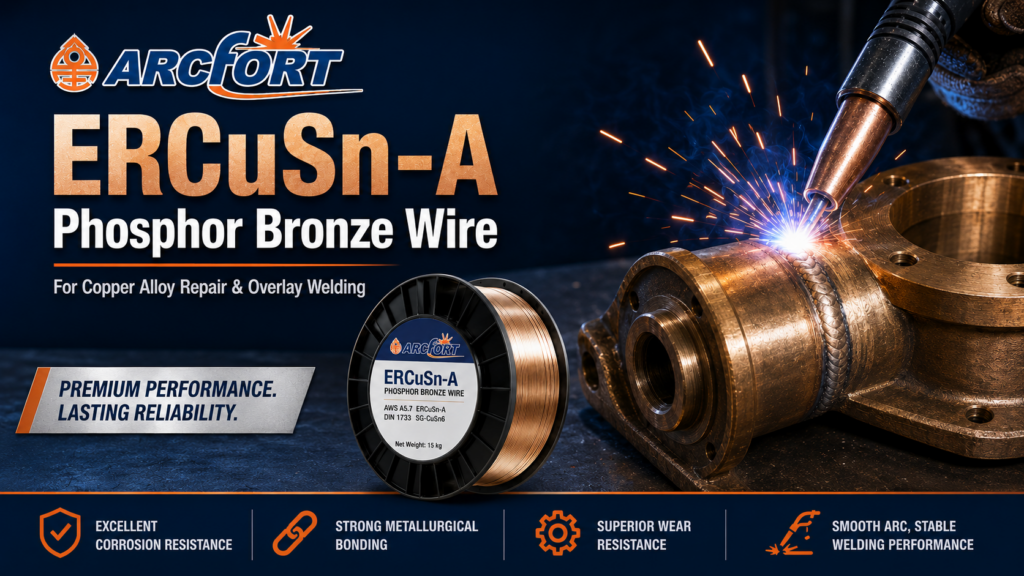
ERCuSn-A Phosphor Bronze Wire for Copper Alloy Repair and Overlay Welding
When manufacturers, repair workshops, and welding professionals need a reliable filler metal for copper alloy repair and overlay welding, ERCuSn-A phosphor bronze wire is one of the most practical choices. Designed for welding bronze, brass, copper-tin alloys, and selected copper alloy components, ERCuSn-A offers a strong combination of wear resistance, corrosion resistance, stable weldability, and good color matching with phosphor bronze base metals.
Whether used for casting repair, bushing restoration, bearing surface rebuilding, or steel overlay applications, ERCuSn-A phosphor bronze welding wire provides dependable performance in both TIG and MIG welding processes.
What Is ERCuSn-A Phosphor Bronze Wire?
ERCuSn-A is a copper-tin phosphor bronze filler metal classified under AWS A5.7. It is commonly known as Phosphor Bronze A and is also associated with CuSn6P-type welding wire in international specifications.
The alloy typically contains copper as the balance, around 4–6% tin, and a controlled phosphorus addition. Tin helps improve the hardness and wear resistance of the weld deposit, while phosphorus works as a deoxidizer to support cleaner welding performance.
This makes ERCuSn-A welding wire suitable for applications where strength, machinability, surface restoration, and corrosion resistance are required.
Main Applications of ERCuSn-A Welding Wire
1. Copper Alloy Repair Welding
One of the most important uses of ERCuSn-A phosphor bronze wire is the repair of copper alloy components. It is widely used for repairing cast copper products, bronze parts, worn bushings, bearings, valve components, pump parts, and industrial machinery elements.
For repair welding, ERCuSn-A helps restore damaged or worn areas while maintaining compatibility with many bronze and brass base materials.
2. Overlay Welding and Surface Build-Up
ERCuSn-A wire for overlay welding is suitable for building up worn surfaces, especially where sliding wear, friction, and moderate corrosion are present. In overlay welding, the wire deposits a phosphor bronze layer onto the base material, improving service life and surface performance.
It is often used for steel surface overlay, bearing areas, wear plates, and mechanical contact surfaces.
3. Welding Bronze and Brass
ERCuSn-A is commonly used for welding bronze and brass parts. It provides good wetting, smooth bead appearance, and reliable bonding when the welding procedure is properly controlled.
For brass-to-steel joining or copper-zinc alloy welding, ERCuSn-A can be a practical filler option when the application allows a bronze weld deposit.
4. TIG and MIG Welding
ERCuSn-A phosphor bronze wire is available for both TIG welding and MIG welding. TIG rods are often selected for precision repair work, small parts, and controlled weld deposits. MIG wire is preferred for higher productivity, longer welds, overlay layers, and production repair jobs.
Why Choose ERCuSn-A Phosphor Bronze Wire?
Excellent Wear Resistance
The tin content in ERCuSn-A improves the hardness and wear resistance of the weld metal. This is especially valuable for repairing bearings, bushings, shafts, sliding parts, and components exposed to friction.
Good Corrosion Resistance
Copper-tin bronze weld deposits offer good resistance to corrosion in many industrial environments. This makes ERCuSn-A suitable for marine equipment, pumps, valves, and machinery exposed to moisture or mild corrosive conditions.
Reliable Weldability
The phosphorus addition helps deoxidize the weld pool, supporting smoother welding and reducing the risk of defects when proper welding parameters are used.
Suitable for Repair and Maintenance
ERCuSn-A is especially useful for maintenance welding because it can restore expensive copper alloy parts instead of replacing them. This reduces downtime, saves cost, and extends the service life of critical equipment.
Good Color Match with Bronze
For visible repair work on bronze components, ERCuSn-A can provide a closer color match than many alternative filler metals, making it useful for both industrial and decorative bronze repair.
Typical Industries Using ERCuSn-A Wire
ERCuSn-A phosphor bronze welding wire is used across many industries, including:
Marine equipment repair
Pump and valve manufacturing
Machinery maintenance
Copper alloy casting repair
Bearing and bushing restoration
Automotive and heavy equipment repair
Metal fabrication
Power generation equipment
Shipbuilding and offshore components
Decorative bronze and architectural metalwork
Welding Tips for ERCuSn-A Phosphor Bronze Wire
To achieve the best results with ERCuSn-A welding wire, welders should control heat input carefully. Copper alloys conduct heat quickly, so thicker parts may require preheating to reduce thermal shock and improve fusion.
For overlay welding, multi-layer welding may be used depending on the required deposit thickness. Pulsed arc welding can help control heat input, reduce distortion, and produce a smoother overlay surface.
Before welding, clean the base metal thoroughly. Remove oil, oxide, paint, grease, and surface contamination. Clean base material is essential for strong, defect-free copper alloy welds.
ERCuSn-A vs. Other Bronze Welding Wires
Compared with silicon bronze wire, ERCuSn-A is often preferred when the application requires a phosphor bronze deposit with better wear resistance. Silicon bronze is widely used for brazing, sheet metal work, and joining dissimilar metals, while ERCuSn-A is more suitable for bronze repair, bearing repair, bushing repair, and copper alloy overlay welding.
Compared with higher-tin bronze wires, ERCuSn-A offers a balanced combination of weldability, strength, and machinability. This makes it a versatile choice for general copper alloy repair and maintenance.
How to Select High-Quality ERCuSn-A Phosphor Bronze Wire
When purchasing ERCuSn-A phosphor bronze wire, buyers should check the following:
First, confirm that the wire meets AWS A5.7 ERCuSn-A or equivalent specifications. Second, choose the correct diameter for your welding process, such as TIG rod sizes for manual repair or MIG wire sizes for semi-automatic welding. Third, check packaging quality to ensure the wire is protected from moisture, contamination, and oxidation. Finally, request a material certificate or chemical composition report when the application requires traceability.
For critical repair, marine, pressure, or industrial applications, using certified welding wire is essential for stable welding quality and long-term performance.
Common Sizes and Forms
This wire is commonly supplied as TIG rods, MIG wire spools, coils, and straight lengths. Common diameters may include 0.8 mm, 0.9 mm, 1.0 mm, 1.2 mm, 1.6 mm, 2.0 mm, 2.4 mm, 3.2 mm, and other customized sizes depending on supplier capability.
TIG rods are ideal for precision repair, while MIG spools are better for production welding, long seams, and overlay welding.
Conclusion
ERCuSn-A phosphor bronze wire for copper alloy repair and overlay welding is a dependable filler metal for industrial maintenance, bronze repair, brass joining, casting restoration, and surface build-up applications. With good wear resistance, corrosion resistance, weldability, and compatibility with many copper alloy materials, It is a practical choice for workshops and manufacturers looking for stable welding performance.
For companies that need high-quality AWS A5.7 ERCuSn-A welding wire, choosing a reliable supplier with consistent chemical composition, clean wire surface, stable packaging, and complete certification can make a major difference in welding quality and long-term component performance.