
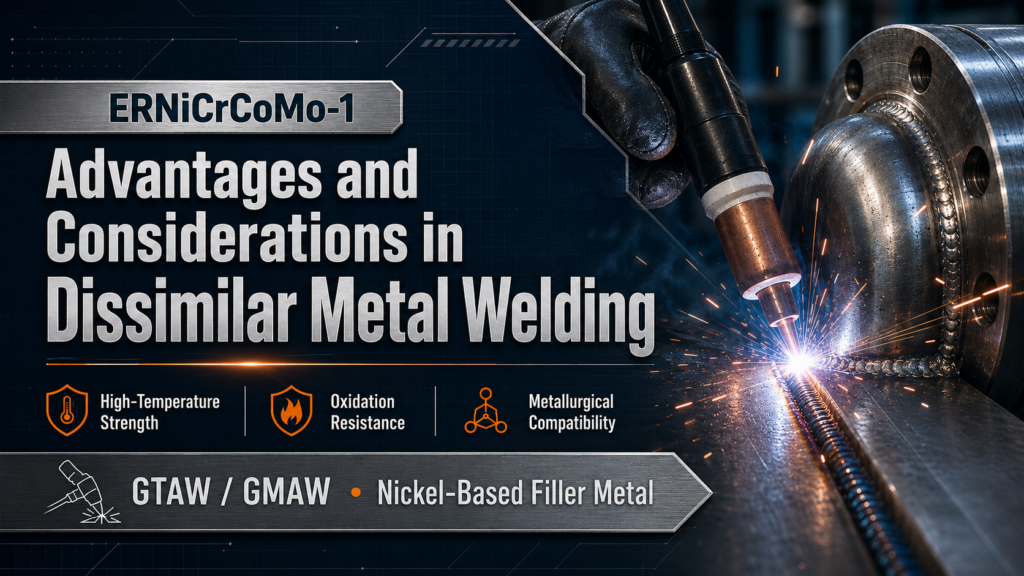
Advantages and Considerations of ERNiCrCoMo-1 in Dissimilar Metal Welding
Dissimilar metal welding is widely used when different alloys must be joined to achieve a balance of strength, corrosion resistance, heat resistance, and cost efficiency. However, welding metals with different thermal expansion rates, chemical compositions, and mechanical properties can create serious challenges. These may include cracking, dilution, brittle phases, loss of corrosion resistance, and reduced high-temperature performance.ERNiCrCoMo-1
ERNiCrCoMo-1 is a nickel-chromium-cobalt-molybdenum filler metal designed for demanding welding environments. It is often selected for applications where high-temperature strength, oxidation resistance, and metallurgical stability are required. In dissimilar metal welding, ERNiCrCoMo-1 can help create reliable weld joints between nickel alloys, heat-resistant alloys, stainless steels, carbon steels, and low-alloy steels when the welding procedure is properly controlled.
What Is ERNiCrCoMo-1?
ERNiCrCoMo-1 is a nickel-based welding wire classified under AWS A5.14. It is commonly associated with Alloy 617-type filler metal and is available for processes such as GTAW, also known as TIG welding, and GMAW, also known as MIG welding.
Its alloy system typically contains nickel as the base element, with chromium, cobalt, and molybdenum as major alloying elements. Each element contributes to performance:
Chromium improves oxidation and corrosion resistance.
Cobalt supports high-temperature strength and stability.
Molybdenum enhances strength and resistance in demanding service environments.
Nickel provides ductility, toughness, and compatibility with many high-performance alloys.
Because of this balanced composition, ERNiCrCoMo-1 is often chosen for welds exposed to elevated temperatures, thermal cycling, corrosive atmospheres, and mechanically demanding service conditions.
Why ERNiCrCoMo-1 Is Used in Dissimilar Metal Welding
Dissimilar metal welding requires a filler metal that can tolerate differences between the base materials. ERNiCrCoMo-1 is useful because it can provide a strong, stable weld deposit while helping reduce compatibility problems between different alloys.
For example, when joining a nickel alloy to stainless steel or a heat-resistant alloy to low-alloy steel, the filler metal must manage dilution from both base metals. ERNiCrCoMo-1 offers a nickel-rich weld metal that can absorb some chemical variation while maintaining useful mechanical and corrosion-resistant properties.
This makes it suitable for components used in heat treatment equipment, power generation systems, petrochemical processing, furnace parts, combustion equipment, and other high-temperature assemblies.
Key Advantages of ERNiCrCoMo-1 in Dissimilar Metal Welding
1. Excellent High-Temperature Strength
One of the main advantages of ERNiCrCoMo-1 is its ability to retain strength at elevated temperatures. In many industrial systems, weld joints are exposed to heat for long periods. A filler metal with poor high-temperature strength can lose load-bearing capacity, deform, or fail prematurely.
ERNiCrCoMo-1 is designed for applications where weld metal stability under heat is important. Its nickel-chromium-cobalt-molybdenum chemistry helps the weld deposit maintain strength in high-temperature service.
This is especially valuable when joining heat-resistant alloys in equipment such as furnace assemblies, combustion parts, ducting systems, and thermal processing units.
2. Strong Oxidation Resistance
Oxidation is a major concern in high-temperature welding applications. When metal surfaces are exposed to hot gases or air, oxide scale can form. If the oxide layer grows too quickly or breaks away, the material can lose thickness and performance over time.
The chromium content in ERNiCrCoMo-1 supports the formation of a protective oxide layer. This helps improve resistance to high-temperature oxidation, making the filler metal useful for welded parts operating in hot, oxidizing environments.
For dissimilar metal welding, this is important because the weld zone may be exposed to harsher conditions than one or both base metals. A filler metal with strong oxidation resistance can improve the durability of the joint.
3. Good Metallurgical Compatibility
Dissimilar metals often react differently during welding. They may have different melting behavior, thermal expansion rates, and chemical responses. This can increase the risk of hot cracking, brittle microstructures, or poor fusion.
ERNiCrCoMo-1 provides a nickel-rich weld deposit with good metallurgical flexibility. Nickel-based filler metals are commonly used in dissimilar welding because they can tolerate dilution from different base metals better than many iron-based fillers.
When the correct welding procedure is used, ERNiCrCoMo-1 can help produce a sound weld joint with stable performance across the fusion zone.
4. Useful for Joining Heat-Resistant Alloys
Many high-temperature systems are built from alloys selected for specific service zones. One section may require oxidation resistance, another may require creep strength, and another may require cost-effective structural support. This creates a need for dissimilar metal joints.
ERNiCrCoMo-1 is well suited for joining heat-resistant alloys where high-temperature service is expected. It is often considered when the weld must perform under thermal stress, hot gas exposure, and long-term elevated-temperature operation.
Its combination of nickel, chromium, cobalt, and molybdenum makes it a practical choice for demanding weldments where ordinary stainless filler metals may not provide enough stability.
5. Suitable for GTAW and GMAW Processes
ERNiCrCoMo-1 can be used with GTAW and GMAW welding processes, giving fabricators flexibility based on production needs.
GTAW is often selected for precision welding, thin sections, root passes, and applications where weld quality and control are critical.
GMAW is often selected for higher productivity, longer welds, and applications where deposition rate matters.
The availability of ERNiCrCoMo-1 for both processes makes it useful for custom fabrication, repair welding, and industrial production.
6. Good Resistance to Corrosive Service Conditions
Dissimilar metal joints are often exposed to complex environments. These may include heat, process gases, oxidizing atmospheres, and corrosive compounds. If the filler metal is not carefully selected, the weld area can become the weak point of the assembly.
ERNiCrCoMo-1 offers corrosion-resistant performance due to its nickel-based composition and chromium-molybdenum alloying system. While actual corrosion resistance depends on the full service environment, this filler metal is often preferred when the weld must resist both heat and chemical attack.
Important Considerations Before Using ERNiCrCoMo-1
1. Base Metal Compatibility Must Be Verified
Although ERNiCrCoMo-1 is useful for many dissimilar metal combinations, it should not be selected blindly. Engineers and welding specialists should confirm compatibility with the exact base metals, service temperature, load condition, and corrosion environment.
The welding procedure should consider dilution from both base materials. Excessive dilution may change the weld metal chemistry and reduce the expected performance.
2. Heat Input Control Is Critical
High heat input can increase grain growth, distortion, and residual stress. In dissimilar metal welding, it can also increase the width of the heat-affected zone and affect the microstructure of both base metals.
When welding with ERNiCrCoMo-1, heat input should be controlled according to the approved welding procedure. Proper travel speed, current, voltage, interpass temperature, and shielding gas control are essential for a consistent weld.
3. Cracking Risk Should Be Managed
Dissimilar metal joints can be more vulnerable to cracking because the joined materials may expand and contract differently. Stress can build up during cooling, especially in thick sections or restrained joints.
To reduce cracking risk, fabricators should use proper joint design, clean base metal surfaces, suitable preheat or interpass practices when required, and controlled welding parameters. In critical applications, procedure qualification and testing are strongly recommended.
4. Service Conditions Must Guide Filler Selection
ERNiCrCoMo-1 performs well in many high-temperature environments, but welding filler selection should always be based on actual service conditions. Static load, cyclic load, thermal cycling, pressure, corrosion exposure, and expected service life all matter.
For example, a weld used in a steady high-temperature environment may require different performance priorities than a weld exposed to repeated vibration or thermal fatigue. ERNiCrCoMo-1 may be an excellent choice for one condition but may require comparison with other nickel-based filler metals for another.
5. Post-Weld Inspection Is Important
Because dissimilar metal welds often serve in critical equipment, inspection should not be overlooked. Common inspection methods may include visual testing, liquid penetrant testing, radiographic testing, ultrasonic testing, or mechanical testing, depending on the application.
Post-weld inspection helps confirm weld soundness and reduces the risk of unexpected failure during service.
Common Applications of ERNiCrCoMo-1 in Dissimilar Metal Welding
ERNiCrCoMo-1 is commonly considered for high-temperature and corrosion-resistant applications, including:
Gas handling components
Heat treatment equipment
Furnace fixtures and assemblies
Petrochemical processing equipment
Power generation components
High-temperature ducting
Combustion-related parts
Overlay welding where similar high-temperature chemistry is desired
Repair welding of heat-resistant alloy components
In these applications, weld performance is often influenced by temperature, stress, atmosphere, and base metal selection. ERNiCrCoMo-1 can help improve joint reliability when used with a qualified welding procedure.
Best Practices for Welding with ERNiCrCoMo-1
To achieve better weld quality, fabricators should follow several practical guidelines.
First, clean the base metals thoroughly before welding. Nickel alloy welds are sensitive to contamination from oil, grease, paint, sulfur, lead, and other surface impurities.
Second, use suitable shielding gas for the welding process. Proper shielding helps prevent oxidation and porosity in the weld metal.
Third, control heat input and interpass temperature. Excessive heat can affect weld structure and increase distortion.
Fourth, select the correct wire diameter for the joint design and welding process. Wire size influences deposition rate, penetration, and control.
Fifth, qualify the welding procedure for critical applications. A procedure qualification test helps verify that the selected parameters can produce the required weld properties.
ERNiCrCoMo-1 vs Other Nickel Alloy Filler Metals
ERNiCrCoMo-1 is not the only nickel alloy filler metal used in dissimilar welding. Other nickel-based fillers may be preferred depending on the base metals and service conditions.
The advantage of ERNiCrCoMo-1 is its strong combination of high-temperature strength, oxidation resistance, and stability. However, for applications involving severe cyclic loading, specific corrosion media, or special mechanical requirements, alternative filler metals may need to be evaluated.
The best choice depends on the complete welding requirement, not only the filler metal classification.
Conclusion
ERNiCrCoMo-1 is a high-performance nickel-based welding wire for demanding dissimilar metal welding applications. Its nickel-chromium-cobalt-molybdenum composition provides valuable advantages, including high-temperature strength, oxidation resistance, corrosion resistance, and metallurgical stability.
It is especially useful when joining heat-resistant alloys or creating welds that must perform in elevated-temperature service. However, successful results depend on proper filler selection, base metal compatibility, heat input control, welding procedure qualification, and post-weld inspection.
For applications involving high heat, dissimilar alloys, and demanding service conditions, ERNiCrCoMo-1 can be a strong filler metal choice when used with the right welding procedure.