

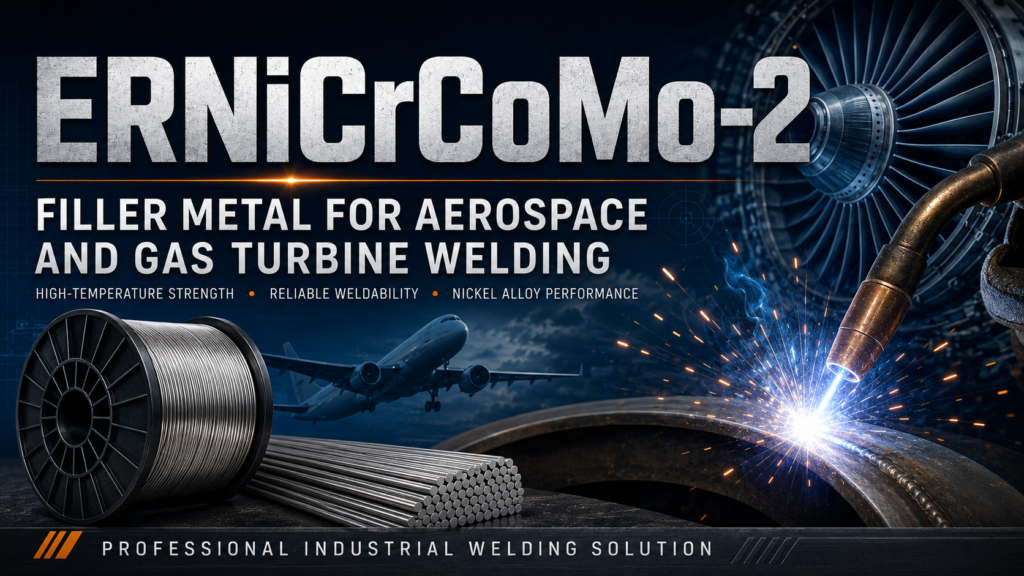
ERNiCrCoMo-2 Filler Metal for Aerospace and Gas Turbine Welding
ERNiCrCoMo-2 filler metal is a nickel-based welding consumable designed for demanding high-temperature applications. In aerospace and gas turbine manufacturing, welded components must withstand heat, stress, oxidation, vibration, and long service cycles. Choosing the correct filler metal is therefore not only a welding decision, but also a performance and safety decision.
For projects involving nickel-chromium-cobalt-molybdenum alloy systems, ERNiCrCoMo-2 welding wire is often selected for its balance of strength, weldability, and stability at elevated temperatures. It is commonly used where welded joints must maintain mechanical integrity in hot sections, exhaust systems, combustion-related structures, and other critical assemblies.
What Is ERNiCrCoMo-2 Filler Metal?
ERNiCrCoMo-2 is a nickel alloy filler metal classified for welding high-performance nickel-based materials. Its alloy system is built around nickel, chromium, cobalt, and molybdenum, with additional strengthening elements that help support high-temperature performance.
The key purpose of ERNiCrCoMo-2 filler metal is to produce weld deposits that can perform under severe thermal and mechanical conditions. This makes it suitable for industries where ordinary stainless steel or general-purpose welding wire cannot meet the required service environment.
In practical use, ERNiCrCoMo-2 may be supplied as TIG filler rod, MIG welding wire, or other bare wire forms depending on welding process, diameter requirement, and project specification.
Why ERNiCrCoMo-2 Is Important in Aerospace Welding
Aerospace welding requires more than a clean weld bead. Components used in aircraft engines, exhaust structures, and high-temperature assemblies must retain strength after repeated heating and cooling cycles. Welded joints may also be exposed to vibration, pressure variation, and oxidation.
ERNiCrCoMo-2 filler metal is valued in aerospace welding because it is designed for nickel alloy systems that operate in elevated-temperature environments. Its composition helps support creep resistance, thermal stability, and joint reliability when properly welded and heat treated according to the project requirements.
For aerospace fabricators, consistent wire quality is especially important. Clean surface finish, controlled chemistry, stable feeding, and accurate diameter tolerance all help reduce welding defects and improve repeatability.
ERNiCrCoMo-2 for Gas Turbine Welding
Gas turbine components operate in some of the most demanding industrial environments. Combustion zones, transition pieces, exhaust sections, turbine support parts, and hot-gas-path components may face continuous exposure to heat, oxidation, and mechanical loading.
ERNiCrCoMo-2 filler metal is suitable for welding applications where nickel-based high-temperature alloys are required. In gas turbine welding, the filler metal must help the joint resist thermal fatigue, maintain strength at elevated temperatures, and support long-term service performance.
For repair and fabrication work, ERNiCrCoMo-2 welding wire can help create reliable weld deposits when used with the correct welding parameters, shielding gas, joint preparation, and post-weld procedures.
Key Benefits of ERNiCrCoMo-2 Welding Wire
One of the main advantages of ERNiCrCoMo-2 filler metal is its ability to perform in high-temperature environments. The nickel-based matrix provides a strong foundation for heat resistance, while chromium helps improve oxidation resistance. Cobalt and molybdenum contribute to high-temperature strength and overall alloy performance.
Another benefit is its suitability for precision welding. In aerospace and turbine manufacturing, welders often need excellent control over arc stability, puddle behavior, and bead shape. High-quality ERNiCrCoMo-2 welding wire supports consistent welding results when matched with proper process control.
ERNiCrCoMo-2 also offers value for critical components where weld integrity is essential. By using a filler metal designed for demanding nickel alloy service, manufacturers can improve the reliability of welded structures exposed to heat and stress.
Common Applications of ERNiCrCoMo-2 Filler Metal
ERNiCrCoMo-2 filler metal can be used in several high-temperature welding applications, including:
Aerospace engine components
Gas turbine hot-section parts
Combustion system assemblies
Exhaust system components
High-temperature structural parts
Nickel alloy fabrication
Repair welding for heat-resistant alloys
Industrial turbine maintenance
Precision TIG welding of nickel alloy parts
MIG welding for suitable nickel-based assemblies
These applications require careful welding procedure control. The final performance of the weld depends not only on the filler metal, but also on base material condition, welding method, heat input, shielding gas, cleanliness, and inspection standards.
TIG and MIG Welding
ERNiCrCoMo-2 filler metal may be used for TIG welding when precise weld control is required. TIG welding is often preferred for thin sections, complex geometry, high-quality root passes, and critical aerospace parts. It allows the welder to control heat input and filler addition accurately.
MIG welding may be selected when productivity and deposition rate are important. For suitable components, ERNiCrCoMo-2 MIG wire can support efficient welding while maintaining the benefits of a nickel-based filler metal. Stable wire feeding and proper parameter setup are essential for achieving consistent results.
Regardless of the process, clean base material is critical. Nickel alloy welding requires removal of oil, grease, oxide, marking residue, and surface contamination before welding. Poor cleaning can lead to porosity, cracking, or reduced weld performance.
How to Select ERNiCrCoMo-2 Filler Metal
When selecting ERNiCrCoMo-2 filler metal, buyers and engineers should review the welding specification first. Important factors include wire diameter, welding process, base alloy, applicable standard, certificate requirement, surface condition, and packaging method.
For critical aerospace and gas turbine projects, material traceability is also important. A reliable ERNiCrCoMo-2 welding wire should be supplied with clear product identification, heat number, chemical composition data, and quality documentation as required by the customer.
The correct selection should also consider whether the filler metal will be used for new fabrication, maintenance repair, overlay welding, or component restoration. Each application may require different welding parameters and inspection procedures.
Quality Requirements for Critical Welding Projects
Aerospace and gas turbine welding normally require strict quality control. ERNiCrCoMo-2 filler metal used in these fields should have stable chemistry, smooth surface finish, accurate diameter, and reliable spool or straight-length packaging.
Common quality expectations include:
Consistent chemical composition
Clean and bright wire surface
Good feeding performance
Low contamination risk
Stable arc behavior
Clear marking and traceability
Suitable certification documents
Proper moisture-resistant packaging
For high-temperature service, even small welding defects can affect long-term performance. This is why material quality, welder qualification, and procedure qualification should be managed together.
Storage and Handling of ERNiCrCoMo-2 Welding Wire
Proper storage helps maintain welding performance. ERNiCrCoMo-2 welding wire should be stored in a clean, dry environment away from dust, moisture, oil, and corrosive substances. The packaging should remain sealed until use whenever possible.
Before welding, the wire should be inspected for surface contamination, rust-colored staining, mechanical damage, or packaging problems. Although nickel alloy filler metals are generally corrosion resistant, poor handling can still introduce contaminants that affect weld quality.
For critical welding work, operators should avoid touching the wire surface with dirty gloves and should keep filler rods or wire spools protected during production.
ERNiCrCoMo-2 vs General Nickel Alloy Filler Metals
Not all nickel alloy filler metals are the same. ERNiCrCoMo-2 is designed for a specific high-temperature alloy system and should not be randomly replaced with another nickel filler metal. Different classifications may have different chemistry, strength levels, thermal behavior, and crack resistance.
Using the wrong filler metal can lead to reduced high-temperature strength, poor compatibility with the base metal, or failure to meet project specifications. For aerospace and gas turbine welding, filler metal selection should always follow the approved welding procedure and engineering requirements.
Buyer Checklist for ERNiCrCoMo-2 Filler Metal
Before purchasing ERNiCrCoMo-2 filler metal, buyers should confirm the following details:
Product classification: ERNiCrCoMo-2
Welding process: TIG, MIG, or other required process
Wire form: straight rod, spool, coil, or cut length
Diameter and tolerance
Applicable standard
Chemical composition certificate
Heat number and traceability
Surface finish requirement
Packaging method
Project-specific documentation
Delivery schedule
Technical support availability
A clear purchase specification helps avoid wrong material selection and reduces delays in production or inspection.
Conclusion
ERNiCrCoMo-2 filler metal is an important welding consumable for aerospace and gas turbine applications that require high-temperature strength, weld reliability, and nickel alloy compatibility. Its nickel-chromium-cobalt-molybdenum alloy system makes it suitable for demanding welded components exposed to heat, oxidation, and mechanical stress.
For manufacturers, repair facilities, and engineering buyers, the value of ERNiCrCoMo-2 welding wire depends on both material quality and correct welding practice. When selected according to the proper specification and used with qualified welding procedures, ERNiCrCoMo-2 filler metal can help support durable weld performance in critical aerospace and gas turbine service.