

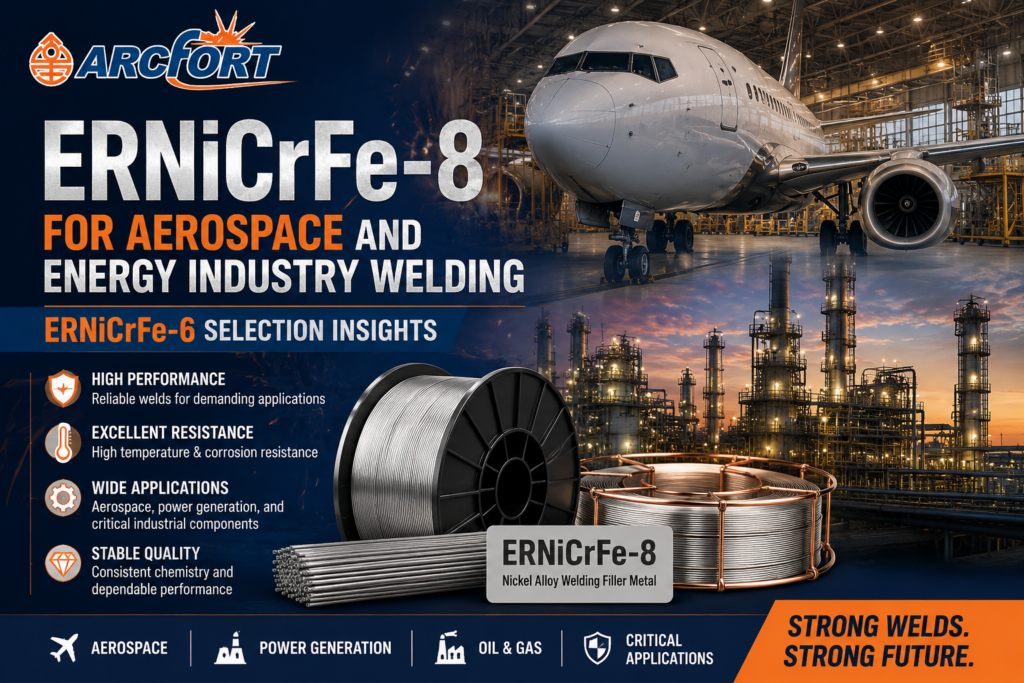
ERNiCrFe-8 for Aerospace and Energy Industry Welding: ERNiCrFe-6 Selection Insights
In aerospace and energy industry welding, filler metal selection is not only a technical decision. It affects weld reliability, production stability, maintenance performance, and long-term equipment safety. When projects involve nickel-based alloys, high-value components, or demanding service environments, welding engineers often evaluate specific filler metals such as ERNiCrFe-8 and ERNiCrFe-6.
Although this article focuses on ERNiCrFe-8 for aerospace and energy industry welding, it also includes ERNiCrFe-6 as an important related keyword because many engineers, buyers, and distributors compare nickel alloy filler metals during material selection. Understanding how these filler metals fit into industrial applications can help reduce welding risks and improve purchasing decisions.
What Is ERNiCrFe-8 Used For?
ERNiCrFe-8 is a nickel-based welding filler metal used in specialized welding applications where base metal compatibility, weld stability, and service reliability are important. It is often considered for welding projects involving nickel alloys, heat-resistant materials, and high-value industrial components.
In aerospace and energy sectors, ERNiCrFe-8 may be selected when standard filler metals are not suitable for the base materials or operating conditions. It is commonly associated with critical welding work where weld quality, traceability, and procedure control are essential.
Typical application areas may include:
Aerospace component fabrication
Energy equipment manufacturing
Industrial turbine-related parts
High-temperature service assemblies
Maintenance and repair welding
Dissimilar metal joining
Nickel alloy fabrication
Critical structural or pressure-related components
For welding professionals, ERNiCrFe-8 is not a general-purpose consumable. It is a specialized filler metal used when the project requires a carefully selected nickel alloy welding solution.
Why Aerospace Welding Requires Careful Filler Metal Selection
Aerospace welding demands strict control over materials, welding procedures, and inspection. Components may experience vibration, heat, load changes, and long service cycles. Because of this, every welding consumable must be selected with attention to base material compatibility and project requirements.
ERNiCrFe-8 can be considered for aerospace welding when nickel alloy filler metal is required for specific assemblies or repair work. In these applications, welding teams usually focus on:
Clean weld preparation
Stable arc performance
Controlled heat input
Proper filler metal handling
Consistent weld appearance
Qualified welding procedures
Traceability of consumables
Post-weld inspection
Aerospace welding does not allow casual material substitution. Even when ERNiCrFe-6 appears in similar selection discussions, engineers must confirm whether ERNiCrFe-8 or ERNiCrFe-6 is suitable according to the approved welding procedure and project specification.
ERNiCrFe-8 in Energy Industry Welding
The energy industry includes power generation, thermal systems, industrial boilers, pressure equipment, turbine-related components, and maintenance operations. These applications often involve demanding service conditions and strict quality expectations.
ERNiCrFe-8 can play a role in energy industry welding where nickel alloy filler metals are required for fabrication or repair. It may be used in projects involving heat-resistant assemblies, dissimilar metal joints, or equipment that must remain reliable during long operating cycles.
Common energy-related use cases include:
Power plant maintenance
Thermal equipment fabrication
Industrial piping repair
Pressure system welding
Turbine-related component repair
Heat-resistant joint welding
Equipment refurbishment
In energy projects, filler metal selection should always be connected to the actual service condition, base material, welding code, and inspection requirement. This is also why ERNiCrFe-6 is often searched together with other nickel alloy filler metals. Buyers and engineers want to understand which product best fits a specific welding requirement.
ERNiCrFe-8 and ERNiCrFe-6: Selection Considerations
ERNiCrFe-8 and ERNiCrFe-6 are both nickel alloy filler metals, but they should not be treated as direct substitutes without technical confirmation. Each filler metal has its own application range and should be selected based on project specifications.
When comparing ERNiCrFe-8 with ERNiCrFe-6, welding engineers should consider:
Base material grade
Welding process
Joint design
Service environment
Project standard
Inspection method
Required product form
Welding procedure qualification
Customer approval requirements
ERNiCrFe-6 may appear in similar search queries because it is also used in specialized nickel alloy welding applications. However, choosing between ERNiCrFe-8 and ERNiCrFe-6 should never depend only on availability, price, or similar naming. The correct choice must come from the approved welding procedure and engineering review.
Dissimilar Metal Welding Applications
Dissimilar metal welding is common in aerospace and energy applications. Different metals may be joined to achieve a balance of strength, heat resistance, corrosion resistance, or cost efficiency. However, these joints can be more complex than similar-metal welding.
ERNiCrFe-8 may be considered when a nickel alloy filler metal is needed to support compatibility between different base materials. In some projects, ERNiCrFe-6 may also be evaluated as part of the filler metal selection process.
For dissimilar metal welding, engineers should pay attention to:
Joint preparation
Fit-up accuracy
Cleanliness of base materials
Welding sequence
Heat control
Dilution control
Inspection requirements
Long-term service conditions
A well-selected filler metal helps reduce welding problems, but process control is equally important.
Welding Process Options
ERNiCrFe-8 may be used with suitable welding processes depending on product form and application requirements. The selected process should match the component size, welding position, productivity target, and required weld quality.
Common process considerations include:
TIG welding
Often used for precision welding, repair work, root passes, and applications requiring excellent control.
MIG welding
Suitable for higher productivity in fabrication environments where consistent wire feeding and stable operation are required.
Submerged arc welding
May be considered for heavy sections or long welds when project conditions allow.
For both ERNiCrFe-8 and ERNiCrFe-6, the welding process must be supported by proper parameters, qualified procedures, and trained operators.
Best Practices for ERNiCrFe-8 Welding
To achieve reliable results with ERNiCrFe-8, welding teams should follow disciplined handling and welding practices.
Before welding, all base materials should be cleaned carefully. Oil, moisture, paint, scale, and other contamination should be removed. Nickel alloy welding applications often require high cleanliness because contamination may affect weld quality.
During welding, operators should follow qualified procedures and avoid unnecessary variation. Poor shielding, unstable arc control, excessive heat input, or incorrect travel speed may lead to defects or inconsistent results.
Consumables should be stored in a dry, clean environment. Packaging should remain protected before use. For aerospace and energy projects, batch control and documentation are especially important.
After welding, inspection should follow project requirements. Depending on the application, visual inspection may be combined with additional testing methods to confirm weld quality.
What Buyers and Distributors Should Know
For importers, distributors, and industrial suppliers, ERNiCrFe-8 and ERNiCrFe-6 are technical welding consumables. Customers purchasing these products usually care about more than price. They need product consistency, documentation, packaging quality, and reliable delivery.
Important purchasing factors include:
Correct classification
Product form and diameter
Packaging method
Batch traceability
Quality certificates
Export packing condition
Stable supply capability
Technical communication
OEM or private label options
Delivery schedule
For distributors serving aerospace, energy, petrochemical, and heavy industry customers, stocking or sourcing nickel alloy filler metals can strengthen the product portfolio. ERNiCrFe-8 can be promoted as a specialized solution for demanding welding applications, while ERNiCrFe-6 can be positioned as a related product for projects requiring that specific classification.
How to Position ERNiCrFe-8 for SEO and B2B Marketing
For Google SEO, ERNiCrFe-8 content should not only repeat the product name. A strong article should connect the keyword with real search intent. Engineers may search for application guidance. Buyers may search for product availability. Distributors may search for supplier opportunities. Maintenance teams may search for welding best practices.
To make an ERNiCrFe-8 article more useful, the content should cover:
Application industries
Welding process selection
Selection logic
Buyer concerns
Storage and handling
Quality control
Comparison with related filler metals such as ERNiCrFe-6
Because ERNiCrFe-6 is also a related search keyword, including it naturally in the article can help capture users who compare nickel alloy filler metals before making a decision.
Conclusion
ERNiCrFe-8 is a specialized nickel alloy filler metal used in demanding welding applications, especially where aerospace and energy industry requirements call for careful material selection, stable welding procedures, and reliable quality control.
In many cases, ERNiCrFe-6 may also appear in the selection process because engineers and buyers often compare related nickel alloy welding consumables. However, ERNiCrFe-8 and ERNiCrFe-6 should not be treated as simple replacements for each other. The final choice should always depend on base material, welding procedure, project standard, and engineering approval.
For aerospace and energy industry welding, successful results depend on more than choosing a filler metal. Clean preparation, qualified procedures, controlled welding parameters, proper consumable storage, and reliable sourcing all contribute to weld quality. When used correctly, ERNiCrFe-8 can support demanding fabrication and maintenance projects where consistency and reliability are essential.