

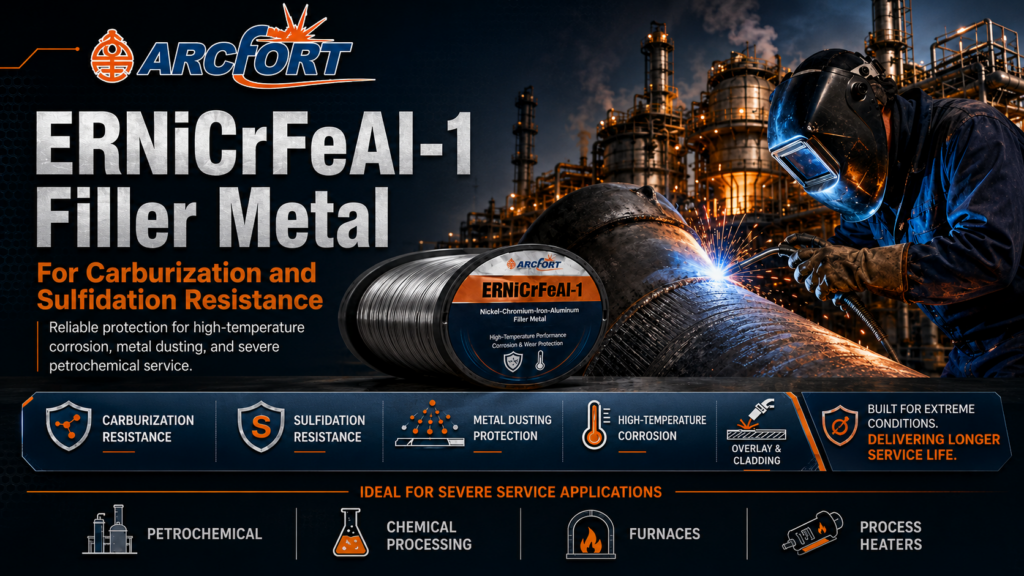
ERNiCrFeAl-1 Filler Metal for Carburization and Sulfidation Resistance
ERNiCrFeAl-1 filler metal is a specialized nickel-chromium-iron-aluminum welding consumable designed for severe high-temperature corrosion environments. It is mainly used where welded components must resist carburization, sulfidation, oxidation and metal dusting in demanding industrial service.
In chemical plants, petrochemical units, reformers, heat treatment systems, furnace components and high-temperature process equipment, welded joints are often exposed to carbon-rich gases, sulfur-containing atmospheres and aggressive thermal conditions. Under these environments, ordinary welding materials may suffer from rapid degradation, surface attack, embrittlement or premature failure.
ERNiCrFeAl-1 filler metal is selected when high-temperature corrosion resistance is more important than ordinary weld strength alone. Its nickel-based alloy system, combined with chromium and aluminum, helps create weld deposits suitable for equipment operating in aggressive carburizing and sulfidizing atmospheres.
For engineers, fabricators, maintenance teams and industrial buyers, understanding ERNiCrFeAl-1 is essential for selecting the right filler metal for critical high-temperature corrosion applications.
What Is ERNiCrFeAl-1 Filler Metal?
ERNiCrFeAl-1 is a nickel alloy filler metal classified under nickel and nickel-alloy welding consumables. It belongs to the Ni-Cr-Fe-Al alloy family and is commonly associated with Alloy 693-type welding applications.
The main alloying elements include nickel, chromium, iron and aluminum. Each element plays an important role in the weld metal performance.
Nickel provides thermal stability, corrosion resistance and compatibility with nickel alloy base metals. Chromium improves resistance to oxidation and many high-temperature corrosion mechanisms. Aluminum contributes to protective oxide formation and helps improve resistance to carburization, sulfidation and metal dusting.
ERNiCrFeAl-1 filler metal may be used in different welding processes depending on the product form and application, including:
TIG welding
MIG welding
Automated welding
Weld overlay
Cladding
Repair welding
Dissimilar metal surfacing
Its main purpose is to produce a weld deposit that can perform in severe high-temperature corrosion service.
ERNiCrFeAl-1 Why Carburization Resistance Matters
Carburization is a high-temperature corrosion mechanism where carbon enters the metal surface. It usually occurs in carbon-rich atmospheres, such as process gases containing carbon monoxide, hydrocarbons or other carbon-bearing compounds.
When carburization occurs, the metal may become harder and more brittle. This can reduce ductility, damage mechanical performance and increase cracking risk. Over time, carburization can shorten equipment service life and increase maintenance cost.
Carburization is commonly found in:
Petrochemical reforming units
Heat treatment furnaces
Cracking equipment
Furnace tubes
Process heaters
Carbon-rich gas systems
High-temperature chemical equipment
Thermal processing components
ERNiCrFeAl-1 filler metal is used when welded areas need to resist carbon pickup and maintain more stable performance in carbon-containing high-temperature atmospheres.
ERNiCrFeAl-1 Why Sulfidation Resistance Is Important
Sulfidation is another aggressive high-temperature corrosion mechanism. It occurs when sulfur-containing gases or compounds react with metal surfaces at elevated temperatures. Sulfidation can cause rapid metal loss, surface scaling and reduced component reliability.
In some industrial environments, sulfidation can be more damaging than ordinary oxidation. It is especially important in petrochemical, refining and chemical processing equipment.
Sulfidation may occur in:
Refinery process units
Petrochemical heaters
Sulfur-containing gas environments
Chemical reactors
High-temperature piping
Furnace components
Thermal processing equipment
Waste gas treatment systems
ERNiCrFeAl-1 filler metal helps improve resistance to sulfidation because its alloy system is designed for high-temperature corrosion protection, especially where chromium and aluminum are needed to support protective surface films.
The Role of Aluminum in ERNiCrFeAl-1
One of the key differences between ERNiCrFeAl-1 and many general nickel alloy filler metals is the presence of aluminum.
Aluminum helps promote the formation of a protective aluminum oxide layer under suitable high-temperature conditions. This oxide layer can act as a barrier between the metal surface and the aggressive environment.
In applications involving carburization, sulfidation and metal dusting, this protective behavior is highly valuable. It helps slow down harmful reactions and supports longer equipment life.
This is why ERNiCrFeAl-1 is often selected for high-temperature corrosion applications rather than ordinary nickel alloy welding.
Key Properties of ERNiCrFeAl-1 Filler Metal
1. Strong Carburization Resistance
ERNiCrFeAl-1 is suitable for carbon-rich high-temperature environments where carburization is a major risk. It helps reduce carbon penetration into the weld metal and supports more reliable performance in furnace and petrochemical applications.
2. Good Sulfidation Resistance
The alloy design helps resist sulfur-related high-temperature attack. This makes ERNiCrFeAl-1 useful for selected chemical and petrochemical systems where sulfur-containing gases may be present.
3. Resistance to Metal Dusting
Metal dusting is a severe form of high-temperature corrosion that can cause metals to break down into powder-like carbon and metal particles. It is especially dangerous in carbonaceous atmospheres.
ERNiCrFeAl-1 filler metal is often considered for applications where metal dusting resistance is required.
4. High-Temperature Oxidation Resistance
Chromium and aluminum support the formation of protective oxide films. This helps improve oxidation resistance in thermal service.
5. Stable Weld Deposit
With correct welding procedures, ERNiCrFeAl-1 can produce stable weld deposits suitable for critical high-temperature equipment.
6. Suitable for Weld Overlay and Cladding
ERNiCrFeAl-1 is often used for corrosion-resistant weld overlay, where the goal is to protect the surface of a component from aggressive service conditions.
Main Applications of ERNiCrFeAl-1 Filler Metal
ERNiCrFeAl-1 filler metal is used in industries where high-temperature corrosion resistance is essential.
Common applications include:
Petrochemical process equipment
Chemical processing systems
Refinery components
Heat treatment furnaces
Furnace tubes and fixtures
Process heaters
Reforming equipment
Cracking units
High-temperature piping
Reactor components
Metal dusting service environments
Weld overlay on carbon steel or stainless steel
Corrosion-resistant cladding
High-temperature repair welding
These applications require a filler metal that can protect the weld area against severe thermal and chemical attack.
ERNiCrFeAl-1 for Petrochemical Equipment
Petrochemical equipment often operates under high temperature, pressure and chemically aggressive conditions. Carbon-rich gases and sulfur-bearing compounds may exist in the process stream, creating strong corrosion risks.
ERNiCrFeAl-1 filler metal can be used for selected petrochemical welding applications where resistance to carburization, sulfidation and metal dusting is required.
Typical petrochemical applications include:
Reformers
Process heaters
Cracking equipment
Furnace tubes
High-temperature piping
Hot gas components
Reactor internals
Corrosion-resistant overlays
For petrochemical operators, welding material selection affects equipment safety, service life and maintenance intervals. A properly selected filler metal helps reduce the risk of early failure.
ERNiCrFeAl-1 for Chemical Processing Equipment
Chemical processing equipment may face complex corrosion conditions involving heat, reactive gases and process chemicals. When welding high-temperature corrosion-resistant alloys, the weld metal must meet the same service demands as the base material.
ERNiCrFeAl-1 filler metal is suitable for applications where the weld deposit must resist high-temperature corrosion mechanisms beyond ordinary oxidation.
It can be considered for:
Chemical reactors
Process vessels
Heat exchangers
Hot gas ducts
Thermal processing lines
Corrosion-resistant cladding
Repair welding of high-value equipment
In these applications, the weld must not become the weak point of the system.
ERNiCrFeAl-1 for Weld Overlay and Cladding
Weld overlay is a common method used to improve the surface performance of industrial components. Instead of making the entire component from an expensive nickel alloy, a corrosion-resistant layer can be deposited on the surface of a lower-cost base metal.
ERNiCrFeAl-1 filler metal can be used for weld overlay when the service environment requires resistance to carburization, sulfidation or metal dusting.
Key benefits of weld overlay include:
Improved surface corrosion resistance
Extended equipment service life
Reduced material cost compared with full alloy construction
Repair of worn or corroded surfaces
Protection of carbon steel or stainless steel substrates
Custom surface performance for severe environments
However, overlay welding must be carefully controlled. Excessive dilution from the base metal can reduce the corrosion resistance of the deposited layer.
Welding Process Options
ERNiCrFeAl-1 filler metal may be supplied in different forms depending on the welding method.
TIG Welding
TIG welding is suitable for precision welding, repair work, root passes and high-quality nickel alloy welds. It provides excellent control over the weld pool and heat input.
MIG Welding
MIG welding can improve productivity for fabrication and overlay applications. Proper wire feeding, shielding gas and parameter control are important for stable results.
Automated Welding
Automated welding may be used for repeatable overlay, cladding or production welding. It helps improve consistency and reduce human variation.
Weld Overlay
For overlay applications, ERNiCrFeAl-1 must be deposited with careful control of heat input, bead overlap and dilution.
Important Welding Considerations
Nickel alloy welding requires careful preparation and process control. ERNiCrFeAl-1 is no exception.
Clean the Base Metal
Before welding, remove:
Oil
Grease
Paint
Rust
Moisture
Oxides
Scale
Cutting fluids
Surface contamination
Clean surfaces help reduce porosity, cracking and corrosion performance loss.
Control Heat Input
Heat input affects dilution, microstructure and weld quality. For high-temperature corrosion-resistant welds, heat input must be controlled to maintain proper weld deposit performance.
Use Proper Shielding Gas
For TIG and MIG welding, shielding gas protection is essential. Poor shielding may lead to oxidation, porosity and poor weld appearance.
Avoid Cross-Contamination
Do not use carbon steel tools on nickel alloy surfaces without proper cleaning. Contamination can reduce corrosion resistance.
Control Dilution in Overlay Welding
For overlay and cladding, dilution must be controlled carefully. Too much dilution can reduce the chromium and aluminum content in the weld surface, weakening resistance to carburization and sulfidation.
Follow Qualified Welding Procedures
Critical equipment should always be welded according to qualified procedures. Parameters should not be adjusted randomly during production.
How to Select ERNiCrFeAl-1 Filler Metal
When selecting ERNiCrFeAl-1 filler metal, industrial buyers should consider the following factors.
1. Service Environment
Identify whether the component will face carburization, sulfidation, oxidation, metal dusting or mixed high-temperature corrosion.
2. Base Metal Compatibility
Confirm whether the base material is a nickel alloy, stainless steel, carbon steel or another alloy requiring overlay or joining.
3. Welding Process
Choose TIG rod, MIG wire or another form according to the welding method and production requirement.
4. Operating Temperature
High-temperature corrosion behavior depends strongly on operating temperature. The filler metal should match the service temperature range and atmosphere.
5. Dilution Requirement
For overlay applications, confirm the required number of layers and maximum dilution level.
6. Quality Documents
Request chemical composition reports, material certificates and batch traceability documents when required.
7. Inspection Requirements
Critical applications may require visual inspection, dye penetrant testing, chemical analysis, hardness testing or corrosion performance verification.
ERNiCrFeAl-1 vs General Nickel Alloy Filler Metal
General nickel alloy filler metals are widely used for corrosion resistance, dissimilar metal welding and high-temperature service. However, ERNiCrFeAl-1 is more specialized.
It is particularly valuable when the environment involves:
Carburization
Sulfidation
Metal dusting
High-temperature corrosion
Petrochemical process gases
Chemical furnace atmospheres
Corrosion-resistant overlay requirements
For ordinary corrosion service, another nickel alloy filler may be enough. For carbon-rich and sulfur-containing high-temperature environments, ERNiCrFeAl-1 may offer a more suitable solution.
Quality Control for ERNiCrFeAl-1 Filler Metal
Because ERNiCrFeAl-1 is used in critical high-temperature corrosion applications, quality control is very important.
Key quality control points include:
Accurate chemical composition
Stable wire diameter
Clean wire surface
Smooth wire feeding
Heat number traceability
Proper packaging
Material certificates
Batch consistency
Welding performance testing
Storage and handling control
For industrial buyers, stable quality is as important as alloy selection. A correct alloy with poor quality control can still create welding problems.
Storage and Handling Recommendations
To maintain welding performance, ERNiCrFeAl-1 filler metal should be stored and handled carefully.
Recommended practices include:
Store in a clean and dry environment
Keep packaging sealed until use
Avoid moisture and oil contamination
Protect wire from dust and mechanical damage
Use clean gloves when handling TIG rods
Cover wire spools when not in use
Keep different alloy grades clearly separated
Maintain batch identification and traceability
Good storage helps preserve weld quality and prevents contamination-related defects.
Common Industries Using ERNiCrFeAl-1
ERNiCrFeAl-1 filler metal is suitable for industries that require strong high-temperature corrosion resistance, including:
Petrochemical industry
Chemical processing
Refining
Heat treatment equipment
Furnace manufacturing
Power generation
Thermal processing
High-temperature piping fabrication
Corrosion-resistant equipment manufacturing
Industrial maintenance and repair
These industries require welding consumables that can support long service life in aggressive environments.
Benefits for Industrial Buyers
ERNiCrFeAl-1 filler metal offers important benefits for fabricators, maintenance companies and equipment manufacturers:
Helps resist carburization
Helps resist sulfidation
Suitable for metal dusting environments
Supports high-temperature corrosion protection
Useful for weld overlay and cladding
Suitable for chemical and petrochemical equipment
Provides stable nickel alloy weld deposits
Helps extend service life of critical components
Reduces risk of premature corrosion failure when properly applied
For severe service environments, the right filler metal can reduce downtime, repair cost and equipment replacement frequency.
Conclusion
ERNiCrFeAl-1 filler metal is a specialized nickel-chromium-iron-aluminum welding consumable designed for high-temperature corrosion resistance. It is especially useful where carburization, sulfidation, oxidation and metal dusting are major concerns.
Its alloy system provides a strong foundation for welding and overlay applications in petrochemical equipment, chemical processing systems, furnace components, high-temperature piping and corrosion-resistant industrial equipment.
For buyers and engineers, selecting ERNiCrFeAl-1 means evaluating the complete service environment, including temperature, atmosphere, base metal, welding process and inspection requirements.
When used with proper welding procedures, clean preparation and strict quality control, ERNiCrFeAl-1 filler metal can help provide reliable weld performance in some of the most demanding high-temperature corrosion environments.