
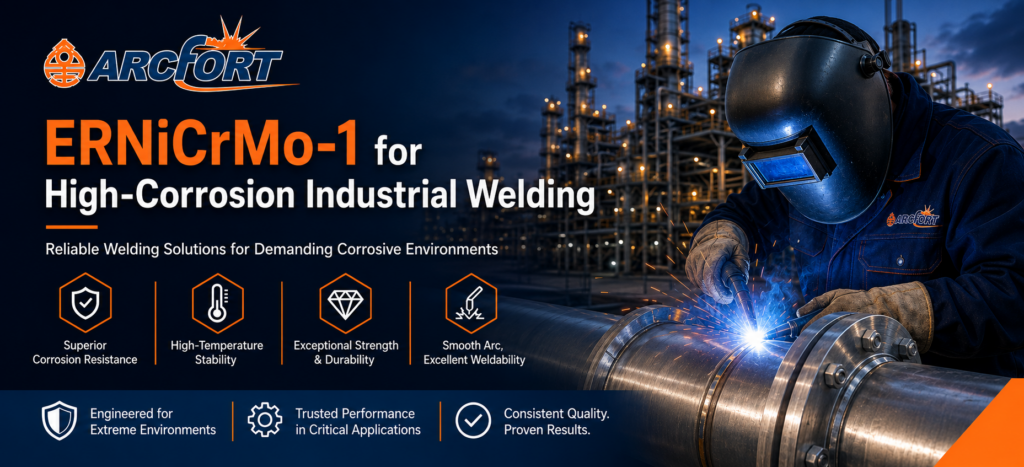
ERNiCrMo-1 for High-Corrosion Industrial Welding
High-corrosion industrial environments place extreme demands on welded joints. In chemical processing, refinery maintenance, marine-related equipment, and high-temperature process systems, weld failure is rarely a small issue. A weak weld can lead to leakage, downtime, safety risks, and expensive repair work.ERNiCrMo-1
This is why filler metal selection matters.
ERNiCrMo-1 is a nickel-chromium-molybdenum welding wire designed for demanding alloy welding applications where corrosion resistance, weld stability, and long-term service reliability are important. It is commonly considered for welding nickel-based alloys, corrosion-resistant components, and industrial equipment exposed to aggressive operating conditions.
AWS A5.14 covers nickel and nickel-alloy bare welding electrodes and rods, including general requirements, testing, packaging, and application guidance.
ERNiCrMo-1 Why High-Corrosion Welding Needs the Right Filler Metal
In ordinary fabrication, weld strength may be the main concern. In high-corrosion environments, the situation is more complex. The weld metal must not only join the base materials but also survive chemical attack, heat, pressure, and repeated service cycles.
Common industrial corrosion challenges include:
Acidic process media
Chloride-containing environments
Oxidizing and reducing conditions
High-temperature corrosion
Localized corrosion near welded zones
Stress-related cracking risks
Repair welding on aged or exposed equipment
When the filler metal is not properly matched to the application, the weld area can become the weakest point of the entire component.
What Makes ERNiCrMo-1 Suitable for Harsh Environments?
ERNiCrMo-1 belongs to the nickel-chromium-molybdenum filler metal family. This alloy system is widely associated with corrosion-resistant welding applications because nickel provides a stable base for harsh service conditions, chromium supports oxidation resistance, and molybdenum helps improve performance in aggressive corrosion environments.
For industrial users, the value of ERNiCrMo-1 is not only in its alloy type but also in the problems it helps address during fabrication and repair.
It can be used where the welding application requires:
Good corrosion resistance in demanding service conditions
Reliable joining of compatible nickel alloy materials
Weld metal suitable for harsh chemical or process environments
Stable performance in industrial maintenance welding
A filler metal option for corrosion-resistant alloy repair
Typical Industries Using ERNiCrMo-1
Chemical Processing Equipment
Chemical plants often operate with aggressive liquids, gases, and mixed process media. Reactors, vessels, piping systems, and heat exchangers may face corrosion from acids, chlorides, and other chemicals.
In this type of environment, ERNiCrMo-1 can be selected for welding compatible corrosion-resistant alloys where ordinary stainless or low-alloy filler metals may not provide the required service performance.
Petrochemical and Refinery Maintenance
Refinery equipment is exposed to complex operating conditions, including heat, pressure, sulfur-bearing environments, and corrosive process streams. During maintenance, repair welding must restore both structural integrity and corrosion resistance.
ERNiCrMo-1 can be considered for repair or fabrication work involving nickel alloy components used in harsh refinery service.
Heat Exchangers and Process Vessels
Heat exchangers and vessels often combine pressure, temperature, and corrosive media. Welded joints in these components must remain stable over long service periods.
For compatible alloy systems, ERNiCrMo-1 provides a practical filler metal option for welding areas where corrosion resistance is a key performance requirement.
Industrial Repair Welding
Repair welding in high-corrosion equipment is especially demanding because the base material may already be affected by thermal cycles, service exposure, or surface degradation.
Using the correct filler metal helps reduce the risk of premature failure after repair. ERNiCrMo-1 is suitable for applications where weld quality, compatibility, and corrosion resistance must be considered together.
Problems ERNiCrMo-1 Can Help Solve
1. Weld Failure in Corrosive Service
In corrosive environments, the weld zone may fail earlier than the base metal if the filler metal is not suitable. ERNiCrMo-1 helps support better weld performance in demanding corrosion-related applications.
2. Poor Filler Metal Compatibility
A common mistake in industrial welding is selecting a filler metal based only on strength. For nickel alloy welding, compatibility with the base material and service environment is critical. ERNiCrMo-1 is designed for specific nickel-chromium-molybdenum alloy welding needs.
3. Repair Welding in Harsh Conditions
Maintenance teams often need to repair equipment without replacing the entire component. ERNiCrMo-1 can be used as part of a repair welding solution for compatible corrosion-resistant alloy equipment.
4. Corrosion Around Welded Areas
Welded joints may experience different corrosion behavior compared with the base material. Proper filler metal selection helps reduce the risk of the weld becoming the first failure point.
Welding Process Considerations
ERNiCrMo-1 can be used in common nickel alloy welding processes depending on project requirements, equipment design, and welding procedure qualification.
In nickel alloy welding, attention should be given to:
Base material identification
Joint cleanliness
Heat input control
Proper shielding gas selection
Correct welding parameters
Interpass temperature control
Procedure qualification
Welder skill and inspection requirements
For GMAW, AWS A5.14 guidance notes that direct current electrode positive is often used, and argon or argon-helium shielding gases are commonly used for nickel alloy welding applications.
How to Select ERNiCrMo-1 Correctly
Before selecting ERNiCrMo-1, engineers and procurement teams should confirm several points:
Base Material Compatibility
The filler metal must match the alloy system and welding procedure requirements.Service Environment
The type of corrosion, temperature, pressure, and media exposure should be reviewed.Applicable Standards
Project requirements may refer to AWS, ASME, ISO, or customer-specific welding specifications.Welding Process
TIG, MIG, or other applicable processes should be selected based on joint design and production conditions.Quality Documentation
Material certificates, batch traceability, and inspection records are important for high-risk industrial applications.
Why Procurement Teams Should Care
For procurement teams, ERNiCrMo-1 is not simply a welding wire item. It is part of the quality control system for high-value industrial equipment.
When sourcing ERNiCrMo-1, buyers should pay attention to:
Stable chemical composition
Batch traceability
Reliable packaging
Clear product marking
Technical data availability
Welding procedure support
Consistent supply capacity
In high-corrosion welding, choosing a low-cost but poorly controlled filler metal can create much higher costs later through rework, shutdowns, or field failures.
Conclusion
High-corrosion industrial welding requires more than ordinary filler metal selection. The weld must perform under chemical attack, heat, pressure, and long-term service conditions.
ERNiCrMo-1 is a practical filler metal option for compatible nickel alloy welding applications in chemical processing, petrochemical equipment, heat exchangers, process vessels, and industrial repair work.
For projects where corrosion resistance and weld reliability are critical, ERNiCrMo-1 should be evaluated carefully as part of the welding procedure, material selection, and quality control system.