

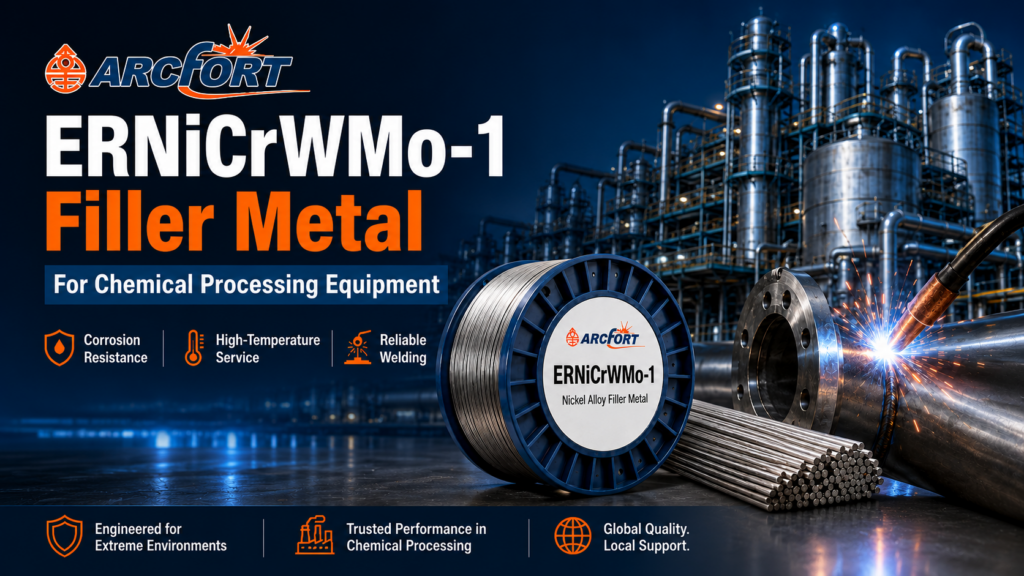
ERNiCrWMo-1 Filler Metal for Chemical Processing Equipment
Chemical processing equipment often operates in some of the most demanding welding environments. Components may be exposed to corrosive media, elevated temperatures, pressure changes, and continuous production cycles. In these conditions, the choice of filler metal directly affects weld reliability, service life, and maintenance cost.ERNiCrWMo-1
ERNiCrWMo-1 filler metal is designed for nickel-based alloy welding applications where corrosion resistance, heat resistance, and weld stability are important. For chemical processing plants, it can be used in equipment where welded joints must withstand aggressive operating conditions and long-term exposure to industrial chemicals.
Why Chemical Processing Equipment Needs Reliable Filler Metal
In chemical processing, welded parts are not only expected to join metals together. They must also help maintain the integrity of the entire system. Poor filler metal selection may lead to premature corrosion, cracking, weld failure, leakage, or unplanned shutdowns.
Common equipment that may require corrosion-resistant filler metal includes:
Reactors
Heat exchangers
Pressure vessels
Chemical storage tanks
Piping systems
Valves and fittings
Process columns
Maintenance and repair components
For these applications, ERNiCrWMo-1 filler metal can be considered when nickel alloy welding performance is required and when the welded area needs strong resistance against harsh service conditions.
Key Advantages of ERNiCrWMo-1 Filler Metal
1. Corrosion Resistance in Harsh Environments
Chemical plants often process acidic, alkaline, chloride-containing, or mixed chemical media. These environments can attack ordinary weld metal quickly. ERNiCrWMo-1 filler metal is suitable for applications where the weld deposit must resist corrosion and maintain stable performance in demanding service.
This makes it useful for equipment exposed to chemical solutions, industrial gases, high-humidity environments, and corrosive process fluids.
2. Suitable for Nickel Alloy Welding
Nickel-based alloys are widely used in chemical processing equipment because of their resistance to corrosion and heat. ERNiCrWMo-1 filler metal is used for welding nickel alloy materials and related corrosion-resistant components.
It may be applied in TIG welding and MIG welding depending on the fabrication requirement, base material, joint design, and production condition.
3. Stable Weld Quality for Critical Components
Chemical processing equipment often requires stable weld quality because even a small defect may cause leakage or production risk. ERNiCrWMo-1 filler metal helps support consistent weld performance when proper welding procedures, shielding gas, cleaning, and heat input control are used.
For critical fabrication, welding engineers should also control joint preparation, interpass temperature, dilution, and post-weld inspection.
4. Good Choice for Repair and Maintenance Welding
Many chemical plants face equipment wear, corrosion, and local damage after long-term operation. Replacing the full component can be expensive and time-consuming. In some cases, repair welding with a suitable nickel alloy filler metal can help extend equipment service life.
ERNiCrWMo-1 filler metal may be used for repair welding where compatible base materials and service conditions require corrosion-resistant weld deposits.
Typical Applications of ERNiCrWMo-1 in Chemical Processing
ERNiCrWMo-1 filler metal can be considered for welding applications such as:
Chemical equipment fabrication
Corrosion-resistant piping systems
Heat exchanger parts
Reactor repair
Pressure vessel welding
Tank and vessel maintenance
Nickel alloy component joining
Dissimilar metal welding under suitable procedure control
Corrosion-resistant overlay or cladding applications
Before welding, the base metal, working temperature, chemical medium, welding process, and design standard should be checked carefully.
Welding Considerations for ERNiCrWMo-1 Filler Metal
To achieve reliable weld results, the following points should be considered:
Clean the Base Material
Nickel alloy welding requires clean surfaces. Oil, grease, paint, rust, moisture, and other contaminants should be removed before welding. Poor cleaning may cause porosity, cracking, or unstable weld appearance.
Control Heat Input
Excessive heat input may affect weld structure and corrosion resistance. Welding parameters should be controlled according to the material thickness, welding position, and process requirement.
Use Proper Shielding Gas
For TIG and MIG welding, proper shielding gas protection is important. Poor gas coverage may lead to oxidation, porosity, or poor weld surface quality.
Match the Filler Metal with the Base Metal
The filler metal should be selected according to the base material, service environment, design requirement, and applicable welding standard. For chemical processing equipment, corrosion resistance should always be considered together with mechanical performance.
Inspect the Weld Properly
For critical chemical equipment, visual inspection alone may not be enough. Depending on the project requirement, additional testing such as radiographic testing, ultrasonic testing, liquid penetrant testing, or corrosion evaluation may be needed.
Why ERNiCrWMo-1 Matters for Long-Term Equipment Reliability
In chemical processing plants, downtime can be costly. Weld failure may cause production interruption, safety risks, repair cost, and delivery delay. Choosing the right filler metal helps reduce these risks from the beginning.
ERNiCrWMo-1 filler metal offers value for applications where corrosion-resistant welding is required. It helps support longer service life, better weld reliability, and more stable operation in demanding chemical processing environments.
How to Select ERNiCrWMo-1 Filler Metal
When selecting ERNiCrWMo-1 filler metal, buyers and welding engineers should consider:
Base metal grade
Welding process
Chemical exposure
Working temperature
Pressure condition
Required weld strength
Corrosion resistance requirement
Applicable standards
Wire diameter
Certificate and batch traceability
Packaging and storage conditions
For industrial buyers, consistent quality and stable supply are also important. Chemical equipment projects often require repeat orders, batch consistency, and reliable documentation.
Conclusion
ERNiCrWMo-1 filler metal is a valuable choice for chemical processing equipment where corrosion resistance, weld stability, and long-term reliability are important. It can be used in demanding industrial welding applications such as reactors, pressure vessels, piping systems, heat exchangers, and maintenance repair work.
For chemical plants, equipment manufacturers, and industrial maintenance teams, selecting the right filler metal is not only a welding decision. It is also a decision about safety, service life, and production stability.
When the application involves corrosive media, high-demand equipment, or critical welded joints, ERNiCrWMo-1 filler metal can help provide a stronger foundation for reliable chemical processing equipment welding.