
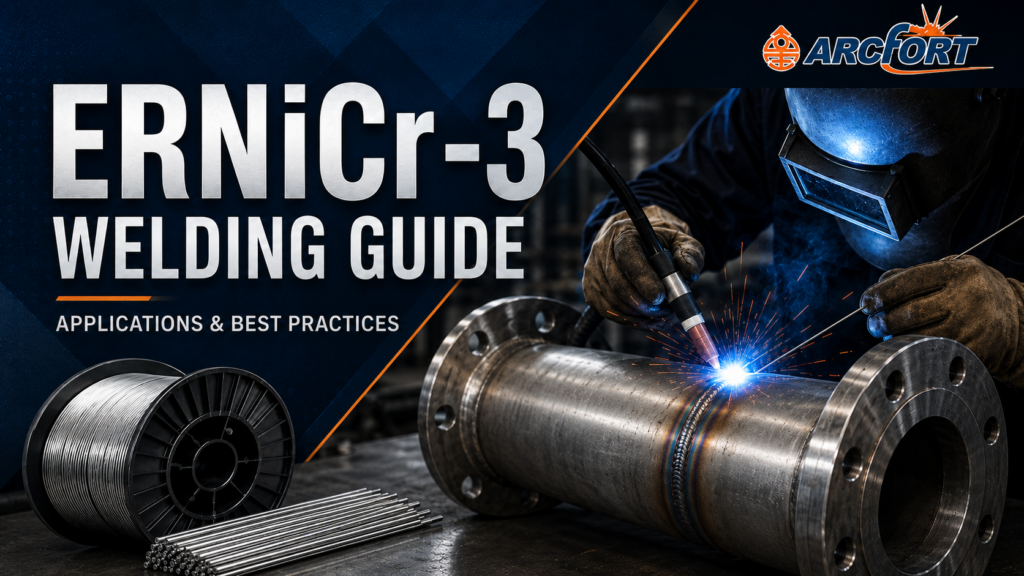
ERNiCr‑3 (Alloy 82) Welding Guide: Applications and Best Practices
In nickel alloy welding, ERNiCr‑3—also referred to as Alloy 82—has become a trusted filler metal for challenging joints. This article explores where ERNiCr‑3 fits into fabrication workflows, why it is valued across industries, and how to get the most from this versatile material.
Overview of ERNiCr‑3
ERNiCr‑3 is part of a family of nickel‑chromium‑iron filler metals designed for arc welding processes such as TIG (GTAW), MIG (GMAW) and submerged‑arc welding (SAW). Its formulation allows it to be used with a wide range of base metals, including nickel‑based alloys and steels. It is also well suited to dissimilar joint welding, where nickel alloys are joined to stainless or carbon steels.
Typical Applications
Because ERNiCr‑3 can be used with various alloys, its applications span multiple industries. For example, it is frequently employed to weld nickel‑chromium‑iron alloys specified in several common ASTM standards. It is also used for overlaying steel surfaces with a nickel‑based cladding to enhance corrosion resistance. The filler metal’s versatility extends to joining steel to stainless steel and to other nickel‑base alloys.
This broad applicability means ERNiCr‑3 shows up in sectors such as oil and gas, petrochemical processing and power generation. The wire is used to fabricate piping and furnace equipment for plants operating over a wide temperature range, from cryogenic service to elevated temperatures. In desalination facilities, where chloride‑bearing environments can attack welds, Alloy 82 is chosen because it resists pitting and stress‑corrosion cracking.
Benefits and Service Performance
Manufacturers appreciate ERNiCr‑3 for its high strength and corrosion‑resistant characteristics, especially at elevated temperatures. These attributes make it suitable for joining dissimilar alloys that may experience different thermal expansions or corrosive exposure. According to industry descriptions, high‑quality versions of this filler metal are produced with tightly controlled chemistries to ensure consistent cleanliness and operator appeal. As a result, the welds exhibit good mechanical integrity and resistance to oxidation.
Another notable advantage is the filler metal’s compatibility with newer manufacturing techniques. Certain ERNiCr‑3 wires are marketed as suitable for laser welding.This opens opportunities for engineers looking to build components additively while maintaining the proven performance of traditional Alloy 82 welds.
Best Practices for Welding with ERNiCr‑3
To achieve sound welds, proper practices are essential. Before welding, clean base materials thoroughly to remove oil, dirt and oxides; nickel alloys are particularly sensitive to contamination. Select a shielding gas that matches your process—pure argon or argon‑helium mixes are common for GTAW and GMAW. Maintain the recommended welding parameters for the chosen wire diameter, keeping amperage and voltage within manufacturer guidelines to avoid porosity or lack of fusion.
When using ERNiCr‑3 on dissimilar joints, ensure that preheat and interpass temperatures are appropriate for the thicker or higher‑alloy side of the joint. On cladding applications, deposit multiple layers if necessary to achieve the desired corrosion resistance. After welding, allow welds to cool slowly; rapid quenching can induce stress. Storage of consumables in a dry environment prevents moisture pickup and hydrogen‑induced cracking.
Conclusion
ERNiCr‑3 (Alloy 82) continues to earn its place as a workhorse filler metal for joining nickel alloys and steels. Its adaptability across welding processes, suitability for dissimilar joints, and resistance to corrosion in demanding environments have made it a preferred choice for fabricators in energy, chemical and marine sectors. By understanding its applications and following established best practices, welders can produce reliable, high‑quality joints that perform over a broad temperature range.