

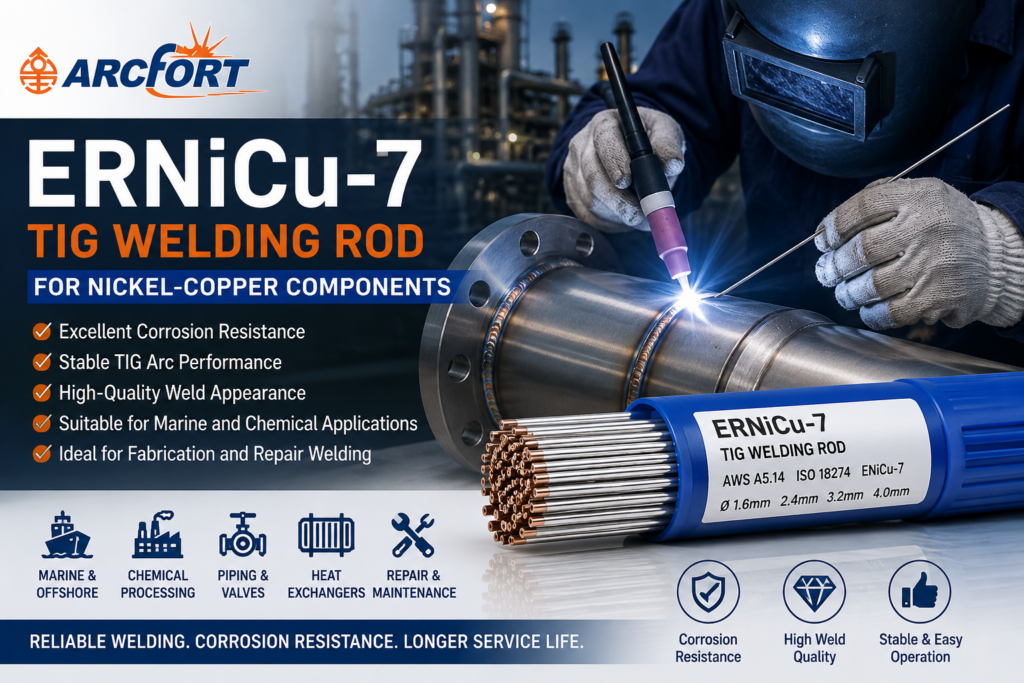
ERNiCu-7 TIG Welding Rod for Nickel-Copper Components
Nickel-copper components are widely used in industries where corrosion resistance, seawater resistance, and stable mechanical performance are required. From marine equipment to chemical processing systems, these materials must perform reliably in harsh operating environments.ERNiCu-7
For these demanding applications, ERNiCu-7 TIG welding rod is a common filler metal choice for welding nickel-copper alloys and related components. It is designed to provide stable arc performance, good weld appearance, and reliable corrosion resistance when used with proper TIG welding procedures.
What Is ERNiCu-7 TIG Welding Rod?
ERNiCu-7 is a nickel-copper alloy filler metal used for welding nickel-copper base metals and selected dissimilar metal applications. In TIG welding, it is supplied as straight welding rods and used with an external shielding gas to produce clean and controlled welds.
Because TIG welding offers excellent arc control, ERNiCu-7 TIG rods are often selected for precision work, repair welding, thin-wall components, root passes, and high-quality welded joints.
Why ERNiCu-7 Is Used for Nickel-Copper Components
Nickel-copper alloys are chosen for applications where ordinary stainless steel or carbon steel may not provide enough corrosion resistance. These components often work in seawater, brine, acidic media, alkaline environments, or industrial chemical systems.
ERNiCu-7 TIG welding rod helps support weld performance in these conditions by offering:
Good resistance to seawater corrosion
Suitable performance for nickel-copper alloy welding
Stable TIG arc behavior
Clean weld bead appearance
Strong compatibility with corrosion-resistant components
Reliable performance in repair and fabrication work
For buyers and welding engineers, this makes ERNiCu-7 a practical filler metal for both new equipment manufacturing and maintenance welding.
Typical Applications of ERNiCu-7 TIG Welding Rod
ERNiCu-7 TIG welding rod is widely used for nickel-copper components in industries such as:
Marine and Offshore Equipment
Marine environments are highly corrosive because of saltwater, humidity, and long-term exposure. ERNiCu-7 TIG rods are suitable for welding components used in seawater service, shipbuilding, offshore platforms, and marine repair.
Typical parts include:
Seawater piping
Pump components
Valve bodies
Heat exchanger parts
Marine fittings
Offshore maintenance components
Chemical Processing Equipment
Chemical plants often use nickel-copper materials where resistance to corrosive chemicals is required. ERNiCu-7 TIG welding rod may be used for process equipment, piping systems, and repair welding when nickel-copper compatibility is needed.
Typical applications include:
Chemical pipelines
Tanks and vessels
Heat exchangers
Reactors
Valves and fittings
Maintenance repair parts
Industrial Maintenance and Repair
Many nickel-copper components are expensive to replace. TIG repair welding with ERNiCu-7 can help extend equipment service life when the base material and service environment are suitable.
It is especially useful for controlled repair work where weld quality, appearance, and corrosion resistance are important.
Key Benefits of ERNiCu-7 TIG Welding Rod
1. Excellent Corrosion Resistance
The main reason to select ERNiCu-7 is its suitability for corrosion-resistant welding. It performs well in environments where nickel-copper components are exposed to saltwater, brine, and certain industrial chemical conditions.
This makes it valuable for marine equipment, chemical processing systems, and corrosion-prone industrial parts.
2. Stable TIG Welding Performance
TIG welding requires a filler rod that feeds smoothly and produces stable weld metal. ERNiCu-7 TIG welding rod supports controlled welding, clean bead formation, and precise weld placement.
This is important for thin-wall components, root passes, high-quality joints, and repair areas with limited access.
3. Suitable for Critical Components
Nickel-copper components are often used in systems where leakage, corrosion failure, or weld defects may create serious production risks. ERNiCu-7 TIG rod helps support reliable welded joints when the welding procedure is properly controlled.
For critical components, welders should pay close attention to joint preparation, cleaning, heat input, shielding gas protection, and inspection requirements.
4. Useful for New Fabrication and Repair
ERNiCu-7 TIG welding rod can be used in both manufacturing and maintenance. It is suitable for fabricating new nickel-copper components and repairing existing parts exposed to corrosive environments.
This flexibility makes it useful for workshops, shipyards, chemical equipment manufacturers, and industrial maintenance teams.
Welding Considerations for ERNiCu-7 TIG Rod
To achieve reliable weld quality, proper welding control is essential.
Clean the Base Metal Carefully
Nickel-copper welding requires clean surfaces. Oil, grease, moisture, oxide, paint, and other contaminants should be removed before welding. Poor cleaning can cause porosity, cracking, or unstable weld quality.
Use Proper Shielding Gas
TIG welding normally requires high-quality shielding gas coverage. Inadequate shielding can lead to oxidation, surface contamination, and poor weld appearance.
Control Heat Input
Excessive heat input can affect the weld structure and may increase the risk of distortion or weld defects. Welding parameters should be selected according to material thickness, joint design, welding position, and project requirements.
Match the Filler Metal to the Base Material
Before selecting ERNiCu-7, confirm the base metal grade, service temperature, corrosive media, and design standard. Correct filler metal selection is especially important for chemical and marine applications.
Inspect the Weld After Welding
For important nickel-copper components, inspection should not be ignored. Depending on the project, visual testing, liquid penetrant testing, radiographic testing, ultrasonic testing, or pressure testing may be required.
How to Select ERNiCu-7 TIG Welding Rod
When purchasing ERNiCu-7 TIG welding rod, industrial buyers should consider:
Base material compatibility
Welding process and position
Rod diameter
Chemical service environment
Marine or offshore exposure
Required mechanical properties
Welding procedure requirements
Certificate and batch traceability
Packaging and storage condition
Stable supply capability
For repeated industrial orders, consistent quality is just as important as product selection. Stable composition, clean surface condition, reliable packaging, and clear documentation help reduce welding problems and project risks.
Common Industries Using ERNiCu-7 TIG Welding Rod
ERNiCu-7 TIG welding rod is suitable for many industries that use nickel-copper components, including:
Marine engineering
Offshore equipment
Shipbuilding and repair
Chemical processing
Petrochemical equipment
Heat exchanger manufacturing
Pump and valve production
Industrial maintenance
Corrosion-resistant fabrication
These industries often require welds that can withstand long-term service in aggressive environments.
Conclusion
ERNiCu-7 TIG welding rod is an important filler metal for welding nickel-copper components used in marine, chemical processing, offshore, and industrial maintenance applications. It offers good corrosion resistance, stable TIG welding performance, and reliable weld quality when used with proper welding procedures.
For nickel-copper components such as pumps, valves, piping systems, tanks, heat exchangers, and marine equipment, ERNiCu-7 provides a practical welding solution for both fabrication and repair.
Choosing the right filler metal helps improve weld reliability, reduce maintenance risk, and support longer service life in demanding industrial environments.