
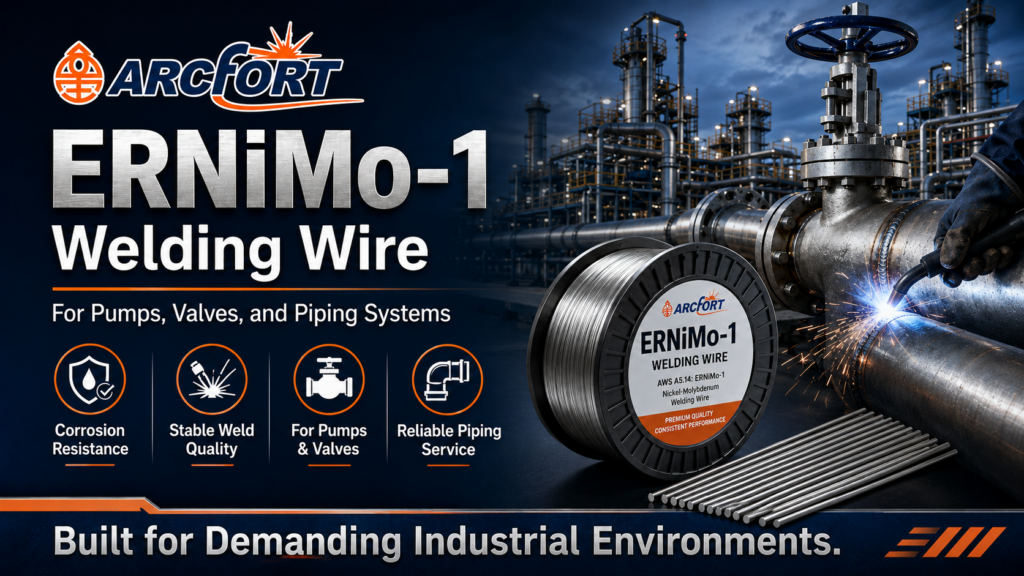
ERNiMo-1 Welding Wire for Pumps, Valves, and Piping Systems
Pumps, valves, and piping systems are essential parts of many industrial operations. In chemical plants, petrochemical facilities, marine systems, power equipment, and industrial processing lines, these components often work under pressure, corrosion, temperature changes, and continuous fluid movement.ERNiMo-1
When these systems are made from nickel-molybdenum alloys or related corrosion-resistant materials, the choice of welding wire becomes very important. ERNiMo-1 welding wire is used for nickel-molybdenum alloy welding applications where corrosion resistance, weld stability, and long-term service performance are required.
For pumps, valves, and piping systems, reliable weld quality helps reduce leakage risk, maintenance cost, and unexpected shutdowns.
What Is ERNiMo-1 Welding Wire?
ERNiMo-1 is a nickel-molybdenum filler metal used for welding nickel alloy materials and corrosion-resistant industrial components. It is commonly supplied as MIG welding wire or TIG welding rod, depending on the welding process and project requirement.
This welding wire is selected for applications where the weld deposit must perform in aggressive service conditions. It is especially useful when equipment is exposed to corrosive media, chemical solutions, industrial gases, or severe operating environments.
Why Pumps, Valves, and Piping Systems Need the Right Welding Wire
Pumps, valves, and piping systems are often exposed to flowing liquids, gases, pressure cycles, and chemical attack. A weak welded joint can create serious problems, including leakage, corrosion failure, production interruption, and safety risks.
Common welding challenges in these components include:
Corrosion in weld zones
Porosity caused by contamination
Cracking from improper heat input
Poor weld appearance
Leakage at joints
Inconsistent weld quality
Reduced service life
Expensive repair work
ERNiMo-1 welding wire helps support reliable welding when the base material, welding procedure, and service environment are properly matched.
Key Benefits of ERNiMo-1 Welding Wire
1. Corrosion Resistance for Harsh Service
Many pumps, valves, and piping systems operate in corrosive environments. Ordinary filler metals may not provide enough resistance in chemical service or severe industrial conditions.
ERNiMo-1 welding wire is suitable for corrosion-resistant alloy welding applications where the weld metal must withstand demanding media and long-term exposure.
This makes it valuable for systems handling aggressive fluids, chemical solutions, and industrial process materials.
2. Suitable for Nickel-Molybdenum Alloy Welding
Nickel-molybdenum alloys are often used in environments where corrosion resistance is more important than ordinary strength alone. ERNiMo-1 welding wire is designed for welding these alloy systems and compatible components.
Using the correct filler metal helps improve weld compatibility and reduces the risk of premature weld failure.
3. Reliable Performance for Pressure and Flow Systems
Pumps, valves, and piping systems must maintain tightness and structural integrity during operation. Weld quality is especially important because these components may experience pressure changes, vibration, thermal movement, and fluid flow.
ERNiMo-1 welding wire helps support stable weld deposits when proper welding parameters and inspection procedures are used.
4. Useful for Fabrication and Repair Welding
ERNiMo-1 welding wire can be used in both new fabrication and maintenance repair. In many industrial plants, replacing a full pump, valve, or piping section may be costly. Repair welding with a suitable filler metal can help extend service life when the base material and operating conditions are suitable.
This makes ERNiMo-1 useful for equipment manufacturers, repair workshops, maintenance teams, and industrial plants.
Typical Applications of ERNiMo-1 Welding Wire
ERNiMo-1 welding wire can be considered for many corrosion-resistant welding applications involving pumps, valves, and piping systems.
Common applications include:
Pump casings
Pump shafts and related parts
Valve bodies
Valve seats and fittings
Corrosion-resistant piping
Chemical process pipelines
Industrial fluid transfer systems
Pressure-containing components
Heat exchanger connections
Repair welding of nickel alloy parts
Fabrication of corrosion-resistant assemblies
Maintenance welding in chemical and petrochemical plants
Before welding, the base metal grade, operating medium, pressure condition, temperature, and project standard should be confirmed carefully.
ERNiMo-1 for Pump Welding
Pumps often handle fluids that can be corrosive, hot, abrasive, or chemically active. Welded pump parts must resist both mechanical stress and chemical attack.
ERNiMo-1 welding wire may be used for pump components where nickel-molybdenum alloy compatibility and corrosion resistance are required. Proper welding control helps reduce the risk of weld defects, leakage, and premature damage.
For pump repair work, cleaning is especially important because used components may contain oil, scale, chemical residue, or surface contamination.
ERNiMo-1 for Valve Welding
Valves control flow, pressure, and process safety. Welded valve components must maintain sealing performance and reliable strength during long-term service.
ERNiMo-1 welding wire can be used for suitable nickel alloy valve components exposed to corrosive media. It is important to control heat input and avoid distortion, especially when welding parts connected to sealing surfaces or precision-machined areas.
For critical valves, post-weld inspection and pressure testing may be required.
ERNiMo-1 for Piping System Welding
Piping systems often involve many welded joints. Each joint must maintain integrity under service pressure, temperature changes, and fluid flow.
ERNiMo-1 welding wire is suitable for corrosion-resistant piping applications where the welded joint must match the performance requirements of nickel-molybdenum alloy systems.
In piping fabrication, welders should control root pass quality, shielding gas protection, interpass cleaning, and joint alignment. Good welding practice helps reduce leakage risk and improves long-term system reliability.
TIG and MIG Welding with ERNiMo-1
ERNiMo-1 can be used with different welding processes depending on the application.
TIG Welding
TIG welding is often selected for root passes, thin-wall piping, precision valve components, and repair welding. It offers excellent control and clean weld appearance.
MIG Welding
MIG welding is often used for higher productivity and longer welds. It may be suitable for larger components or fabrication work where efficient welding is required.
The welding process should be selected based on material thickness, joint type, welding position, quality requirement, and production efficiency.
Welding Considerations for ERNiMo-1
To achieve stable weld quality, several key factors should be controlled.
Clean the Base Material
Nickel alloy welding requires clean surfaces. Remove oil, grease, paint, moisture, oxides, chemical residue, and other contaminants before welding. Poor cleaning may cause porosity, cracking, or unstable weld quality.
Control Heat Input
Excessive heat input can affect weld quality and component performance. Welding parameters should be selected according to the material thickness, joint design, and welding position.
Use Proper Shielding Gas
For TIG and MIG welding, shielding gas protection is very important. Inadequate gas coverage may lead to oxidation, porosity, and poor weld appearance.
Avoid Cross-Contamination
ERNiMo-1 welding wire should be stored and handled carefully. Avoid contamination from carbon steel dust, moisture, oil, or dirty tools. Clean handling helps protect weld quality.
Inspect Important Welds
For pumps, valves, and piping systems, inspection is essential. Depending on the project requirement, testing may include visual inspection, liquid penetrant testing, radiographic testing, ultrasonic testing, pressure testing, or leak testing.
How to Select ERNiMo-1 Welding Wire
When selecting ERNiMo-1 welding wire, buyers and welding engineers should consider:
Base metal grade
Welding process
Wire or rod diameter
Corrosive medium
Operating pressure
Service temperature
Joint design
Welding position
Required weld performance
Inspection requirement
Certificate and batch traceability
Packaging and storage condition
Stable supply capability
For industrial buyers, product consistency is very important. Stable composition, clean wire surface, smooth feeding performance, clear labeling, and reliable documentation can help reduce welding problems and improve project control.
Why ERNiMo-1 Matters for Industrial Reliability
In pumps, valves, and piping systems, weld failure can lead to leakage, production stoppage, safety concerns, and costly maintenance. The weld area must be able to perform under the same demanding conditions as the base material.
ERNiMo-1 welding wire helps support corrosion-resistant welding for nickel-molybdenum alloy components used in severe industrial service. With proper filler metal selection, welding procedure control, and inspection, it can help improve equipment reliability and service life.
Conclusion
ERNiMo-1 welding wire is a practical filler metal for pumps, valves, and piping systems that require corrosion resistance and stable weld performance. It is suitable for nickel-molybdenum alloy welding, chemical processing equipment, petrochemical systems, industrial piping, valve components, pump parts, and maintenance repair applications.
For reliable results, ERNiMo-1 should be selected according to the base material, operating medium, temperature, pressure, welding process, and project requirements. Proper cleaning, heat input control, shielding gas protection, and inspection are essential for stable weld quality.
When pumps, valves, and piping systems must work in corrosive and demanding environments, ERNiMo-1 welding wire provides an effective solution for long-term industrial welding reliability.