

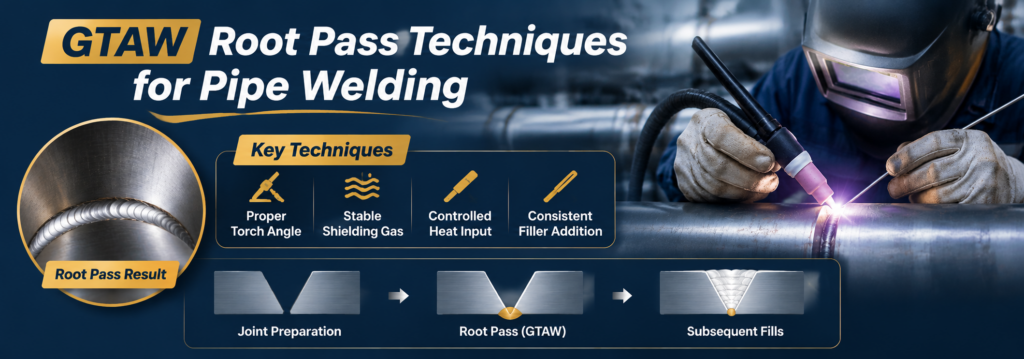
GTAW Root Pass Techniques depend on the relationship between joint preparation, arc control, and filler addition. A consistent pipe root requires more than steady torch movement: bevel geometry, root opening, root-face thickness, and internal alignment must support controlled fusion. This guide focuses on manual open-root welding with added filler metal. Dimensions and operating parameters must follow the applicable welding procedure specification, or WPS.
GTAW Root Pass Techniques: Understanding Joint Geometry
The root pass establishes the first weld layer at the inside of a pipe joint. In an open-root configuration, the welder must fuse both root edges while controlling the molten metal across the opening.
Four fit-up features influence this balance:
| Feature | Function | Potential problem when inconsistent |
|---|---|---|
| Bevel angle | Provides access for the arc and filler | Restricted access or uneven sidewall fusion |
| Root gap | Separates the opposing root edges | Incomplete penetration or an unstable weld pool |
| Root face | Controls the thickness of metal at the root edge | Uneven melting or excessive local penetration |
| Internal alignment | Positions the pipe bores relative to each other | Irregular root profile and unequal edge melting |
These features work together. Increasing current cannot reliably compensate for every fit-up problem, particularly when conditions change around the circumference.
Bevel Angle and Access
Distinguish between the bevel angle on one pipe end and the included groove angle formed by both ends. Confusing these measurements can produce a joint different from the specified preparation.
A narrow groove may restrict tungsten positioning, visibility, and filler access. A wider groove improves access but increases the weld volume and may alter the required technique.
Prepare the bevel uniformly and remove burrs, oxide, oil, and machining residue. Inspect the internal edge as well as the visible groove faces.
Root Gap and Circumferential Consistency
The root gap is the opening between the prepared pipe ends. It affects arc access to the root edges and the amount of molten metal that must bridge the joint.
A gap that closes during welding can make penetration difficult to maintain. An opening that becomes too wide can increase the risk of burn-through or excessive root reinforcement.
Measure the opening at several positions before and after tacking. One acceptable measurement does not establish acceptable fit-up around the entire pipe.
GTAW Root Pass Techniques: Controlling the Root Face
The root face, also called the land, is the unbevelled portion at the pipe edge.
An excessively thick land may resist melting under the specified welding conditions. An excessively thin or irregular land can melt unevenly and destabilize the root opening.
Uniformity is therefore essential. A locally heavy land beside a thin section forces the welder to manage two different melting conditions within a short distance.
Do not assume that a knife edge or a particular land thickness is suitable for every joint. The correct preparation depends on the material, wall thickness, welding position, and qualified procedure.
GTAW Root Pass Techniques: Arc and Filler Wire Control
A stable arc and coordinated filler addition help maintain fusion while controlling root contour.
Maintain a Consistent Arc Length
Keep the arc short and stable within the requirements of the procedure. An unnecessarily long arc changes the heat distribution and can reduce control at the root edges.
Position the torch so the arc acts on both sides of the joint. Excessive torch inclination may favour one edge, restrict shielding, or make filler placement difficult.
Freehand welding and walking the cup can both be effective when suitable for the joint and permitted by the procedure. Neither method automatically guarantees penetration.
Feed Filler into the Leading Edge
Introduce clean filler into the leading portion of the molten pool under shielding protection. Avoid touching the tungsten or repeatedly pushing cold wire against an unmelted root edge.
Coordinate the amount added with travel speed and edge melting:
- Excessive addition can chill the pool and interrupt fusion.
- Insufficient addition can leave inadequate metal to bridge the opening.
- Irregular feeding can produce an uneven root profile.
- Contact between filler and tungsten can contaminate the electrode.
Keep the heated filler tip within the shielding envelope where practicable. If it becomes oxidized or contaminated, remove the affected portion before continuing.
Match Wire Diameter to the Procedure
Wire diameter influences access, feeding behaviour, and the amount of metal introduced with each addition. Larger wire can remove more heat from a small pool, while smaller wire may require more frequent feeding.
The wire does not need to match the root gap automatically. Select its classification and diameter according to the WPS, then maintain a repeatable feeding rhythm.
Effective GTAW Root Pass Techniques coordinate filler addition with visible edge fusion rather than using wire to cover an unfused opening. A neat external bead can conceal incomplete penetration or lack of fusion.
Control Starts, Stops, and Tack Transitions
Use the specified current-reduction and crater-filling method when stopping. Maintain shielding during cooling as required by the procedure and material.
Before restarting, inspect and prepare the termination. Remove defects and feather the transition where required so the new weld can fuse into sound metal.
Tacks incorporated into the weld must be acceptable and compatible with the procedure. Defective tacks should not simply be welded over.
Shielding and Position Changes
Protect the Internal Surface Where Required
Torch shielding protects the exposed weld pool, but it does not necessarily protect the pipe bore.
Materials susceptible to root oxidation may require backing gas. Establish purge conditions before welding and maintain them for the duration required by the procedure.
Provide suitable venting. Excessive internal pressure can disturb the molten root, while excessive gas flow may create turbulence rather than improve protection. Where oxygen limits apply, verify them using the specified measurement method.
Adapt to Fixed-Pipe Welding
On a fixed pipe, gravity changes its effect on the pool as the welder moves around the circumference. Comfortable hand support, consistent torch positioning, and controlled pool size become especially important.
Adjust technique only within the permitted procedure range. If the gap, alignment, or land falls outside tolerance, stop and correct the fit-up rather than attempting to overcome it through uncontrolled changes in heat input.
GTAW Root Pass Techniques: Troubleshooting and Inspection
Root appearance helps identify process problems, but appearance alone does not establish weld acceptance.
| Observation | Possible contributors | What to check |
|---|---|---|
| Incomplete penetration | Closing gap, heavy land, insufficient local melting, excessive travel speed | Fit-up measurements and permitted welding settings |
| Excessive penetration | Wide opening, thin land, slow travel, excessive local heating | Joint consistency and pool control |
| Root concavity | Unbalanced heat and filler addition, pool movement, purge-pressure effects | Technique, shielding arrangement, and root profile |
| Uneven root bead | Internal mismatch, irregular preparation, inconsistent feeding | Alignment and circumferential fit-up |
| Tungsten inclusion | Electrode contact with the pool or filler | Electrode condition and affected weld area |
| Oxidized root | Inadequate backing protection or leakage | Purge integrity and specified oxygen conditions |
Before depositing subsequent passes, examine the root using the access and methods required by the inspection plan. Direct viewing or a borescope can reveal surface conditions, but neither proves the absence of subsurface discontinuities.
Acceptance depends on the governing requirements and any specified nondestructive examination. The practical objective is consistent fusion, an acceptable internal profile, and a sound foundation for the remaining weld passes.