

H08Cr2AlMo Weld Metal Alloying Strategy: Balancing Strength, Oxidation Resistance and Toughness
Introduction: The Importance of Alloy Design in H08Cr2AlMo Weld Metal
High-temperature steel welding applications require more than simple weld strength. Components operating under elevated temperatures, thermal cycling, and long-term mechanical stress must maintain structural integrity while resisting oxidation and microstructural degradation.H08Cr2AlMo
H08Cr2AlMo welding wire is developed for heat-resistant steel welding applications where the weld metal must achieve a balanced combination of:
High-temperature strength
Oxidation resistance
Creep resistance
Impact toughness
Long-term structural stability
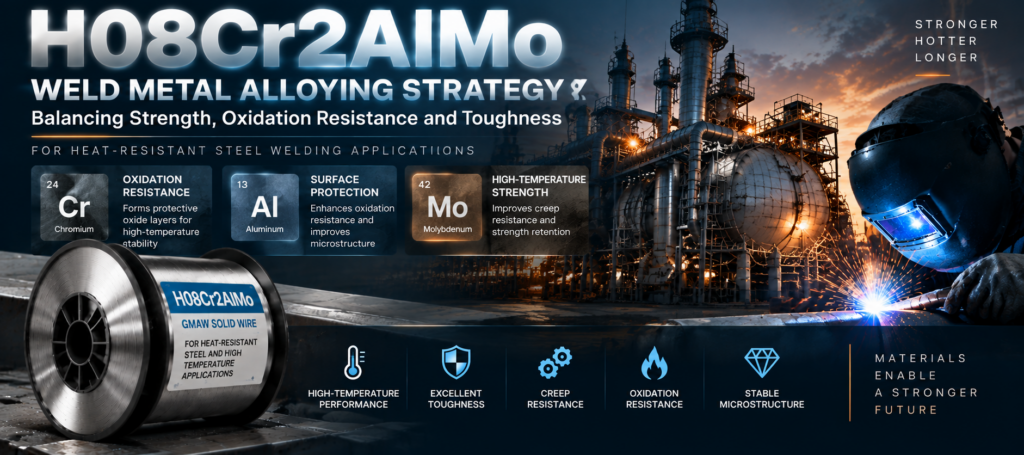
The performance of H08Cr2AlMo is primarily determined by its carefully controlled alloying system. Chromium (Cr), aluminum (Al), and molybdenum (Mo) work together to improve weld metal properties through different metallurgical mechanisms. Chromium contributes to oxidation resistance and carbide strengthening, aluminum enhances protective surface stability, and molybdenum improves high-temperature strength and creep resistance.
Understanding the alloying strategy behind H08Cr2AlMo helps engineers optimize welding procedures and select suitable materials for demanding heat-resistant steel fabrication.
1. Overview of H08Cr2AlMo Weld Metal Design
1.1 Purpose of H08Cr2AlMo Alloy System
H08Cr2AlMo belongs to the category of low-alloy heat-resistant welding materials designed for joining chromium-containing steels used in elevated-temperature environments.
The main design objective is to achieve a stable weld structure that can withstand:
Continuous high-temperature exposure
Thermal expansion and contraction
Mechanical loading
Oxidizing atmospheres
Unlike conventional welding materials that mainly focus on room-temperature strength, H08Cr2AlMo is engineered for long-term service reliability.
1.2 Key Metallurgical Requirements
A successful heat-resistant weld metal must maintain:
Strength Retention
The weld must preserve sufficient mechanical strength during prolonged high-temperature operation.
Oxidation Resistance
The surface must resist oxygen diffusion and corrosion reactions under elevated temperatures.
Toughness
The weld structure must prevent brittle failure caused by thermal stress and mechanical impact.
The alloy design of H08Cr2AlMo addresses these requirements through a balanced Cr-Al-Mo strengthening strategy.
2. Role of Chromium in H08Cr2AlMo Weld Metal
2.1 Chromium as an Oxidation Resistance Element
Chromium is one of the most important elements in heat-resistant steel welding.
Its primary function is improving oxidation resistance by promoting the formation of protective chromium-rich oxide layers.
These oxide films reduce:
Oxygen penetration
Surface degradation
High-temperature corrosion
As a result, chromium improves the durability of weld metal exposed to aggressive thermal environments.
2.2 Chromium and Carbide Strengthening
Chromium also participates in carbide formation during thermal exposure.
Controlled chromium-containing carbides contribute to:
Increased hardness stability
Improved wear resistance
Enhanced high-temperature strength
However, excessive carbide formation may reduce toughness, making alloy balance essential.
The H08Cr2AlMo composition is designed to provide strengthening benefits while maintaining sufficient ductility.
3. Role of Aluminum in H08Cr2AlMo Alloy Strategy
3.1 Aluminum and High-Temperature Oxidation Protection
Aluminum provides a unique contribution to high-temperature performance.
During oxidation, aluminum can promote the formation of stable aluminum-rich oxide layers, which act as protective barriers.
These layers help:
Reduce oxidation rates
Improve surface stability
Extend component service life
This makes aluminum especially valuable in applications involving repeated heating and cooling cycles.
3.2 Aluminum Effects on Weld Microstructure
Besides oxidation resistance, aluminum influences weld metal microstructure.
Controlled aluminum content can affect:
Inclusion characteristics
Phase transformation behavior
Grain refinement
Proper control is necessary because excessive aluminum may influence weld toughness and processing characteristics.
4. Role of Molybdenum in H08Cr2AlMo Weld Performance
4.1 Molybdenum for High-Temperature Strength
Molybdenum is a critical strengthening element in heat-resistant alloys.
Its main contributions include:
Solid solution strengthening
Improved creep resistance
Delayed high-temperature softening
During long-term service, molybdenum helps maintain mechanical properties when temperatures rise.
4.2 Molybdenum and Creep Resistance
Creep deformation is one of the major failure mechanisms in high-temperature components.
Molybdenum improves resistance against:
Slow plastic deformation
Grain boundary weakening
Strength loss during prolonged exposure
This makes H08Cr2AlMo suitable for applications requiring stable performance over extended operating periods.
5. Synergistic Effects of Cr-Al-Mo Alloying
5.1 Chromium-Molybdenum Strengthening Interaction
Chromium and molybdenum work together to improve high-temperature mechanical performance.
Their combined effects include:
Enhanced hardenability
Improved structural stability
Better resistance to thermal degradation
Chromium contributes corrosion resistance, while molybdenum provides additional high-temperature strengthening.
5.2 Aluminum-Assisted Oxidation Resistance
The addition of aluminum complements chromium by improving protective oxide formation.
The Cr-Al combination provides:
Improved oxidation protection
Reduced surface deterioration
Better thermal durability
This synergy is important for components exposed to high-temperature oxidation environments.
5.3 Balanced Strength and Toughness
Increasing alloy content can improve strength but may reduce toughness.
Therefore, H08Cr2AlMo requires careful control of alloy proportions to avoid:
Excessive hardness
Brittle phase formation
Reduced impact resistance
The goal is not maximum alloy content but optimized metallurgical balance.
6. Microstructure Control in H08Cr2AlMo Weld Metal
6.1 Phase Transformation During Cooling
After welding, the molten weld pool undergoes rapid solidification and cooling.
The final weld structure depends on:
Alloy composition
Cooling rate
Heat input
Thermal history
Controlled transformation helps achieve stable ferritic and alloy-strengthened structures.
6.2 Carbide Precipitation Behavior
During high-temperature service, alloy elements may form carbide particles.
Controlled carbide precipitation can improve:
Creep resistance
Strength retention
Microstructural stability
However, uncontrolled precipitation may lead to:
Reduced toughness
Embrittlement
Performance degradation
Therefore, carbide stability is a key consideration in H08Cr2AlMo metallurgy.
7. Balancing Toughness in Heat-Resistant Weld Metal
7.1 Challenges of High Alloy Content
High-alloy weld metals often face a trade-off between strength and toughness.
Excessive strengthening elements may increase:
Hardness
Brittleness
Crack sensitivity
H08Cr2AlMo achieves performance through controlled alloying rather than excessive alloy addition.
7.2 Factors Improving Weld Toughness
Toughness depends on:
Grain refinement
Phase distribution
Residual stress control
Alloy balance
Proper welding practices help maintain a tough and reliable weld structure.
8. Welding Process Considerations for H08Cr2AlMo
8.1 Heat Input Control
Heat input directly influences weld microstructure.
Excessive heat input may cause:
Grain coarsening
Reduced toughness
Lower mechanical stability
Optimized heat input supports better weld performance.
8.2 Preheating and Post-Weld Heat Treatment
Heat-resistant steels often require controlled thermal processing.
Important considerations include:
Preheating temperature
Cooling conditions
Post-weld heat treatment
These processes help reduce residual stress and improve long-term weld reliability.
9. Applications of H08Cr2AlMo Weld Metal
9.1 Boiler and High-Temperature Equipment
H08Cr2AlMo is suitable for components requiring:
High-temperature strength
Oxidation resistance
Long service life
9.2 H08Cr2AlMo Pressure and Thermal Systems
Critical thermal systems require weld metals capable of maintaining performance under continuous operation.
Key requirements include:
Structural stability
Resistance to thermal fatigue
Reliable mechanical properties
9.3 H08Cr2AlMo Energy and Industrial Fabrication
Modern industrial equipment increasingly demands materials that can operate efficiently at elevated temperatures.
H08Cr2AlMo provides a solution through advanced alloy design and controlled weld metallurgy.
H08Cr2AlMo Conclusion
The alloying strategy of H08Cr2AlMo welding wire is based on achieving a balanced relationship between strength, oxidation resistance, and toughness.
Chromium improves oxidation protection and carbide strengthening, aluminum enhances protective surface stability, and molybdenum provides high-temperature strength and creep resistance.
Through controlled Cr-Al-Mo alloy design, H08Cr2AlMo weld metal achieves reliable performance in demanding heat-resistant steel applications. Understanding these metallurgical mechanisms allows engineers to optimize welding processes and develop durable structures capable of long-term operation under extreme conditions.