

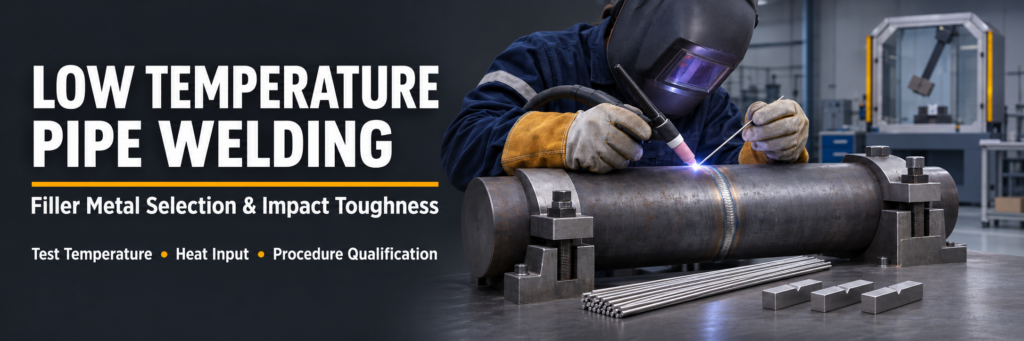
Low Temperature Pipe Welding: Filler Selection
Low Temperature Pipe Welding requires filler metals that deliver the specified strength and toughness under the conditions established for the finished joint. Matching the pipe’s tensile strength alone is insufficient. Selection must also consider impact test temperature, heat treatment, welding process, and the thermal cycle experienced by both the weld metal and heat-affected zone.
The starting point is the piping specification and approved welding procedure. A consumable described as suitable for cold service is only a candidate until its supporting data and qualification coverage match the application.
Define Service Requirements for Low Temperature Pipe Welding
First distinguish low-temperature service from welding in cold weather.
A pipe operating below freezing may be fabricated in a warm workshop. Conversely, outdoor winter welding does not automatically mean the finished pipe is designed for low-temperature service.
Before selecting a filler, establish:
- The specified pipe grade and delivery condition.
- The minimum design metal temperature.
- Applicable impact testing requirements or permitted exemptions.
- Required tensile properties.
- Joint thickness and configuration.
- Welding processes and positions.
- Postweld heat treatment requirements.
- Additional service-specific restrictions.
Do not assume that the required impact test temperature always equals the minimum design metal temperature. The governing rules may establish different relationships depending on material, thickness, specimen size, and other factors.
Impact Toughness in Low Temperature Pipe Welding
Impact toughness describes resistance to fracture under a specified impact test condition.
The Charpy V-notch test measures the energy absorbed when a notched specimen breaks under impact loading. Results are normally reported with the test temperature and specimen dimensions.
For many ferritic steels, toughness decreases as temperature falls. A satisfactory room-temperature result therefore does not establish suitability for colder service.
Charpy absorbed energy is also not interchangeable with fracture toughness or a direct prediction of component life. Where additional fracture-mechanics assessment is required, the relevant testing and engineering evaluation remain necessary.
Select Filler Metals for Low Temperature Pipe Welding
Review the complete consumable classification and supporting documentation rather than selecting from a strength designation alone.
A suitable candidate must meet the required combination of strength, toughness, composition, welding usability, and heat-treatment compatibility.
Some low-alloy fillers use nickel additions to support low-temperature toughness. However, nickel content alone is not a selection rule. Weld properties depend on the full composition and resulting microstructure.
Avoid unnecessary strength overmatching. A higher-strength deposit may introduce different hardenability and hydrogen-control requirements without providing a useful benefit.
For joints made using multiple processes, evaluate the root, fill, and cap consumables together. A well-supported fill-pass selection does not compensate for an unsuitable root consumable.
Reading Certificates for Low Temperature Pipe Welding
Separate classification requirements, typical product data, and batch-specific test results.
Typical values describe results obtained under stated conditions. They are not automatically guaranteed values for every batch or production weld.
When reviewing documentation, check the following:
| Certificate detail | Why it matters |
|---|---|
| Full classification | Identifies the applicable consumable requirements |
| Test temperature | Establishes the temperature associated with the result |
| Specimen dimensions | Prevents inappropriate comparison between specimen sizes |
| Individual and average values | Supports assessment against the specified criteria |
| Welding conditions | Helps determine relevance to the intended process |
| Thermal condition | Distinguishes as-welded and heat-treated results |
| Gas or flux combination | Identifies the tested consumable system |
| Batch identification | Connects supplied material to supporting evidence |
Do not apply full-size specimen acceptance values directly to subsize specimens without following the governing rules.
Qualify the Procedure for Low Temperature Pipe Welding
Consumable test data and procedure qualification demonstrate different things.
Consumable testing evaluates deposited metal under defined conditions. A procedure qualification evaluates a welded test assembly produced using a particular set of materials and welding variables.
Depending on the applicable requirements, qualification may include impact testing of both weld metal and the heat-affected zone.
This distinction matters because the base material can pass its own impact tests while the welded joint develops a less favorable local microstructure.
Check that qualification covers the intended production conditions, including relevant limits for:
- Material grouping and thickness.
- Welding process and filler classification.
- Heat input or other specified thermal variables.
- Preheat and interpass temperature.
- Welding position and technique.
- Postweld heat treatment.
Where impact testing applies, some changes receive additional restrictions under the governing qualification rules. Review them before substituting consumables or adjusting the production procedure.
Control Heat Input During Low Temperature Pipe Welding
Heat input influences weld cooling, microstructure, and toughness.
Excessive thermal input can promote unfavorable grain growth or other changes. Very low thermal input can also create problems, including rapid cooling, excessive hardness in susceptible materials, and incomplete fusion.
The objective is a qualified operating window.
Record actual welding parameters and travel speed as required. For pulsed processes, use the approved method for determining arc energy or heat input; peak current alone does not describe the thermal cycle.
Control bead size and pass sequence. Different deposition patterns can change reheating of earlier weld metal and adjacent material.
Maintain the specified interpass temperature. A filler that achieved satisfactory test results under controlled conditions may behave differently if production welding accumulates substantially more heat.
Manage Hydrogen
Hydrogen control and impact toughness are related aspects of weld integrity, but they are not interchangeable.
A low-hydrogen designation does not independently guarantee the required Charpy performance. Likewise, good impact data does not remove the need to prevent hydrogen-assisted cracking.
Follow the specified requirements for:
- Consumable storage and exposure.
- Electrode conditioning where applicable.
- Flux handling where used.
- Removal of moisture, oil, rust, and coatings.
- Preheating and temperature maintenance.
- Welding interruptions and restart.
Set preheat using the approved procedure and applicable engineering assessment. Consider steel chemistry, thickness, restraint, hydrogen conditions, and heat input.
Do not lower preheat merely to reduce heat accumulation, or raise interpass temperature merely to accelerate production. Both changes may affect qualification coverage and joint properties.
Verify Production Records
Before releasing work, confirm that production followed the qualified procedure and that required inspections are complete.
Maintain traceability between the weld identifier, material records, filler batches, welding procedure, and inspection reports. Include thermal records where required.
For heat-treated joints, retain the treatment record and verify that the qualified and production conditions are compatible.
Common selection errors include accepting room-temperature impact data for colder service, overlooking heat-treatment condition, and assuming a successful radiographic examination establishes toughness.
Nondestructive examination can identify relevant weld imperfections. It does not measure Charpy absorbed energy or replace required mechanical testing.
Reliable Low Temperature Pipe Welding combines a suitable filler with verified test conditions, qualified welding parameters, and controlled production. Select for the properties of the finished joint—not simply the strength number or cold-service description printed on the consumable documentation.