

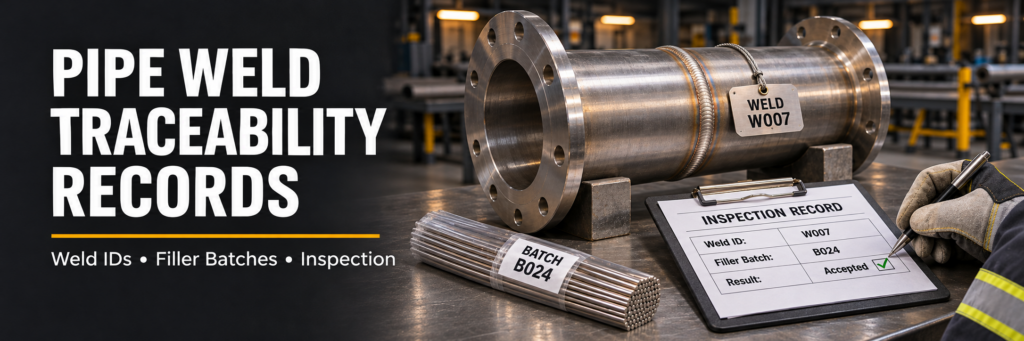
Pipe Weld Traceability Records: A Practical Guide
Pipe Weld Traceability Records connect each physical pipe joint to the materials, people, procedures, and inspections involved in its construction. When those connections are clear, a fabrication team can locate an affected weld, verify its history, and demonstrate its acceptance status. When they are missing, even a folder full of certificates may fail to answer a basic question: which records belong to this joint?
Effective traceability starts before fabrication. It requires consistent weld identification, controlled filler metal batch information, and inspection records that remain linked through repairs and final handover.
Why Traceability Records Matter
A traceability system should answer five practical questions:
- Where is the weld?
- Which materials and filler metal batches were used?
- Who performed the welding?
- Which procedure governed the work?
- What inspections established the final disposition?
These answers support quality investigations, targeted corrective action, and document review. For example, if a filler metal batch becomes subject to investigation, the team should be able to identify the welds associated with that batch without searching every production report manually.
Traceability does not prove weld quality by itself. It provides the evidence trail needed to assess how a weld was produced and accepted.
Define the required level of detail from the applicable fabrication requirements, contract, and inspection plan. Not every project requires the same records or retention period.
Establishing Traceability Records Before Fabrication
Agree on record ownership and identification rules before issuing the first spool.
Assign responsibility for creating weld numbers, recording consumable usage, entering inspection results, and approving completed documentation. Without clear ownership, different teams may create conflicting versions of the same information.
Prepare a master weld register and a controlled weld map. Confirm that both use the same identifiers and drawing revisions.
Also define how the system will handle field welds, additional joints, repairs, and replaced pipe sections. These situations should follow established rules rather than improvised numbering.
Weld Identification in Traceability Records
Assign each joint a unique identifier within the defined project scope. A practical format might combine a line number, spool number, and sequential weld number.
For example, L120-S03-W007 could identify weld 007 on spool 03 of line 120. The format itself matters less than consistent application and prevention of duplicates.
Display the identifier on the weld map and associate it with the physical joint using an approved marking method. Consider whether cutting, cleaning, coating, or installation could remove or conceal the identification.
Avoid marking methods that could damage the material or violate project requirements.
Keep the weld identity stable throughout its lifecycle. If a joint is removed and replaced, retain its original history and create a clearly linked replacement record according to the project convention.
Minimum Fields for Pipe Weld Traceability Records
Use structured fields so records can be searched and checked consistently.
| Record field | Information to capture |
|---|---|
| Weld identification | Unique weld number and physical location |
| Drawing reference | Drawing number, revision, and weld map reference |
| Joint details | Weld type, pipe size, and wall thickness |
| Parent materials | Material grades and required heat or piece identifiers |
| Welding procedure | Applicable procedure number and revision |
| Personnel | Welder or operator identifiers, linked to qualification records |
| Production details | Welding date and relevant process or pass information |
| Filler metal | Classification, diameter, batch identifier, and certificate reference |
| Inspection | Report references, examination scope, results, and disposition |
| Repairs | Repair event, associated records, and reinspection status |
Where multiple welders, processes, or filler batches are involved, provide enough detail to distinguish their contributions.
Filler Metal Batches in Pipe Weld Traceability Records
A filler metal classification describes the consumable type. It does not identify the particular production batch used on a weld.
At receipt, verify the package identification against the supporting documentation. Preserve the original batch designation and connect any internal inventory code to it.
Control identification throughout storage and issue:
- Keep different batches distinguishable.
- Transfer identification when consumables enter smaller containers.
- Record the batch issued for the relevant welding activity.
- Maintain required storage, conditioning, and exposure records.
- Follow a defined process for returned or unidentified consumables.
An issue record shows what was supplied, but it may not establish what was actually deposited. Close that gap by recording usage at the weld or work-package level required by the project.
If the batch changes during welding, record the additional batch and its applicable scope. For example, root and fill passes may use different consumables. A single batch field should not conceal that distinction.
Inspection Evidence in Pipe Weld Traceability Records
Inspection reports must identify the welds examined and the extent of examination. A report number without a reliable weld reference leaves the evidence disconnected from the joint.
Depending on the specified inspection method, capture relevant information such as:
- Examination date and procedure reference.
- Inspector or examiner identification.
- Weld number and examination coverage.
- Applicable acceptance criteria.
- Findings, results, and disposition.
- Supporting images or data references where required.
Keep inspection stages separate. Fit-up acceptance, visual examination, nondestructive testing, and final release represent different decisions.
Avoid marking a weld simply as “complete” when required examinations remain outstanding. Clear statuses help prevent premature release.
Where sampling applies, distinguish welds directly examined from those accepted under the specified sampling provisions.
Managing Repairs in Pipe Weld Traceability Records
A repair adds to the weld history; it should not erase the original result.
Link each repair event to the original weld identifier. Record the defect location, repair scope, applicable repair procedure, welder, filler batch, and required reinspection.
Use a defined convention to distinguish successive repair events. The system should show which inspection result relates to the original weld and which relates to the repaired condition.
Do not replace a failed report with a passing report and discard the earlier evidence. Retaining both establishes how the final disposition was reached.
If the entire joint is cut out, document that action and link the replacement joint to the removed weld.
Auditing Pipe Weld Traceability Records Before Handover
Audit the connections between records, not merely the presence of documents.
Select a physical weld and trace it through the weld map, register, material information, consumable records, and inspection reports. Then reverse the exercise: select a filler batch and identify the welds associated with it.
Check for duplicate identifiers, missing batch references, outdated drawing revisions, unresolved repairs, and inconsistent acceptance statuses.
A controlled spreadsheet may suit a small project, while larger operations may need a database. Either approach requires access control, backups, and a visible history of corrections. Digital entry alone does not ensure accuracy.
Before handover, reconcile the register with the as-built configuration and confirm that outstanding requirements have been resolved.
Reliable Pipe Weld Traceability Records create a continuous, verifiable history from joint preparation to final acceptance. Unique weld identifiers, preserved batch information, and linked inspection evidence make that history useful when a specific joint needs to be reviewed, investigated, or released.