

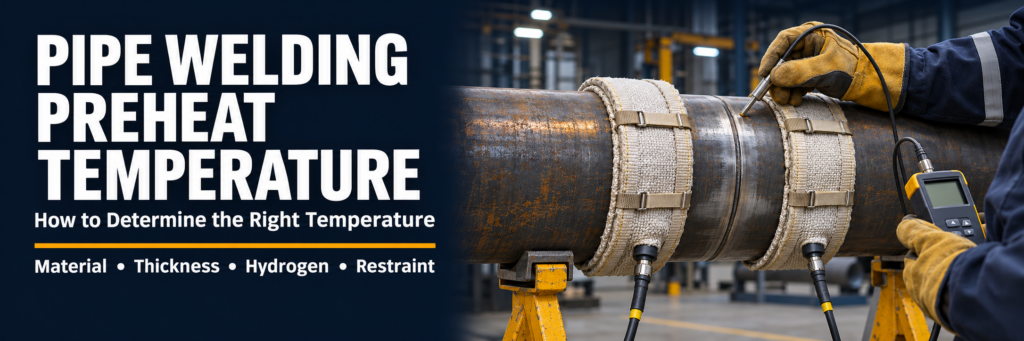
Pipe Welding Preheat Temperature: How to Determine It
Pipe Welding Preheat Temperature depends on the material, joint geometry, welding process, and applicable fabrication requirements. Choosing a temperature from wall thickness alone can overlook important cracking risks. The practical starting point is the approved welding procedure specification, supported by material records and the requirements governing the work.
This guide focuses primarily on carbon and low-alloy steel pipe. Stainless steels, aluminum alloys, and other materials require different assessments; the same preheating rules should not be applied across all pipe materials.
Start With the Required Pipe Welding Preheat Temperature
Before calculating anything, check whether an approved welding procedure specification, or WPS, already covers the joint.
Confirm that its material range, thickness limits, welding process, consumables, and other applicable variables match the proposed work. Read the specified minimum preheat alongside the interpass temperature limits and any heating or interruption instructions.
If the procedure does not cover the joint, refer the issue to the responsible welding engineer. A generic temperature chart cannot extend a procedure’s qualified range.
Where project requirements and procedure instructions appear inconsistent, resolve the conflict before welding. Simply selecting the higher temperature may violate another material or process limitation.
Inputs for Determining Pipe Welding Preheat Temperature
Collect reliable information before selecting a calculation method.
| Input | What to verify |
|---|---|
| Base material | Grade, delivery condition, and actual chemical composition |
| Joint dimensions | Wall thickness, fitting thickness, and joint configuration |
| Welding process | Process used for each stage, including tacking |
| Consumables | Classification, diffusible hydrogen information, and handling requirements |
| Welding parameters | Expected heat input or arc energy, as defined by the method |
| Restraint | Fit-up forces, assembly stiffness, and freedom to contract |
| Site conditions | Initial metal temperature, wind, moisture, and heat loss |
| Service requirements | Required strength, toughness, hardness, and operating conditions |
For dissimilar joints, review both materials. A pipe-to-fitting connection may have a different thermal response from a pipe-to-pipe joint of the same nominal pipe size.
Use Carbon Equivalent to Assess Pipe Welding Preheat Temperature
Carbon equivalent helps assess the hardenability of certain steels. It combines the effects of carbon and selected alloying elements into an index.
One widely used expression is:
CEIIW = C + Mn/6 + (Cr + Mo + V)/5 + (Ni + Cu)/15
Element values are entered as weight percentages.
A higher value generally indicates greater hardenability within the formula’s applicable material range. However, carbon equivalent is not a direct temperature calculator.
Other indices, including Pcm and CET, use different expressions and belong to different assessment methods. Do not insert one index into a chart developed for another.
Use actual material certificate chemistry where available. If required composition information is missing, obtain it or follow an expressly permitted alternative assessment.
Calculation Example for Pipe Welding Preheat Temperature
Consider an illustrative steel composition:
- Carbon: 0.12%
- Manganese: 1.20%
- Chromium: 0.20%
- Molybdenum: 0.10%
- Vanadium: 0.02%
- Nickel: 0.20%
- Copper: 0.15%
The calculation is:
CEIIW = 0.12 + 1.20/6 + (0.20 + 0.10 + 0.02)/5 + (0.20 + 0.15)/15
CEIIW ≈ 0.407
This result characterizes one aspect of weldability. It does not establish a preheat of 100°C, 150°C, or any other temperature by itself.
The next step is to use an applicable assessment method with the remaining inputs, including thickness, hydrogen level, heat input, and restraint.
Select a Valid Method for Pipe Welding Preheat Temperature
Use a method recognized by the governing requirements and suitable for the steel and welding conditions.
Check its limits before using its equations or charts. These may restrict the chemistry, strength range, thickness, hydrogen category, or heat input.
Thickness definitions also matter. Some methods use combined thickness or another defined measure of heat flow. Substituting nominal pipe wall thickness without checking the method can produce an incorrect result.
For susceptible steels, preheating slows cooling and gives diffusible hydrogen more opportunity to escape. It forms part of a broader cracking-control strategy that also includes consumable handling, joint preparation, and welding technique.
Heat input must be considered carefully. Increasing it may reduce cooling rate, but excessive heat can compromise other properties. Changes must remain within the approved procedure.
Likewise, low-hydrogen consumables do not automatically eliminate preheating. Their benefit depends on proper storage, conditioning where required, and protection from contamination.
Record the assessment inputs, method, limitations, and approval. The selected temperature should become a controlled production requirement rather than an undocumented workshop decision.
Measure Pipe Welding Preheat Temperature Correctly
Heating the joint is only useful when the required temperature is achieved at the specified measurement locations.
Use suitable temperature-indicating materials, contact instruments, or thermocouples according to the procedure. Measurement distance, timing, and surface location should follow the applicable instructions.
For pipe joints, check the required locations around the circumference. A reading beside a heater does not establish that the opposite side is warm enough.
Important controls include:
- Heating the specified band on both sides of the joint.
- Allowing temperature to equalize as required.
- Checking thick fittings and other areas with greater heat loss.
- Measuring immediately before the relevant welding operation.
- Keeping instruments within their required verification or calibration status.
Infrared instruments require particular care. Surface finish, emissivity, viewing geometry, and environmental conditions can affect readings.
Do not judge temperature from flame appearance, heating time, or whether the surface feels warm. These observations do not demonstrate compliance.
Maintain Preheat Temperature Between Passes
Minimum preheat, interpass temperature, postheating, and postweld heat treatment describe different controls.
Minimum preheat establishes the required starting condition. Interpass requirements control temperature before subsequent passes and may include both minimum and maximum limits.
Postheating may be specified to support hydrogen removal. Postweld heat treatment serves different metallurgical purposes and requires its own controlled procedure. One operation should not be assumed to replace another.
During production:
- Apply preheating to tack welds when required.
- Verify the starting temperature before welding.
- Monitor interpass temperature at the specified stages.
- Follow the approved instructions during interruptions.
- Recheck temperature before restarting.
- Record required readings against the weld identifier.
If the joint falls below the permitted minimum, follow the procedure for reheating and restart. If the maximum interpass temperature is exceeded, follow the specified cooling and disposition instructions.
Avoid Common Preheat Temperature Errors
Several shortcuts can undermine an otherwise sound welding plan:
- Using diameter as the main selection rule. Diameter alone does not establish chemistry, hardenability, or joint heat flow.
- Copying a temperature from a similar job. Differences in material, thickness, consumables, or restraint may change the requirement.
- Treating moisture removal as sufficient preheating. A dry surface may still be below the specified minimum.
- Assuming more heat is always safer. Excessive temperatures can exceed procedure limits or affect material properties.
- Checking only one convenient point. Uneven heating can leave critical areas below the requirement.
- Ignoring consumable condition. Preheat cannot replace proper hydrogen control.
- Omitting records. An undocumented temperature is difficult to verify during quality review.
Reliable Pipe Welding Preheat Temperature selection combines a valid WPS, accurate material information, an applicable engineering assessment, and verified measurements. The objective is a controlled thermal condition that supports sound welding while preserving the properties required from the finished joint.