

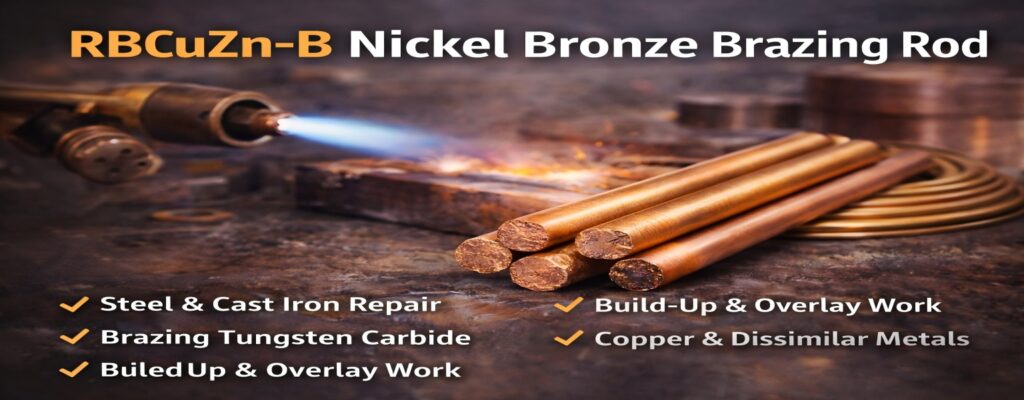
RBCuZn-B Nickel Bronze Brazing Rod | AWS A5.8 Filler Metal
RBCuZn-B nickel bronze brazing rod sits in a useful middle ground between general-purpose bronze filler metals and more specialized brazing alloys. In real workshop practice, it is chosen when the joint needs more than simple fill, but does not necessarily call for a high-silver alloy. Public technical references describe RBCuZn-B as an AWS A5.8 copper-zinc brazing filler metal in the nickel bronze family, and note that compared with RBCuZn-A-type alloys, it includes iron and manganese to increase deposit hardness and strength while retaining the “low-fuming” character associated with this group.
What makes that important is not only chemistry, but application behavior. A rod in this class is valued because it can bridge the gap between joining and surfacing. In other words, it is not used only to make a joint; it is also selected when the deposited metal needs to offer better wear resistance, better support under service load, or more confidence on difficult ferrous repairs than a softer bronze would normally provide.
Where RBCuZn-B Is Commonly Used
One of the most established use cases for nickel bronze rods in this class is braze welding steel and cast iron. That matters because these are the two materials that often create trouble in repair and maintenance work. Mild steel is forgiving, but cast iron is not. It is sensitive to cracking, heat concentration, and poor thermal control. A lower-temperature braze-welding approach with a nickel bronze rod can reduce the thermal shock associated with fusion welding and make repair work more controllable. Harris describes its copper-zinc-nickel braze-welding alloy in this family as developed for steel and cast iron, and other RBCuZn-B references similarly position the alloy for stronger ferrous repairs.
A second major use scenario is repair build-up and localized overlay work. This is where RBCuZn-B becomes more than just a joining alloy. Because the deposit is harder and stronger than a simpler bronze, it is often selected for filling worn edges, rebuilding small damaged sections, restoring fit on low-speed wear surfaces, or putting a protective bronze layer onto a ferrous part before final machining. References for nickel bronze products in this category specifically emphasize higher hardness, higher strength, and suitability for worn components and equipment surfaces subject to service wear.
A third use case is tungsten carbide-to-steel brazing where a higher joining temperature is acceptable. This is an important niche. In cutting, drilling, agricultural, and wear-tool applications, the job is often not to fuse similar metals, but to secure a hard material onto a tougher steel body. Harris notes that alloys in this copper-zinc-nickel braze-welding class can be used for brazing tungsten carbide to steel, which is one reason nickel bronze rods remain relevant in maintenance and tool rebuilding work.
Depending on the exact procedure and service requirements, nickel bronze filler metals in this family are also used on copper, copper alloys, nickel, and some dissimilar metal combinations. Gasflux describes its nickel bronze alloy as commonly used for steel, copper, copper alloys, and nickel, while related technical sheets also point to suitability for malleable cast iron and selected copper-alloy work. That does not mean RBCuZn-B is automatically the best choice for every dissimilar joint, but it does explain why engineers keep it in consideration when a tougher bronze-type filler is needed across mixed materials.
The Process Characteristics That Define RBCuZn-B
The first process characteristic that stands out is stronger deposit performance than ordinary bronze-type brazing rods. Public RBCuZn-B references specifically link the additions of iron and manganese to increased hardness and strength in the deposited metal. In practical terms, that means the alloy is better suited to joints or overlays that will see mechanical loading, edge wear, or repeated service rather than purely decorative or low-duty joining.
The second characteristic is improved flow behavior for a high-temperature bronze alloy. Gasflux notes that nickel bronze alloys of this type are formulated with nickel to improve flow characteristics. Good flow matters because many brazing problems are not caused by filler chemistry alone, but by poor wetting and uneven distribution at the joint line. A rod that wets more predictably gives the operator better control when working on ferrous materials, especially in hand torch operations.
The third characteristic is the low-fuming nature commonly associated with this classification. In bronze brazing, zinc vaporization is always an operating concern. RBCuZn-B is commonly described as a low-fuming rod, which is a practical benefit because it supports steadier brazing conditions and cleaner operator control compared with older high-fume bronze approaches. That does not eliminate the need for ventilation, but it is still a meaningful process advantage.
Another useful characteristic is that this alloy is often workable in both joining and surfacing modes. Some filler metals are great at capillary joints but less attractive for build-up. Others are good for surfacing but not ideal for controlled joining. RBCuZn-B is often chosen precisely because it can serve both functions, especially in repair environments where the technician may need to fill, reinforce, and rebuild in the same operation. That versatility is one of the reasons nickel bronze rods continue to hold a place in fabrication and maintenance shops.
What Is Special About RBCuZn-B?
The special value of RBCuZn-B is not that it is the strongest alloy in the brazing world, but that it combines several useful traits at once. It offers more strength and hardness than simpler naval bronze-type rods, keeps good flow for hand-applied brazing work, and remains suitable for difficult ferrous repairs where full fusion welding may be too aggressive or too risky. That combination is what gives the alloy its identity.
Another special point is its repair logic. In repair welding, the best filler metal is not always the one with the highest published property. It is often the one that produces an acceptable result with lower crack risk, lower distortion, and better control over the heat-affected area. That is where a nickel bronze braze-welding rod becomes especially valuable. On cast iron, for example, the operator is often trying to avoid a harsh thermal cycle. On worn steel parts, the aim may be to restore shape and serviceability without unnecessarily melting the whole edge. RBCuZn-B fits that practical logic well.
It is also special because it can function as a problem-solving alloy rather than only a production alloy. Production lines tend to optimize around repeatability. Repair shops deal with unknowns: contamination, uneven section thickness, mixed base metals, previous repairs, and incomplete service history. A rod that flows well, gives a stronger bronze deposit, and can be used for both joining and build-up has real value in those less predictable conditions. This is one reason nickel bronze remains relevant across maintenance, rebuild, and hard-surface support work.
What Should Be Noted During Welding or Brazing?
The first point is joint and surface preparation. No bronze brazing rod performs well on oil, scale, oxide, paint, or embedded contamination. This becomes even more important on cast iron and worn steel parts because surface dirt is often driven deeper into the substrate during service. If the base metal is not cleaned properly, wetting suffers, porosity increases, and the deposit may sit on the surface instead of bonding correctly. Joint quality in brazing depends heavily on penetration, void control, and the condition of the fit-up.
The second point is choosing the right heating approach. Public RBCuZn-B guidance recommends a neutral or slightly oxidizing flame, not an excessively reducing or overly harsh flame. That matters because this alloy depends on controlled surface condition and steady filler flow. Too much direct, aggressive heat can drive zinc loss, disturb wetting, and make the deposit less consistent. The goal is not to melt the rod in open flame and drop metal onto a cold part. The goal is to heat the base metal correctly so the filler flows because the joint is ready to receive it.
The third point is using a suitable flux. References for RBCuZn-B and nickel bronze alloys call for boric-acid/boric-type fluxes or other appropriate high-temperature bronze brazing fluxes, and Gasflux lists fluxes specifically intended for nickel bronze and low-fuming bronze applications on steel, copper, brass, bronze, and malleable iron. In practice, that means operators should match the flux to the alloy and the base metal rather than treating flux as an afterthought. With a bare rod, the wrong flux choice can turn a good alloy into a poor process.
Another critical point is temperature discipline. Nickel bronze rods are forgiving compared with some specialty fillers, but that does not mean overheating is harmless. Even a low-fuming alloy can lose its process advantage if the operator dwells too long, overheats thin sections, or keeps the rod under excessive flame. Overheating can hurt flow, worsen oxidation, and make a repair look sound while hiding a weak metallurgical bond underneath. For steel and cast iron in particular, the operator should heat deliberately, maintain control, and avoid turning a brazing job into an accidental fusion-welding job.
On cast iron, extra caution is needed with thermal shock and restraint. Although a braze-welding method can be gentler than fusion repair, cast iron still responds badly to careless heating and cooling. Preheat practice, bead placement, and cooling rate should be chosen according to section thickness and crack sensitivity. On carbide-to-steel work, caution shifts toward avoiding excessive heat that could damage the carbide or weaken retention by altering the interface condition. The same rod may be used in both jobs, but the heat strategy should not be the same.
Finally, operators should keep in mind that alloy selection still depends on the application. Harris notes that brazing filler selection depends on the base metals, joint clearance, service conditions, brazing temperature, and cost. So even though RBCuZn-B is a strong all-around nickel bronze rod, it should not be treated as the answer to every brazing problem. It performs best when its strengths match the job: stronger bronze deposit, better wear support, practical braze welding on ferrous substrates, and useful performance in repair and overlay work.
Conclusion
RBCuZn-B nickel bronze brazing rod is best understood as a high-utility repair and braze-welding alloy. Its real value lies in where it performs: steel and cast iron repair, localized build-up and overlay, carbide-to-steel attachment, and selected dissimilar or copper-alloy work where a stronger bronze deposit is useful. What separates it from simpler bronze rods is the combination of higher hardness and strength, good flow, and low-fuming process behavior. What determines success in use is not only the rod itself, but clean surfaces, correct flux, controlled flame chemistry, and disciplined heat input.