

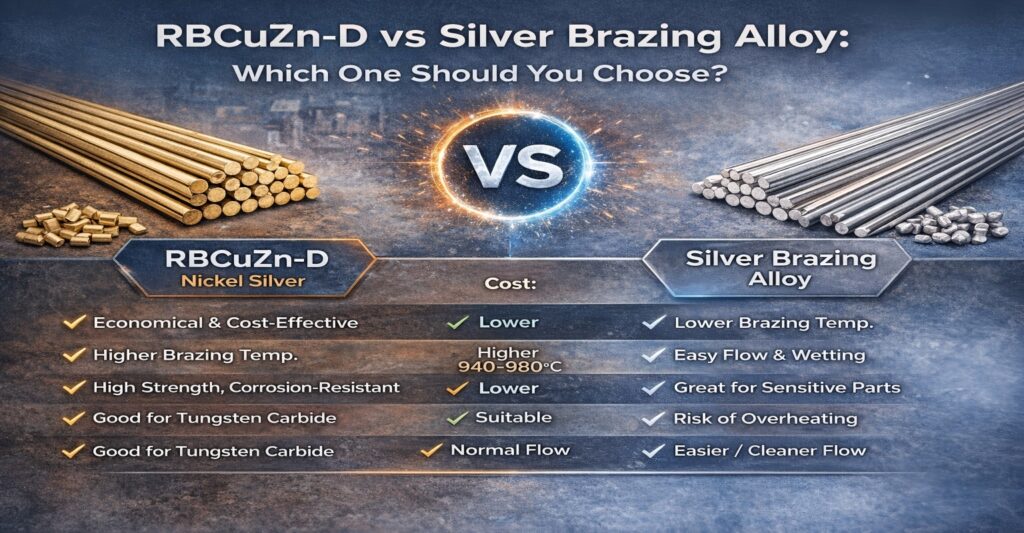
RBCuZn-D vs Silver Brazing Alloy: Which One Should You Choose?
If you are comparing RBCuZn-D vs silver brazing alloy, you are probably trying to answer a practical question, not a theoretical one: which filler metal gives the best balance of cost, brazing temperature, strength, and application fit? That is exactly where this comparison matters.
RBCuZn-D is commonly described in public product literature as a nickel silver brazing filler metal under AWS A5.8, often used as a replacement for higher-cost silver brazing alloys when a higher brazing temperature is acceptable. Public datasheets also describe it as a high-strength, nickel-bearing copper-zinc filler metal with good ductility and corrosion resistance.
By contrast, silver brazing alloy is not one single product. It is a broad family of brazing alloys, often available in cadmium-free grades, used across steel, stainless steel, copper, brass, nickel alloys, and tungsten carbide. Many silver alloys are valued because they braze at lower temperatures, flow easily, and work well for neat, precise joints.
That means the real decision is not “which alloy is better in general,” but which alloy is better for your application.
What Is RBCuZn-D?
RBCuZn-D is a copper-zinc-nickel brazing alloy, often called nickel silver. One technical sheet lists its composition at roughly 46–50% copper, 9–11% nickel, a small silicon addition, and balance zinc, with a melting range of 921–935°C and a working temperature of 940–980°C. The same sheet describes it as suitable for brazing steel, cast iron, malleable cast iron, nickel, and nickel alloys.
Public industry references also describe RBCuZn-D as being used widely as a replacement for high-cost silver brazing alloys when higher heat is acceptable, and as a filler metal frequently used for tungsten carbide, steel, and nickel-based applications.
So, if you want the short definition: RBCuZn-D is a higher-temperature, nickel-bearing brazing alloy designed for strong, durable joints and cost-sensitive applications where silver is not essential.
What Is a Silver Brazing Alloy?
Silver brazing alloys are a large family of filler metals that use silver as a major alloying element. Different grades have different melting ranges and properties, but public manufacturer data consistently shows the same overall pattern: many cadmium-free silver brazing alloys offer lower brazing temperatures, good wetting, short melting ranges, and smooth capillary flow.
For example, Johnson Matthey lists SILVER-FLO 55 at 630–660°C and SILVER-FLO 56 at 618–652°C, both as general-purpose cadmium-free silver brazing filler metals with low brazing temperatures and free-flowing behavior. Gasflux lists a 56% silver alloy at 618–652°C solidus/liquidus and a broader brazing range of 652–760°C, while its 50% silver alloy is listed at 660–707°C solidus/liquidus with a brazing range of 707–843°C.
In other words, compared with RBCuZn-D, silver brazing alloys generally let you braze at significantly lower temperatures.
The Biggest Difference: Brazing Temperature
The most important difference between RBCuZn-D vs silver brazing alloy is temperature.
RBCuZn-D melts at around 921–935°C and is typically worked at 940–980°C. Many commonly used cadmium-free silver brazing alloys, by comparison, melt and flow in roughly the 618–707°C region, depending on grade.
That difference matters because lower brazing temperature usually means:
less heat input into the assembly,
lower risk of distortion on sensitive parts,
easier brazing on thin or precision components,
and better suitability where base metal overheating must be minimized.
On the other hand, if your process and base materials can tolerate higher heat, RBCuZn-D may become attractive because it can reduce filler metal cost while still providing strong, corrosion-resistant deposits.
Cost: Why Buyers Compare RBCuZn-D to Silver Brazing Alloy
The second major difference is cost structure.
Public RBCuZn-D product literature repeatedly positions it as a replacement for high-cost silver brazing alloys when the application can accept a higher brazing temperature. That positioning alone tells you why this comparison is so common in Google searches: buyers are often evaluating whether they can maintain acceptable performance while reducing filler metal cost.
Silver brazing alloys contain significant silver content, and public product charts show grades with 25%, 40%, 45%, 50%, 55%, and 56% silver, among others. More silver usually means higher raw material cost.
That does not mean RBCuZn-D is automatically the better buying decision. It means RBCuZn-D is often the better value choice when lower-temperature silver flow characteristics are not essential.
Joint Performance and Flow Behavior
Silver brazing alloys are widely chosen for their free-flowing characteristics, easy wetting, and neat joint appearance. Public manufacturer data specifically describes many silver grades as free flowing, easy to use, and well suited to precise joints and dissimilar metals.
RBCuZn-D, by contrast, is presented more as a high-strength, durable, higher-temperature alloy. Public datasheets describe it as having very high tensile strength, good ductility, excellent corrosion resistance, and machinable deposits that work-harden in service.
This creates a practical rule of thumb:
Choose silver brazing alloy when you want lower temperature, easier flow, and cleaner capillary brazing performance.
Choose RBCuZn-D when you want higher-temperature service capability, strong durable deposits, and a lower-cost alternative to silver in suitable applications.
Material Compatibility
RBCuZn-D is commonly listed for steel, cast iron, malleable cast iron, nickel, nickel alloys, and hard alloys / tungsten carbide. Multiple public references highlight tungsten carbide as a particularly important use case.
Silver brazing alloys have a broader general-purpose reputation in public literature. Suppliers describe them as suitable for steel, stainless steel, copper, brass, nickel alloys, and tungsten carbide, and in many cases suitable for joining dissimilar metals as well.
So if your shop handles a wide range of precision joining jobs across many base metals, silver brazing alloy often gives more flexibility. If your work is concentrated in carbide, steel, cast iron, or nickel alloy applications and you can tolerate higher heat, RBCuZn-D may be the more economical fit.
RBCuZn-D vs Silver Brazing Alloy for Tungsten Carbide
This is one of the most searched comparison angles, and for good reason.
Public sources describe RBCuZn-D as being used primarily or most often for brazing tungsten carbide, or as a binder matrix in tungsten carbide composite rods.
At the same time, public silver brazing alloy data also shows that many silver grades are used for tungsten carbide and carbide-tipped parts, especially where improved wetting, lower heat input, and better capillary flow are beneficial.
That means:
RBCuZn-D is often a strong choice for cost-sensitive carbide brazing and wear applications.
Silver brazing alloy is often preferred for lower-temperature, precision carbide brazing, especially when protecting heat-sensitive assemblies matters.
Which One Should You Choose?
If you need a simple buying answer, use this framework:
Choose RBCuZn-D when:
you want to reduce dependence on expensive silver-bearing filler metals,
your process can tolerate higher brazing temperature,
you are brazing steel, cast iron, nickel alloys, or tungsten carbide,
and you value high-strength, durable deposits over the lowest possible brazing temperature.
Choose silver brazing alloy when:
you need lower brazing temperature,
you want better wetting and capillary flow,
you are working with precision joints, dissimilar metals, stainless steel, copper alloys, or heat-sensitive parts,
or you want a broad general-purpose alloy family with many grade options.
Final Verdict
There is no universal winner in the RBCuZn-D vs silver brazing alloy debate.
RBCuZn-D stands out when cost control, high strength, corrosion resistance, and higher-temperature brazing are acceptable priorities. Silver brazing alloys stand out when lower temperature, easy flow, and broad general-purpose compatibility are more important. Public technical data supports that distinction very clearly.
So the best choice is not the one with the better name. It is the one that matches your base metals, process temperature, joint design, and commercial target.