


shipbuilding welding consumables: Materials and Requirements
Shipbuilding is one of the most demanding industries for welding. From hull construction to offshore structures, shipbuilding welding consumables play a critical role in ensuring structural integrity, safety, and long-term durability in harsh marine environments.
1. shipbuilding welding consumables:Common Base Materials in Shipbuilding
Ship structures are exposed to saltwater, cyclic loading, and low temperatures. Typical base materials include:
Carbon and Low-Alloy Shipbuilding Steels
Grades such as AH36, DH36, EH36
Used in hulls, decks, bulkheads, and frames
Require good toughness and crack resistance
High-Strength Structural Steels
Used to reduce weight and increase payload capacity
Require controlled hydrogen levels and excellent impact toughness
Stainless Steels
Applied in tanks, piping, and corrosion-sensitive areas
Require corrosion-resistant weld metal and proper heat input control
Aluminum Alloys
Used in superstructures and high-speed vessels
Require lightweight consumables with excellent crack resistance
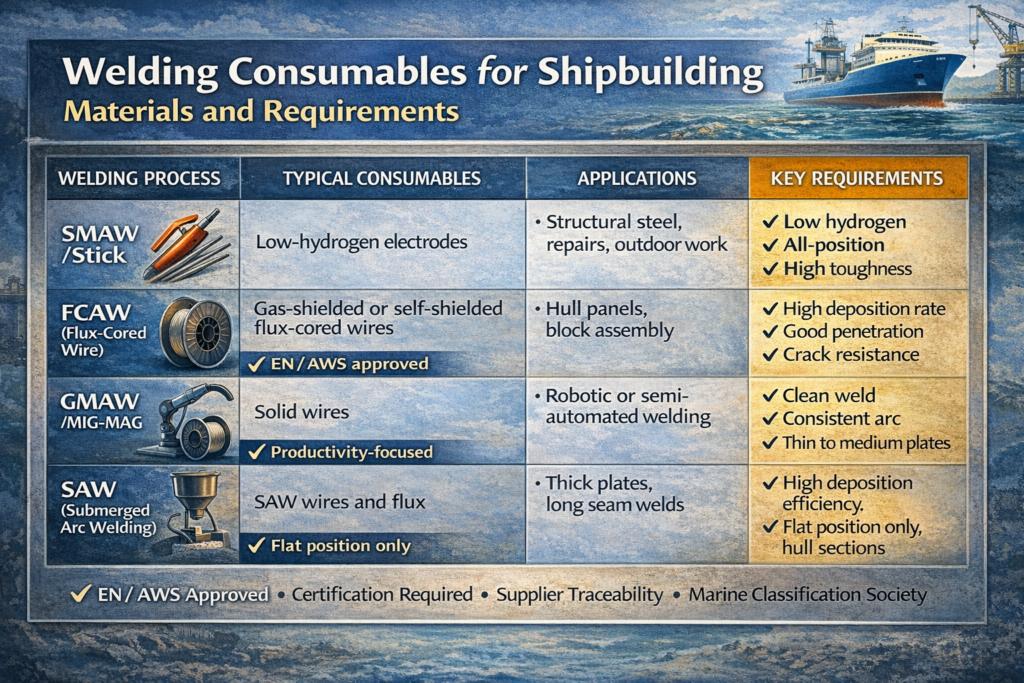
2. shipbuilding welding consumables:Key Welding Consumables Used in Shipbuilding
Shipyards use a wide range of consumables depending on joint design and productivity needs.
Shielded Metal Arc Welding (SMAW) Electrodes
Low-hydrogen electrodes for structural welding
Good arc stability and all-position capability
Commonly used for repairs and outdoor welding
Flux-Cored Wires (FCAW)
High deposition rate and good penetration
Widely used in panel lines and block assembly
Available in gas-shielded and self-shielded types
Solid Wires (GMAW / MIG-MAG)
Used in automated and robotic welding systems
Clean weld appearance and high productivity
Suitable for thin to medium plate thickness
Submerged Arc Welding (SAW) Consumables
Ideal for long, straight welds and thick plates
High deposition rate and excellent weld quality
Commonly used in flat-position welding of hull sections
3. shipbuilding welding consumables:Technical Requirements for Shipbuilding Welding Consumables
Classification Society Approval
Welding consumables must be approved by major classification societies, such as:
ABS
DNV
LR
BV
CCS
Approval ensures compliance with marine safety standards.
Mechanical Properties
Consumables must meet strict requirements for:
Tensile strength
Yield strength
Impact toughness at low temperatures
Hydrogen Control
Low diffusible hydrogen levels are essential to:
Prevent hydrogen-induced cracking
Ensure long-term weld reliability in thick plates
Weldability and Productivity
Consumables should provide:
Stable arc performance
Low spatter and easy slag removal
High deposition efficiency for shipyard productivity
4. shipbuilding welding consumables:Environmental and Service Conditions
Marine welding consumables must withstand:
Corrosion from seawater and humidity
Dynamic and fatigue loading
Temperature variations in different sea zones
Proper consumable selection contributes to extended service life and reduced maintenance costs.
5. shipbuilding welding consumables:Quality Control and Certification
Reliable suppliers provide:
Mill Test Certificates (MTC)
Batch traceability
Compliance with ISO 9001 quality systems
Consistent performance across production batches
These factors are critical for shipyards operating under strict inspection regimes.
Conclusion
Selecting the right welding consumables is essential for shipbuilding success. From material compatibility and classification approvals to productivity and hydrogen control, every detail matters.
By choosing certified, high-quality welding consumables, shipyards can ensure structural safety, operational efficiency, and long-term performance in one of the world’s most challenging environments.