

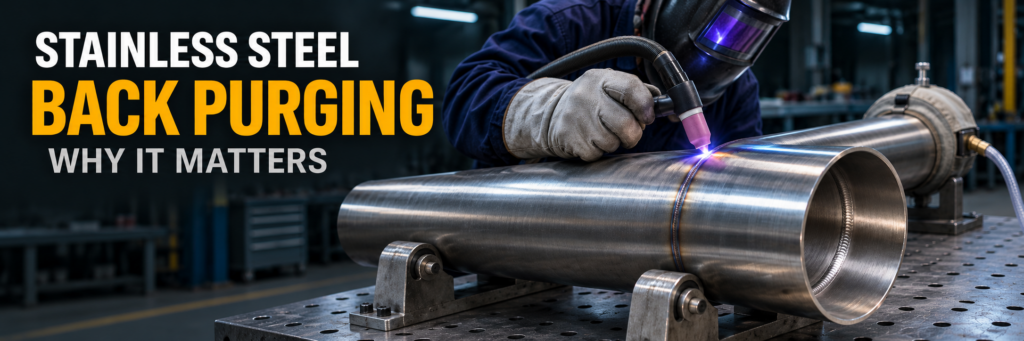
Why Stainless Steel Pipe Welding Requires Back Purging
Stainless Steel Back Purging protects the inside surface of a pipe weld from oxygen while the metal is hot. Without effective root protection, an otherwise acceptable external weld can hide heavy oxidation, a rough internal surface, and reduced corrosion resistance. For full-penetration pipe welding, controlling the atmosphere behind the weld is therefore a critical part of producing a suitable joint.
The shielding gas from a welding torch protects the face of the weld. It does not reliably protect the root inside the pipe. A separate backing atmosphere addresses this exposed area, especially during open-root gas tungsten arc welding.
How Stainless Steel Back Purging Protects the Weld Root
Back purging replaces air around the internal joint with a suitable protective gas before welding begins. That atmosphere remains in place while the root is exposed to temperatures at which significant oxidation can occur.
The objective is controlled oxygen displacement, rather than simply filling the pipe with gas. Leaking seals, trapped air, or an unsuitable flow arrangement can leave oxygen near the joint even when gas is visibly flowing at the outlet.
Effective preparation combines:
- A clean, enclosed purge volume.
- A controlled gas inlet and an unobstructed outlet.
- Suitable gas distribution around the joint.
- Oxygen measurement where required by the welding procedure.
- Continued protection through the specified welding and cooling stages.
Why Stainless Steel Back Purging Reduces Sugaring
When a hot stainless steel root contacts air, it can develop a dark, coarse oxide layer commonly called sugaring. This is more severe than a light surface tint and may leave an irregular internal profile that is difficult to clean.
Increasing torch shielding gas flow does not solve an internal protection problem. The backing atmosphere must reach the root itself.
Heavy oxidation should trigger investigation of the purge setup and assessment against the applicable acceptance criteria. Covering the affected area with additional weld metal does not automatically restore an acceptable internal surface.
Why Stainless Steel Back Purging Matters for Corrosion Resistance
Stainless steel depends on a thin, chromium-rich passive film for corrosion resistance. Welding oxidation can produce heat tint and a chromium-depleted region beneath the oxide, reducing local resistance to corrosion.
This matters particularly where the pipe carries corrosive fluids or encounters chloride-containing environments. The actual effect depends on the alloy, oxidation severity, surface condition, and service exposure.
Root protection helps limit oxidation during fabrication. It does not replace correct material selection, heat-input control, or any specified post-weld surface treatment.
For hygienic piping, internal surface condition also affects cleanability. A rough, oxidized root can retain deposits and complicate cleaning. However, a bright-looking weld alone does not establish compliance with hygienic or corrosion-performance requirements.
Stainless Steel Back Purging Versus Post-Weld Cleaning
Post-weld cleaning and purging perform different tasks. Purging limits oxidation as the joint forms; cleaning removes specified contamination or surface layers afterward.
Where heat tint removal is required, the treatment must address the oxide and the affected underlying surface appropriately. Passivation alone should not be assumed to remove heavy weld scale.
Internal access can make corrective treatment difficult, especially in small-diameter or assembled piping. Preventing excessive oxidation during welding can therefore reduce the need for challenging internal rework.
Setting Up SS Back Purging Correctly
A reliable setup starts with the welding procedure specification, or WPS. The procedure should establish the backing gas, relevant acceptance limits, and how long protection must continue.
Choose a suitable backing gas.
Argon is widely used for austenitic stainless steel pipe roots. Other gases or mixtures may be appropriate for particular alloys and qualified procedures. Duplex stainless steels require additional attention to alloy chemistry and phase balance, so gas selection should not be copied automatically from an austenitic application.
Reduce the enclosed volume.
Suitable purge dams can isolate the joint area instead of requiring the entire pipe length to be purged. Position them to tolerate the expected heat and avoid contaminating the connection.
Provide a controlled outlet.
Displaced air needs an escape path. Excessive internal pressure can disturb the molten root and affect its profile. Do not seal a flowing purge system without appropriate venting.
Verify the atmosphere.
Elapsed time alone cannot confirm that oxygen is sufficiently low. Pipe volume, leaks, flow distribution, and mixing all affect displacement. Where oxygen monitoring is specified, use a suitable instrument and a representative sampling location.
Stainless Steel Back Purging should use the oxygen limit established for the particular material and application. A single oxygen concentration is not a universal acceptance value for every stainless steel piping system.
Common SS Back Purging Mistakes
Several routine setup errors can undermine root protection:
| Mistake | Potential consequence | Practical correction |
|---|---|---|
| Starting before adequate displacement | Early root oxidation | Verify the atmosphere before striking the arc |
| Leaking dams or joint seals | Continuous air ingress | Check containment and repair leaks |
| Excessive gas flow | Turbulence and pressure buildup | Use controlled flow with adequate venting |
| Poor sampling location | Misleading oxygen readings | Sample a representative area near the joint |
| Stopping protection too early | Oxidation during reheating or cooling | Follow the specified protection duration |
| Dirty pipe interiors | Contamination despite low oxygen | Clean and dry the joint area before assembly |
Changing several settings at once makes diagnosis harder. Check containment, gas delivery, measurement, and welding technique systematically.
When SS Back Purging Can Stop
Protection should not automatically end when the root pass is complete. Subsequent passes can reheat the internal surface enough to cause additional oxidation.
The required duration depends on wall thickness, welding sequence, material, and procedure requirements. Maintain the backing atmosphere through the specified passes and cooling conditions, while avoiding excessive internal pressure.
Some qualified welding methods use alternative root-protection arrangements or consumables. Any decision to omit conventional purging must be supported by the applicable procedure and service requirements.
A successful pipe joint needs both sound weld geometry and a suitable internal surface. Stainless Steel Back Purging helps achieve that result by controlling oxygen where torch shielding cannot reliably reach. Consistent preparation, verified protection, and appropriate inspection make the process repeatable.