

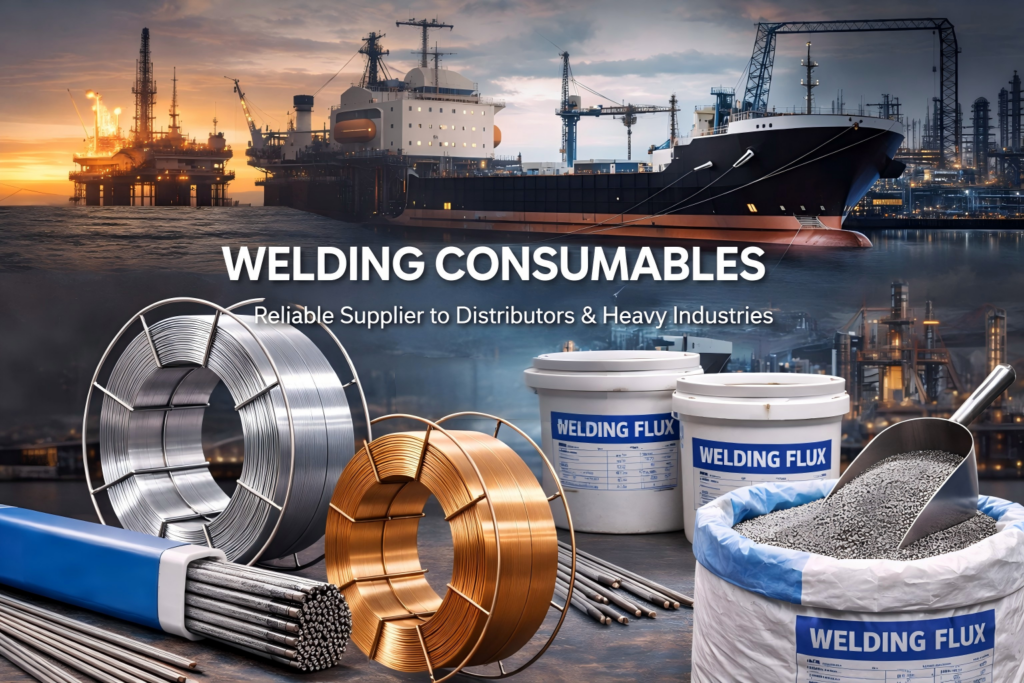
Welding Materials: Types, Applications, and How to Choose the Right Welding Consumables
In modern manufacturing and heavy industry, welding materials play a critical role in ensuring structural integrity, safety, and long-term performance. Choosing the right welding consumables directly affects weld quality, mechanical properties, and production efficiency across industries such as oil & gas, power generation, shipbuilding, pressure vessels, and infrastructure.
This article provides a professional overview of welding materials, their main types, applications, and key selection factors.
What Are Welding Materials?
Welding materials, also known as welding consumables, include electrodes, wires, fluxes, and rods used to form a weld joint during welding processes such as MIG, TIG, FCAW, SAW, and SMAW.
Main Types of Welding Materials
1. Welding Electrodes (Stick Electrodes)
Welding electrodes are widely used in manual welding (SMAW). They are suitable for outdoor work, pipeline welding, and repair applications.
Typical applications:
Structural steel
Pipelines
Construction and maintenance
2. Solid Welding Wire
Solid welding wire is commonly used in MIG and TIG welding, offering stable arc performance and clean weld appearance.
Typical materials:
Carbon steel (ER70S-6)
Stainless steel (ER308L, ER316L)
Low alloy steel
3. Flux Cored Welding Wire (FCAW)
Flux cored wire provides higher deposition rates and better penetration, making it ideal for heavy fabrication and outdoor welding.
Applications:
Shipbuilding
Steel structures
Offshore and petrochemical projects
4. Submerged Arc Welding Materials (SAW)
SAW welding materials include welding wire and flux used together to achieve deep penetration and high productivity.
Applications:
Pressure vessels
Wind towers
Heavy steel fabrication
Welding Materials by Base Metal
Stainless Steel Welding Materials
Used for corrosion-resistant applications.
Low Alloy & High Strength Steel Welding Materials
Designed for high strength and low-temperature performance.
How to Choose the Right Welding Materials
When selecting welding materials, consider the following factors:
Base Metal Composition
Match the welding consumable to the parent material to ensure metallurgical compatibility.Mechanical Properties
Tensile strength, impact toughness, and hardness requirements.Welding Process
MIG, TIG, FCAW, SAW, or SMAW.Application Environment
Low temperature
Corrosive environment
High pressure or load-bearing structures
Standards and Certifications
AWS, ISO, EN, or project-specific requirements.
Why Welding Material Quality Matters
High-quality welding materials help to:
Reduce weld defects
Improve productivity
Lower rework and repair costs
Ensure long-term service reliability
For critical industries such as oil & gas, petrochemical, nuclear power, and mining, selecting certified and tested welding consumables is essential.
Conclusion
As global industries demand higher welding quality and performance, welding materials must meet increasingly strict technical and regulatory standards. Understanding different types of welding consumables and selecting the right product for each application ensures reliable welding performance and long-term value.
Whether you are looking for welding electrodes, solid welding wire, flux cored wire, or submerged arc welding materials, partnering with a professional welding materials supplier is key to project success.