

What Does the “H” Mean in ER308H? A Technical Guide to High-Carbon Stainless Filler Metal
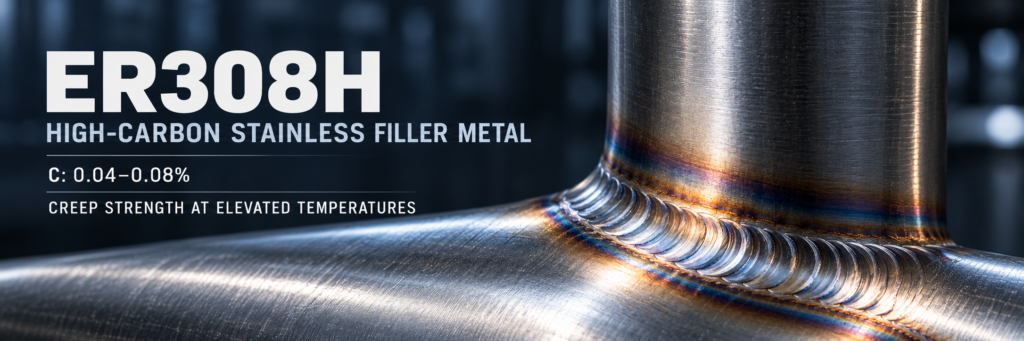
ER308H is an austenitic stainless steel filler metal used where welds must retain strength at elevated temperatures. The letter “H” identifies a controlled high-carbon version of the 308 filler metal family. Its carbon range is typically specified as 0.04–0.08% by weight.
That carbon range is the key difference behind the “H” designation. It can support higher tensile and creep strength in high-temperature service, but it also affects how the weld responds to prolonged heat exposure and corrosion conditions. Understanding this trade-off helps engineers and welding professionals determine when ER308H is appropriate.
What Does the “H” Stand for in ER308H?
In ER308H, “ER” identifies a bare electrode or rod classification under AWS A5.9. “308” identifies the stainless steel filler metal family, while “H” indicates a higher, controlled carbon range.
The “H” does not mean hydrogen. It refers to the carbon content intended for applications where elevated-temperature strength is important. ER308H typically contains 0.04–0.08% carbon, along with chromium and nickel levels characteristic of 308-type austenitic stainless steel filler metals.
The lower limit on carbon matters. Standard ER308 may have a similar maximum carbon limit, but ER308H controls carbon within a range suited to high-temperature applications. A specific wire or rod certificate should always be checked for its actual chemistry.
How Does Carbon Affect It Weld Metal?
Carbon contributes to strength in austenitic stainless steel weld metal. At elevated temperatures, it can promote carbide formation and help the weld resist deformation under sustained loading, a behavior known as creep.
Creep strength matters when a component remains under stress for long periods at high temperature. In suitable applications, ER308H can help produce weld metal with the high-temperature mechanical properties required by the design.
However, higher carbon is not automatically better. Carbon can also increase susceptibility to sensitization under certain thermal exposure conditions. Sensitization occurs when chromium-rich carbides form at grain boundaries, potentially reducing corrosion resistance in adjacent regions. The degree of risk depends on the weld chemistry, temperature, exposure time, service environment, and fabrication procedure.
This is why ER308H should be selected for its intended service conditions rather than treated as a universal upgrade to ER308 or ER308L.
ER308H vs. ER308 and ER308L
The three filler metals share a related stainless steel alloy family, but their carbon limits support different priorities.
| Filler metal | Carbon approach | Typical selection priority |
|---|---|---|
| ER308 | Standard carbon limit | General-purpose 308-type stainless welding |
| ER308H | Controlled higher carbon range, typically 0.04–0.08% | Elevated-temperature strength and creep resistance |
| ER308L | Low-carbon limit, typically no more than 0.03% | Reduced risk of sensitization in many corrosion-sensitive applications |
The choice depends on the base metal, operating temperature, applied stress, corrosion environment, applicable construction code, and qualified welding procedure. ER308H may be appropriate for high-carbon or high-temperature service, while ER308L is often considered when low carbon is a priority. Neither designation alone determines the suitability of a weld for a specific service.
Where Is It Used?
ER308H is used to weld compatible austenitic stainless steels when the application requires a filler metal with controlled carbon for elevated-temperature service. Common industrial contexts include high-temperature piping, tubes, boilers, and process equipment.
Its use may be considered for matching or compatible grades such as 304H, subject to the governing code and engineering requirements. In some applications, it may also be specified for welding other austenitic stainless steel grades. Compatibility should not be assumed from the “308” designation alone: base-metal chemistry, dilution, service conditions, and procedure qualification all matter.
It is not selected simply because a component will become warm. The design temperature, stress level, expected service life, oxidation conditions, corrosion exposure, and post-weld heat treatment requirements should be reviewed together.
Welding and Quality-Control Considerations
It is available in forms used for processes such as gas tungsten arc welding, gas metal arc welding, and submerged arc welding, depending on the product classification and procedure. The correct process and consumable form should be confirmed against the applicable welding procedure specification.
For consistent results:
Verify that the filler metal classification matches the approved procedure.
Review the material test certificate and confirm the actual carbon and alloy content.
Control heat input, interpass temperature, and joint preparation according to the qualified procedure.
Consider dilution from the base metal, especially when matching high-carbon grades.
Use the specified shielding gas, polarity, and transfer mode for the selected process.
Apply the required inspection and testing for the component’s code and service conditions.
A filler metal’s classification does not guarantee the properties of every completed joint. Welding parameters, joint design, base-metal condition, operator technique, and post-weld treatment can all affect the deposited weld metal.
How to Choose ER308H for a Project
Start with the base-metal grade and the applicable construction code. Then identify the design temperature, sustained stress, corrosion environment, and required mechanical properties. Compare those requirements with the filler metal’s classification and certified chemistry.
Where creep strength is central to the design, ER308H may be a suitable candidate. Where resistance to sensitization or corrosion is the primary concern, a lower-carbon filler metal may be more appropriate. The final choice should be supported by the welding procedure qualification and, where required, engineering review.
Frequently Asked Questions About ER308H
Is ER308H a high-carbon stainless steel filler metal?
Yes. It has a controlled carbon range, typically 0.04–0.08%, which is higher than the low-carbon ER308L classification.
Does the “H” in ER308H mean hydrogen?
No. The “H” identifies the controlled higher-carbon version of the 308 filler metal family.
Is ER308H stronger than ER308?
ER308H is designed to provide higher-temperature strength characteristics associated with its controlled carbon content. Actual weld properties depend on the deposited chemistry, welding procedure, and test conditions, so project-specific data should be reviewed.
Can ER308H be used for every 304 stainless steel weld?
No. Filler metal selection depends on the exact base-metal grade and the service requirements. ER308H should be used when its carbon range and high-temperature properties fit the design and are allowed by the applicable procedure and code.
Conclusion
The “H” in ER308H identifies a controlled high-carbon stainless filler metal intended for applications where elevated-temperature strength and creep resistance are important. Its typical 0.04–0.08% carbon range distinguishes it from low-carbon alternatives, while also making service conditions and corrosion requirements especially important to the selection process.
For reliable results, match ER308H to the base metal, confirm the certified chemistry, and follow a qualified welding procedure. The right filler metal is the one that satisfies the component’s complete design and service requirements.